• Get involved.
    We want your input!
    Apply for Membership and join the conversations about everything related to broadcasting.

    After we receive your registration, a moderator will review it. After your registration is approved, you will be permitted to post.
    If you use a disposable or false email address, your registration will be rejected.

    After your membership is approved, please take a minute to tell us a little bit about yourself.
    https://www.radiodiscussions.com/forums/introduce-yourself.1088/

    Thanks in advance and have fun!
    RadioDiscussions Administrators

Jimi Fox Launches TenQ Site

This is very impressive. A lot more than the traditional fan site (because he's more than a fan). He's covered all the bases. He's spending money for site design and hosting. It's all very thought out, and has the copyright issues covered. My only question is how he's funding it. I didn't see any advertising.
 
This is very impressive. A lot more than the traditional fan site (because he's more than a fan). He's covered all the bases. He's spending money for site design and hosting. It's all very thought out, and has the copyright issues covered. My only question is how he's funding it. I didn't see any advertising.

Maybe he just decided to drop a few grand, or maybe there's merch in the future.

It'll be interesting to see if he has audio that hasn't been in circulation among traders the last 48 years.

Jimi was only there for a year, but it was his baby.

For those who haven't seen it, R&R did a two-part piece on KTNQ in November of 1977, when it looked like it was getting somewhere. It had a bad fall book (released in December), the GM resigned and Jimi was out shortly thereafter. It starts on page 24, and continues in the November 25 issue:

 
What happened after that? Did it switched formats or just try again with new management?

A new GM, a string of new PDs, a decision to change format by the owners eight months after Jimi left, followed two weeks later (before any change) by a decision to sell.

Sale consummated July 31, 1979, with KTNQ going Spanish that day at noon.
 
Ironic that the game plan was, for a blip...going (back to) Country.
In the R&R piece linked above, GM Paul Cassidy says Country was also under consideration before they chose Top 40. Before they chose to sell, their plan was to retreat.

In hindsight, that would have been the smart move in 1976—going after KLAC instead of KHJ, KFI, KIQQ, KIIS-FM and KRTH, which at that time was only 40% Gold and was listed as a CHR in R&R.

Late 1976 was too late for a new AM Top 40 in L.A., and (Jimi, if you’re reading, I’m sorry), the whole sped-up turntable “boogie radio” thing was on its last legs everywhere.

This could have worked against KHJ in 1972. ‘76/‘77 was way too late for it.

Not saying it wasn’t fun to listen to, but the odds of success were really slim.
 
As the PD of KTNQ from 1995 until around 2000, this is a fascinating story about the Top 40 battle.

There should be more about how George Storer bought 5 kw daytimer KPOP and spent most of the 60's upgrading it and changing formats... including the flash success of Bill Ballance going into the 70's. Getting 50 kw fulltime and going Top 40 involved financing a station in New Mexico and accepting dreadful high interference from it.
 
In the R&R piece linked above, GM Paul Cassidy says Country was also under consideration before they chose Top 40. Before they chose to sell, their plan was to retreat.

In hindsight, that would have been the smart move in 1976—going after KLAC instead of KHJ, KFI, KIQQ, KIIS-FM and KRTH, which at that time was only 40% Gold and was listed as a CHR in R&R.

Late 1976 was too late for a new AM Top 40 in L.A., and (Jimi, if you’re reading, I’m sorry), the whole sped-up turntable “boogie radio” thing was on its last legs everywhere.

This could have worked against KHJ in 1972. ‘76/‘77 was way too late for it.

Not saying it wasn’t fun to listen to, but the odds of success were really slim.
And the KTNQ night signal, critical then for a Top 40 station, was very strong in the main lobe from City of Industry out to Hawai'i, but in the growing San Fernando Valley and most of the OC, it did not compete well with the other signals.

On the other hand, as a Spanish language station in 1979, it was perfect. Vastly better than KWKW and KALI, and a huge signal over the Hispanic neighborhoods. But, in the 90's, the Spanish language audience moved rapidly to FM and never came back.
 
And the KTNQ night signal, critical then for a Top 40 station, was very strong in the main lobe from City of Industry out to Hawai'i, but in the growing San Fernando Valley and most of the OC, it did not compete well with the other signals.

On the other hand, as a Spanish language station in 1979, it was perfect. Vastly better than KWKW and KALI, and a huge signal over the Hispanic neighborhoods. But, in the 90's, the Spanish language audience moved rapidly to FM and never came back.
I’m surprised by the weakness in the SFV—-it came in like a local at night as far away as Ukiah and Reno.
 
I’m surprised by the weakness in the SFV—-it came in like a local at night as far away as Ukiah and Reno.
It was OK close in, Burbank up to San Fernando and out to Van Nuys, but beyond that the signal was less than that of the FMs, although directional KHJ was also not great in the West Valley. Of course, in the 70's those areas were just starting to grow, so not as big a factor as the OC severe weakness. Beyond Anaheim and Santa Ana, not competitive.
 
Okay, so...

The "Chapters" on the page (all but one of which are "under construction") link to already posted YouTube videos...the best of various TenQ air talent:


Here's the thing, though. Jimi himself sped up the records (by about five percent) at TenQ. He called it "tempo enhancement".

Not exaggerating. Here's what it actually sounded like on-air:


Whoever dubbed and mastered the audio in the airchecks for the TenQ website (all scoped) took the speed back down to match what the records sounded like without "tempo enhancement", which means the jocks and production elements all sound slower than they actually did.

This is common among aircheck traders who aren't familiar with stations---but I'm astonished, given the level of care that appears to have been put into the site, that it got past Jimi to the point of 18 videos being produced with all the aircheck content at the wrong speed.
 
Last edited:
As the PD of KTNQ from 1995 until around 2000, this is a fascinating story about the Top 40 battle.

There should be more about how George Storer bought 5 kw daytimer KPOP and spent most of the 60's upgrading it and changing formats... including the flash success of Bill Ballance going into the 70's. Getting 50 kw fulltime and going Top 40 involved financing a station in New Mexico and accepting dreadful high interference from it.
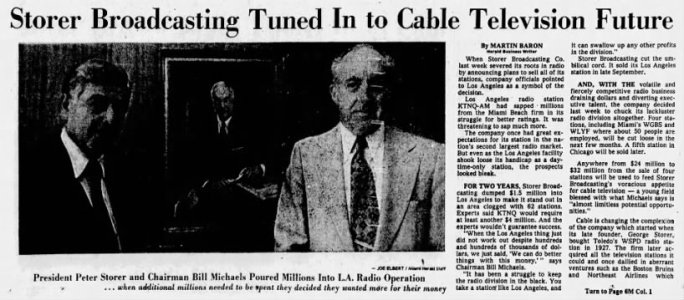
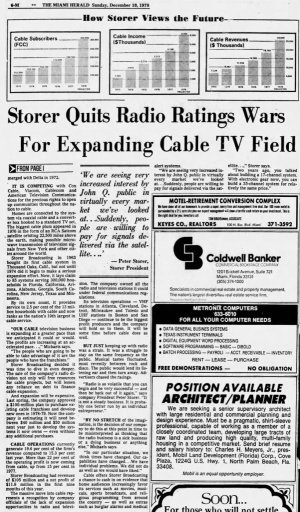
What's fascinating is that Storer ultimately sank $1.5M to relaunch 1020 as KTNQ and get the full-time authorization, but was presented with estimates of an additional $4M needed just for the station to remain viable. That's what drove Storer to dispose of all their radio stations (along with wanting to go all-in on cable television, a gamble that ultimately did the company in).

From the December 10, 1978 Miami Herald:

1737930884587.jpeg
1737931221043.jpeg
 
There should be more about how George Storer bought 5 kw daytimer KPOP and spent most of the 60's upgrading it and changing formats... including the flash success of Bill Ballance going into the 70's.

@DavidEduardo, going back through Broadcasting archives at worldradiohistory.com (I need to buy the fella who runs that thing lunch someday), it looks like the previous owner had an application for the power increase on file when Storer bought it from them in spring of 1959 for $900,000.

The first format was Beautiful Music, and they ran with that until 1964, but could never make meaningful headway against the longtime leader, KPOL.

They went Country in 1965, then *sorta* Top 40 in 1969---in that the music was arguably Top 40, looser than KHJ, but still---and the jocks were (mostly) big-name Top 40 jocks in the market from the past decade---Emperor Bob Hudson, Bill Ballance, Roger Christian.

Lightning struck in 1971---yes, Bill Ballance started the "Feminine Forum", but, because of the popularity of their standup act and record albums, KGBS moved afternoon jock Ron Landry to mornings to team with Hudson---and Hudson & Landry were a legitimate factor in morning ratings, followed then by Ballance, and (after moving Landry), Dave Hull, who until The Real Don Steele showed up, had been the number one afternoon jock in L.A.

Even after the novelty of the Ballance show wore off, the bookends of Hudson & Landry and Dave Hull was a big draw for young adults (18-34) who had aged out of KHJ, but weren't onboard with the album rock of KLOS or KMET.

It started to lose altitude in '73 and by early '74 it was over. They really needed a night signal, but as KTNQ shows, even that wasn't enough.

 
It was OK close in, Burbank up to San Fernando and out to Van Nuys, but beyond that the signal was less than that of the FMs, although directional KHJ was also not great in the West Valley. Of course, in the 70's those areas were just starting to grow, so not as big a factor as the OC severe weakness. Beyond Anaheim and Santa Ana, not competitive.

Interesting. My father rented a house in Phoenix in 1971 with the rest of the family moving there (well here) permanently in 1972. In between, we were always driving to and from Phoenix from our then Tujunga home, sometimes on Sunday nights.

Those Sunday night trips were important because (and there are airchecks to show this), KGBS was allowed to operate at full power on Sunday nights when KDKA went off the air for its early morning testing. I definitely remember picking up the 1020 signal between Indio and Blythe after it came back on the air at 9pm with a fairly good signal; the thing is, after we moved to Phoenix permanently, I rarely if ever heard KGBS' nighttime signal--that Roswell station (then KBCQ if I remember correctly) overpowered it all of the time.

And now I read from @davideduardo that after the switch to KTNQ and the 24-hour operation, the station had very little nighttime signal either going northwest or southeast, meaning that had KBCQ gone off the air, my chances of hearing KTNQ in Phoenix at night would still have been abysmal.

Oh well. I can also tell you that when we spent Christmas 1976 at my mom's folks' home in far west Tujunga, KTNQ came in well there both night and day.
 
Since I've never met or talked to Jimi, I've asked a couple of mutual friends over the last seven months to get the word to him about the aircheck speed issue---it's still there, so I finally broke down and cold e-mailed Jimi today.

We'll see.

It's a shame to put that much effort into a radio station tribute site and not have the audio accurately reflect what the station sounded like.
 
In the R&R piece linked above, GM Paul Cassidy says Country was also under consideration before they chose Top 40. Before they chose to sell, their plan was to retreat.

In hindsight, that would have been the smart move in 1976—going after KLAC instead of KHJ, KFI, KIQQ, KIIS-FM and KRTH, which at that time was only 40% Gold and was listed as a CHR in R&R.

Late 1976 was too late for a new AM Top 40 in L.A., and (Jimi, if you’re reading, I’m sorry), the whole sped-up turntable “boogie radio” thing was on its last legs everywhere.

This could have worked against KHJ in 1972. ‘76/‘77 was way too late for it.

Not saying it wasn’t fun to listen to, but the odds of success were really slim.

Two counterpoints:

1) KGBS-FM was country in 1976 and, if memory serves, remained so after KTNQ-AM debuted. I have to assume that the country format wasn't drawing in the ratings; otherwise, KTNQ-AM would most likely never have happened.

2) In Phoenix, KOOL-FM, the oldies station, sped up its records (though not as much as KTNQ) until late 1981 or early 1982. And KNIX-FM had that speeded-up thing going with its country format until at least 1985. Furthermore, when I went back to Los Angeles in 1981 to attend undergraduate college, XETRA-AM "The Mighty 690," was definitely juicing its turntable (or cart) speeds and didn't stop until the station switched to an oldies format in 1984.
 
1) KGBS-FM was country in 1976 and, if memory serves, remained so after KTNQ-AM debuted. I have to assume that the country format wasn't drawing in the ratings; otherwise, KTNQ-AM would most likely never have happened.

My guess, without digging for ratings, is that the AM's numbers with Country were dismal but that the FM was starting to make inroads against KLAC.

And they were able to automate the FM and (for a couple pf dayparts, anyway) have the AM jocks voicetrack.

One other point: Before Storer made the decision to get out of radio, they had planned to flip the AM back to Country as KXAM and move Ten-Q to the FM as KHTZ (in fact, the call letters on 97.1 were changed in September 1978 and the AM call request had been made in July then withdrawn).

 
KGBS FM had no success as a country station

F74–.4
S75–.8
F75–.7
S76–.7
Don’t have ratings for 77, but had to be below a 1, as my source R and R Ratings Reports only listed stations that year above a 1 share
S78–1.1
F78–1.3 now KHTZ but still country
S79–.9
 
Two counterpoints:

1) KGBS-FM was country in 1976 and, if memory serves, remained so after KTNQ-AM debuted. I have to assume that the country format wasn't drawing in the ratings; otherwise, KTNQ-AM would most likely never have happened.

Counter-counterpoint:

1976 was awfully early for Country on FM.

KGBS-AM was Country before the flip to KTNQ----but it was also a daytimer.

The entire point of the move to fulltime was to make 1020 viable.

In the R&R piece I posted, GM Paul Cassidy said the first year's ad budget for KTNQ was just under one million dollars.

If 1020 had put that promotion money into a Country format on the fulltime 50,000-watt 1020 signal, its odds would have been significantly better against its lone full-signal Country competitor, KLAC, than its odds were against KHJ, KFI, KIIS-FM, KIQQ, KRTH (which R&R listed as a CHR at the time) and, for a lot of the market, KEZY.


Back
Top Bottom