• Get involved.
    We want your input!
    Apply for Membership and join the conversations about everything related to broadcasting.

    After we receive your registration, a moderator will review it. After your registration is approved, you will be permitted to post.
    If you use a disposable or false email address, your registration will be rejected.

    After your membership is approved, please take a minute to tell us a little bit about yourself.
    https://www.radiodiscussions.com/forums/introduce-yourself.1088/

    Thanks in advance and have fun!
    RadioDiscussions Administrators

Just for fun: Is it possible to own your own radio station in 2023 and make a profit?

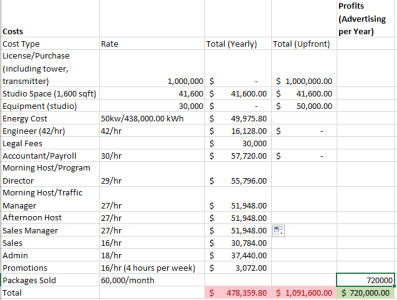
I'm back with a new attempt at designing the budget. Here, I make the assumption that it *could* be possible to bring in $60,000 per month. If that is the case, I estimate that this radio station could potentially turn a profit, and then start chipping away at the debt I had to go into to purchase the existing license, tower, and transmitter (which I am still estimating to cost $1,000,000). What are your thoughts on this budget? Is it a stretch to think that a FM would sell for as little as $1,000,000?
 

Attachments

  • broadcast mock up 3.PNG
    broadcast mock up 3.PNG
    27.6 KB · Views: 12
What size market are you talking about? Are we talking a town of 5k or 50k or 500k? A group or a single stick? I know where I can lay my hands on a profitable group that is well-run and immaculate but it's in a town of 5k, and you'll have to do mornings, sell, play-by-play and work 100+ hours per week. I also know of a station available for half your budget in a town of 150k, but you'll struggle to do $30k a month because of the competition.
 
What size market are you talking about? Are we talking a town of 5k or 50k or 500k? A group or a single stick? I know where I can lay my hands on a profitable group that is well-run and immaculate but it's in a town of 5k, and you'll have to do mornings, sell, play-by-play and work 100+ hours per week. I also know of a station available for half your budget in a town of 150k, but you'll struggle to do $30k a month because of the competition.
In my head, I'm picturing a medium market/rimshot signal that may cover around 1.5 million people. Using the old metric of thinking about each person in the 60dbu as a potential listener (worth 1 dollar each), I believe that a station like this could be valued at 1.5 million (if we were looking at this scenario pre-pandemic). I think the price would be somewhere near 2 million if the studio was already built. I'm saying that my offer would be 1 million if the station didn't have an existing studio, or if the operation needed to be modernized. Additionally, I am looking at an example of a single, stand-alone station.
 
Last edited:
This information is very helpful! Unfortunately, I've never set foot in Mendocino, but it sounds like a lovely place to visit. I'm working through a new attempt at designing a budget at this exact moment, and I'm quickly finding that it is going to be insanely difficult to keep this operation going unless I can bring in 60,000 per month. While that may not be possible in a location like Mendocino, how about in a slightly larger market? Using my closest market comparable, KZTM in Washington State, they hit some key areas of population without being a full-fledged Seattle radio station.
I'd look at that situation in reverse. If you have a station in a metropolitan area that doesn't throw a signal over the entire market, I'd be a lot more concerned about the ones that do. Why wouldn't everyone in KZTM's coverage area simply be listening to one of the Seattle stations instead?
 
I'd look at that situation in reverse. If you have a station in a metropolitan area that doesn't throw a signal over the entire market, I'd be a lot more concerned about the ones that do. Why wouldn't everyone in KZTM's coverage area simply be listening to one of the Seattle stations instead?
I think you'd have to do one of two things (or perhaps both) to make this station viable:

1. Focus on a slightly more niche format that attracts listeners away from stations in the core market that broadcast a similar format.
2. Focus more heavily on programming and advertising that targets the more outlying areas. Offer cheaper advertising packages that work for clients in smaller communities outside of the city that want to advertise, but don't want to pay the premium market prices. This would be my strategy, and I've worked for radio stations that have successfully gone this route. The station I worked for treated their COL (which was outside of the metro) as the core service area, and treated everything else as a bonus.
 
I think you'd have to do one of two things (or perhaps both) to make this station viable:

1. Focus on a slightly more niche format that attracts listeners away from stations in the core market that broadcast a similar format.
2. Focus more heavily on programming and advertising that targets the more outlying areas. Offer cheaper advertising packages that work for clients in smaller communities outside of the city that want to advertise, but don't want to pay the premium market prices. This would be my strategy, and I've worked for radio stations that have successfully gone this route. The station I worked for treated their COL (which was outside of the metro) as the core service area, and treated everything else as a bonus.
And with a niche format and cheaper advertising packages, you think you can hit $60,000 a month in revenue?
 
And with a niche format and cheaper advertising packages, you think you can hit $60,000 a month in revenue?
Absolutely not. But perhaps would you would need to do is take an existing format, and find a way to do it differently. For example, if there is a successful AC station in town, take a soft-AC approach. If I'm investing a million dollars into this operation, this isn't the route I'm going. Instead, I am going to try to build my station around the part of town I service. In the Seattle market, for example, the outlying areas are significantly underserved by the Seattle stations.
 
Absolutely not. But perhaps would you would need to do is take an existing format, and find a way to do it differently. For example, if there is a successful AC station in town, take a soft-AC approach. If I'm investing a million dollars into this operation, this isn't the route I'm going. Instead, I am going to try to build my station around the part of town I service. In the Seattle market, for example, the outlying areas are significantly underserved by the Seattle stations.
Here's what you have to ask yourself: Would serving those outlying areas really make any difference? Would it sway the loyalties of the people who live in those areas, the bulk of whom probably commute to Seattle?

A lot of broadcasters in the shadow of large markets (Contra Costa and Solano County outside San Francisco, Orange County and the San Fernando Valley outside L.A.) have found that there's no there there anymore.
 
A lot of broadcasters in the shadow of large markets (Contra Costa and Solano County outside San Francisco, Orange County and the San Fernando Valley outside L.A.) have found that there's no there there anymore.
First, remember that there is no agency money in suburban stations. Agency buys go from the top downwards, with 4-deep to 6 deep being about the limits for most buys. That, of course, is in the target of the buy... such as "Women 25-44" or "men 36-542 or even complicated ones like "Spanish dominant Hispanics 25-34".

So a suburban station will get no agency buys unless it is very highly rated in the whole market.

So it is local direct. You won't get any Walmart or CVS or Kroger or Auto manufacturer buys as they are agency placed. It's about how much local business there is that is just focused on your coverage area. Local car dealers, local one or two location retailers, local accident, divorce and estate planning lawyers, medical services like BoTox providers, Chiropractors, auto repair locations, AC/Heating services and the like. Day care centers, trade schools, independent insurance agents, local pest control services and home improvement contractors are also possibilities.

I don't mention local restaurants and nightclubs as most of us have learned that they are the worst payers and usually end up being trade accounts.

A lot of what I mention are so small they may not advertise, and if they do it is through the location / search ads that pop up when "googling" a type of business... and those ads often take most of a business' budget, leaving little for radio.

You are better off with a separate, not a suburban, market. But there you will be competing with too many stations for too little money, and the local owners who have been there forever and who are friends with everyone in the Chamber of Commerce or other community groups will have built a wall against the new guy or gal in town.

If you can't own several stations in a smaller market, it's not going to be easy. But with, let's say, two "real FMs" and an AM with a translator, you can offer choices to a business and make packages that are attractive.

In any case, years of actual experience working in radio in an administrative position are going to be essential unless you can afford to hire or share ownership with someone with more experience.

If you want a good smaller market model, look at Townsquare. They combine local radio with local web services to provide clients with a spectrum of ad media and they behave almost as the advertiser's agency. That's a model that has growth; radio alone does not.

Again, deep experience and broad knowledge are needed.
 
The larger the market, the greater number of competitors. It becomes a question of of you can do better than most of the stations. An example of what I'm talking about is a county of 40,000+ and one station in the county seat. Being the only daily local news and high school sports station coupled with an excellent programmer, you can own the market.

A small town like above is not going to generate $60,000 a month. $30,000-$36,000 a month is realistic. If you do things right, you can keep expenses around $25,000.

The challenge is selling around things like Google that produces phone calls to your restaurant, for example, and when the person says hello they hear 'this call generated by Google'. You literally are trying to win out among a huge number of competitors. This means the $$$ you get from the average business might not amount to much...a few hundred...but if you get out there and meet people and are friendly and open, you will likely be on the buy sheet.
 
I've been in broadcasting 52 years this month. I've been talent (in music, talk, traffic and news). I've been a production director, a music director, a program director, a producer, an executive producer, a managing editor and a news director.

I LOVE what I do---or all the things I've done.

When I was 30, I had a little bug in my head about buying the station I started at, doing it right, serving the community and providing jobs.

Today? The LAST thing I'd want to do is buy/own a radio station. The risks are huge, the rewards smaller than ever. And the odds of having to do one or more of the things I said I'd never do if I owned a station---just to keep it afloat---are way too high.
 
IToday? The LAST thing I'd want to do is buy/own a radio station. The risks are huge, the rewards smaller than ever. And the odds of having to do one or more of the things I said I'd never do if I owned a station---just to keep it afloat---are way too high.
About 6 or 7 years ago, I looked at forming a partnership to buy a half dozen good FMs in northern Arizona. Growth market, not ratings driven, no dominant other owner.

The more I looked, the greater the risk. I had, at the time, nearly 60 years of experience in radio, including ownership, management, engineering, sales and programming. Most of my career had been very successful.

The future of radio did not look strong. I could see that web-based services would take over much of the revenue, and open the door to unregulated competition. I decided not to do the deal,

Today, I'd be even less likely to invest in radio.
 
About 6 or 7 years ago, I looked at forming a partnership to buy a half dozen good FMs in northern Arizona. Growth market, not ratings driven, no dominant other owner.

The more I looked, the greater the risk. I had, at the time, nearly 60 years of experience in radio, including ownership, management, engineering, sales and programming. Most of my career had been very successful.

The future of radio did not look strong. I could see that web-based services would take over much of the revenue, and open the door to unregulated competition. I decided not to do the deal,

Today, I'd be even less likely to invest in radio.
Not in the broadcast industry but just my two cents...

The competition from streaming is fierce. Especially given the reduction in cost of mobile internet in cars via your phone. Most newer if not all new cars have bluetooth built in.

Live local radio is awesome but it often won’t pay the bills these days. Something streaming can't replace. I guess community radio attempts to do that but severe funding issues make it difficult. Often leads to constant pledge drives etc.

In my market the fallout of Buckley broadcast and Mapleton communications has happened over the past number of years. These stations now owned by stephens media group. The other big stations are owned by iHeart.

KWAV used to have HD but it’s been gone for some time now. I actually asked the first time it went out and they said equipment failure. It came back and disappeared again. Figured they gave up on it.

In another thread I complained about how basic stuff such as RDS was just disabled and not repaired among with random audio dropouts that went on for months. STL failure maybe? A wild guess as it could be anything in their chain. Still seems to intermittently drop out and annoying to listen to.

Just from my perspective it doesn’t seem well funded and being limped along with max cost savings.
 
Last edited:
Not in the broadcast industry but just my two cents...

The competition from streaming is fierce. Especially given the reduction in cost of mobile internet in cars via your phone. Most newer if not all new cars have bluetooth built in.

Live local radio is awesome but it often won’t pay the bills these days. Something streaming can't replace. I guess community radio attempts to do that but severe funding issues make it difficult. Often leads to constant pledge drives etc.

In my market the fallout of Buckley broadcast and Mapleton communications has happened over the past number of years. These stations now owned by stephens media group. The other big stations are owned by iHeart.

KWAV used to have HD but it’s been gone for some time now. I actually asked the first time it went out and they said equipment failure. It came back and disappeared again. Figured they gave up on it.

In another thread I complained about how basic stuff such as RDS was just disabled and not repaired among with random audio dropouts that went on for months. STL failure maybe? A wild guess as it could be anything in their chain. Still seems to intermittently drop out and annoying to listen to.

Just from my perspective it doesn’t seem well funded and being limped along with max cost savings.
For advertising, it isn't streaming that's your competition, it's Facebook and Google.
 
In my head, I'm picturing a medium market/rimshot signal that may cover around 1.5 million people. Using the old metric of thinking about each person in the 60dbu as a potential listener (worth 1 dollar each), I believe that a station like this could be valued at 1.5 million (if we were looking at this scenario pre-pandemic). I think the price would be somewhere near 2 million if the studio was already built. I'm saying that my offer would be 1 million if the station didn't have an existing studio, or if the operation needed to be modernized. Additionally, I am looking at an example of a single, stand-alone station.
I actually have a real-world scenario that fits a lot of your parameters. Real station, really available. Top 125 market, 800k metro population, FM/AM/FX, no tower, leased studios, around $1.8 million. No revenue, so you're starting from scratch. Also, there are roughly 40 signals, NOT including translators, LPFM, or HD subs. Your first problem is: What format hole are you going to fill in a market with 40+ signals? By yourself? Never mind that every other station in town is part of many multi-station groups, including some really good, long-time local groups that have 20+ year head starts.

You simply are not going to find a station that covers 1.5 million people, without a studio or revenue, that someone is going to accept $1 million for. Just take a look at the deals each week and see what people are paying for stations in markets of way less than 1.5 million.
 
The debt I had to go into to purchase the existing license, tower, and transmitter (which I am still estimating to cost $1,000,000). What are your thoughts on this budget? Is it a stretch to think that a FM would sell for as little as $1,000,000?
Six or seven years ago, a whole cluster was sold in the Terre Haute, IN market for just shy of a million. 105.9, 92.7, 1130 and 95.9 were bought by the company which already operated a rimshot on 104.9 in the market. All of the FMs are Class A facilities. 1130 is a class D AM facility with 1 watt of night p-p-power.

They were bought for that price in license-only condition, notably with no studios.

I use that as an example of what could be bought for $1 million. The group would probably sell for a bit more today, since there is an ongoing business. But we're talking about a small market that would not be described as "flourishing," so don't consider it a lotto ticket.
 
There is one thing I might add. I know of a station in a city of about 125,000. The owner was a stand alone FM with good coverage. The station survived several years before selling but they never were successful. They did fine on listeners but they had two group owners that owned all the other station except for an AM station that was also a stand alone.

The group owners got all the agency buys and many of the budgets from bigger businesses by offering a better cross-section of the city. They also undercut the standalone to win budgets. What they wound up with was smaller businesses that couldn't spend much but needed enough frequency to produce results so they had to slice spot rates to about a third the 'going rate'.

Not many months into the format, they had to let go all the airshifts but morning drive. They were computer driven all other hours. Billing was about $20,000 to $30,000 a month (adjust for inflation for about a decade). They did things right and never gave up. Even computer driven they sounded good. As I said, getting listeners was not the issue. It was the dollars.

This is why I suggest a small market where you are the local station and suggest finding an owner up in years that might teach you what they know and eventually sell to you. With hands on experience and knowledge you have a track record and ready yourself for a larger station. Think of it as crawling before you try to run.

I want to stress not every station is the same and not all areas of the country are as profitable as others. For a town, look for lots of local businesses and fewer chain stores. Where I am, 40,000 people, we have almost one person per household listening (looking at listeners versus households) and there are 50 signals to choose from. People listen on radio, online, via cable TV and smart phone. We are the only daily source of local news. We do very well. We're not the average station so it might take some hunting to find the right station. Plainly put, if you see boarded up downtown buildings, move on.

Quit thinking laying out a million. See what is out there. You might find a situation for much less. You might find a great station that is more. Some small town stations are going for as little as 1 to 3x gross receipts. I spoke to a fellow asking $75,000 for his station that was billing $75,000 with owned studios with living quarters and tower site. His station was popular, the only one in town, and I am not sure he could have billed a whole lot more but he took $2,500 as a salary and lived in the station's apartment, did all the sales and mornings. The station was very turnkey with decent equipment. He had a heart attack and decided it was time to sell.
 
This is why I suggest a small market where you are the local station and suggest finding an owner up in years that might teach you what they know and eventually sell to you.
But one critical step there is that you must work to build similar relationships with the community and business owners that the current, older outgoing owner has. In another RadioDiscussions thread, someone mentioned they were considering buying a station in a smaller community. What changed his mind and made him ultimately decide against it, was when he visited many of the key advertisers. He asked them what they liked about the station, what results they got from advertising there and what value they saw. Almost all the business owners he spoke with didn't talk about the return they saw on their investments or the value they saw in advertising on that station...Rather, they all spoke about their long-standing friendship and personal relationship with the current owner. Their admiration for the current owner, etc. In other words, there was a real risk that all these businesses who were buying time on that station, basically out of loyalty to the current owner and little else, would bale on him once he bought the signal and took it over. He deemed it too high a risk and didn't buy.
 
Status
This thread has been closed due to inactivity. You can create a new thread to discuss this topic.


Back
Top Bottom
