• Get involved.
    We want your input!
    Apply for Membership and join the conversations about everything related to broadcasting.

    After we receive your registration, a moderator will review it. After your registration is approved, you will be permitted to post.
    If you use a disposable or false email address, your registration will be rejected.

    After your membership is approved, please take a minute to tell us a little bit about yourself.
    https://www.radiodiscussions.com/forums/introduce-yourself.1088/

    Thanks in advance and have fun!
    RadioDiscussions Administrators

K-DUNE is K-DONE

I worked summers at WCCW in Traverse City, MI, a very tourist-based economy at the time. While there was some "summer advertising" there was really no huge increase in radio revenue from tourism. There was a "pitch" to advertisers about tourists, most of whom came in cars, listening and hearing ads, businesses knew that the most effective media was the collection of tourist newspapers, magazines and the like that were handed out everywhere.

I can't see that this has changed much over the 6 decades since I worked there! (except that now tourists can type in "steakhouse" and click "Allow to use your location" and, voilá, a list of 'em.

And the year-round population of Grand Traverse County alone is creeping up on 100,000 (and much higher in the summer; fun fact: TVC is the third busiest airport in Michigan after DTW and GRR; it has jumped LAN, AZO, FNT, and MBS over the last decade or so)
 
And the year-round population of Grand Traverse County alone is creeping up on 100,000 (and much higher in the summer; fun fact: TVC is the third busiest airport in Michigan after DTW and GRR; it has jumped LAN, AZO, FNT, and MBS over the last decade or so)
Traverse City and the whole region has developed several additional attractions that create year-round tourism. There is considerable skiing, even though there are no really big mountains, as well as cross country skiing. And the area focused around Leelanau County had lots of vinyards and plenty of stops for tourists to taste and buy.

And there is fudge, all year long, giving the local name for tourists: "fudgies".

The house on Omena Point that was built around 1900 and which my dad got for under $10 thousand in 1963 is now worth nearly $2 million.

And in 1964, there was no local signal you could hear at night. Chicago, and one from Detroit were the options. Now the band is "full" of FMs from Traverse City, Petoskey, Charlevoix and others that reach that location well. Even one of the AMs moved from 1400 to 580 and is a "local" now.
 
Same with Newport, though, which is just 20 miles south, and had a sister station in Lincoln City (along with an FM translator and stream) -- KNPT (and the others in its small cluster) still failed. Tourism apparently doesn't pay the bills for radio and other local media enough to keep more than just a few stations on the air.


Florence, about 20 miles north and within the signal area, had another 8000 and KDUN's signal undoubtedly reached Coos Bay, an area with maybe 20+K, but even that extra reach wasn't enough to keep the station on the air. There just weren't enough local businesses to support the station. Even suburban AM's and FM's in metro areas can have trouble with advertising in today's business climate.

In smaller cities, it's even worse.
Coos Bay is outside of KDUN's 2mv/m contour.
 
Coos Bay is outside of KDUN's 2mv/m contour.
And even in semi-rural areas, you need 5 mV/m to be listenable on AM. 10 mV/m in urbanized areas of any kind.
 
Perhaps the most bizarre form of “tourist radio” was the old 98.3 in Vancouver BC, which aired a “tourist” format. Nothing but a rotating loop of information about what tourists can do in the city. To be fair, the transient tourist population in Vancouver is probably pretty high, but realistically, that’s not a viable format.

KDUN could have potentially been viable if the community around it had the means to support it, but that just wasn’t the case.
 
I worked summers at WCCW in Traverse City, MI, a very tourist-based economy at the time. While there was some "summer advertising" there was really no huge increase in radio revenue from tourism. There was a "pitch" to advertisers about tourists, most of whom came in cars, listening and hearing ads, businesses knew that the most effective media was the collection of tourist newspapers, magazines and the like that were handed out everywhere.

I can't see that this has changed much over the 6 decades since I worked there! (except that now tourists can type in "steakhouse" and click "Allow to use your location" and, voilá, a list of 'em.
Your last statement also can apply to all forms of advertising, regardless of media used, tourism or no tourism.

You just search a product using a search engine. No advertising needed -- the only 'advertising' being the order of listing that the product or service as it appears on the search engine screen.

I could see evidence of that in 2010, when my former GF had visitors from Alaska. They wanted to see a movie. Did they buy a newspaper to see the theatre ads? No. They found the movie within seconds using their smartphone, internet connections.
 
And even in semi-rural areas, you need 5 mV/m to be listenable on AM. 10 mV/m in urbanized areas of any kind.
I'm sorry, I was assuming that Radio Locator was somewhere near reality. Apparently, KDUN is now relicensed and so, I was able to see its pattern from another source. FCC Data shows Coos Bay and North Bend well inside the 2mv/m contour, possibly within three or even four!
 
Apparently, KDUN is now relicensed and so, I was able to see its pattern from another source.

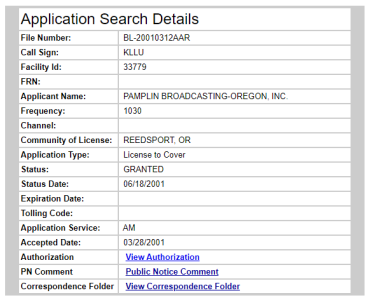
Actually, that's an apparent glitch in the FCC system. The license to cover from the CP that increased the daytime power to 50kW, which never got issued, got shaken loose in LMS on Wednesday. The application for that was filed back in 2001 and I looked at the authorization ... it shows the call letters as "DKDUN" which indicates that the calls were deleted from the active station database.

In fact, the application reference page in LMS shows Pamplin Communications Corp. as the licensee, which would have been correct in 2001.

I am making a wild but somewhat educated guess that the license to cover on that CP had to be issued before it could be deleted, which will likely now happen sometime next week.
 
Actually, that's an apparent glitch in the FCC system. The license to cover from the CP that increased the daytime power to 50kW, which never got issued, got shaken loose in LMS on Wednesday. The application for that was filed back in 2001 and I looked at the authorization ... it shows the call letters as "DKDUN" which indicates that the calls were deleted from the active station database.

In fact, the application reference page in LMS shows Pamplin Communications Corp. as the licensee, which would have been correct in 2001.

I am making a wild but somewhat educated guess that the license to cover on that CP had to be issued before it could be deleted, which will likely now happen sometime next week.
KDUN has been 50KW for decades!
 
KDUN has been 50KW for decades!

Nitpick, and missing the point.

Bearing in mind that I am looking at records that are more than two decades old to make an attempt at figuring out what happened here, please forgive me if I don't get the details 100% right. After all, we are dealing with a uniquely bizarre situation where the license to cover was not processed in a timely manner, went unchecked for close to a quarter-century, and then was apparently discovered when -- two owners later! -- the station went permanently silent.

I still think the most likely explanation is that the Media Bureau had to process that 2001 application in order for there to be a license to cancel. That unprocessed application was, to put it simply, a loose end.
 
Nitpick, and missing the point.

Bearing in mind that I am looking at records that are more than two decades old to make an attempt at figuring out what happened here, please forgive me if I don't get the details 100% right. After all, we are dealing with a uniquely bizarre situation where the license to cover was not processed in a timely manner, went unchecked for close to a quarter-century, and then was apparently discovered when -- two owners later! -- the station went permanently silent.

I still think the most likely explanation is that the Media Bureau had to process that 2001 application in order for there to be a license to cancel. That unprocessed application was, to put it simply, a loose end.
I'm sorry. I misread your entire point because I was unaware of the historical snafu.
 
I'm sorry. I misread your entire point because I was unaware of the historical snafu.

In fairness to you, it was easy to overlook, but it was your observation that (at first glance) KDUN had been "relicensed" that started me digging. But once I looked at the application list at @Michi's FCCdata.org I could see that the last license to cover preceded the file date for the subsequent CP, and from there checking in LMS gave a fairly good image of what probably happened.

What I find most interesting is that CP was in force for a little over 24 years without, apparently, the Media Bureau even making an inquiry as to its status. And that was despite four ownership change applications* during that time (in 2006, 2008, 2013 and 2021) and silent STAs in 2008 and 2021.

* - And yes, I now realize that I miscounted when I said "two owners later" originally. That is how confusing the timeline was to backtrack over!
 
In fairness to you, it was easy to overlook, but it was your observation that (at first glance) KDUN had been "relicensed" that started me digging. But once I looked at the application list at @Michi's FCCdata.org I could see that the last license to cover preceded the file date for the subsequent CP, and from there checking in LMS gave a fairly good image of what probably happened.

What I find most interesting is that CP was in force for a little over 24 years without, apparently, the Media Bureau even making an inquiry as to its status. And that was despite four ownership change applications* during that time (in 2006, 2008, 2013 and 2021) and silent STAs in 2008 and 2021.

* - And yes, I now realize that I miscounted when I said "two owners later" originally. That is how confusing the timeline was to backtrack over!

I know a station that operated under CP status for 20 plus years.. wasnt like an upgrade or move... it had never been granted a permanent license
 
I know a station that operated under CP status for 20 plus years.. wasnt like an upgrade or move... it had never been granted a permanent license

So the Media Bureau is sloppier than I had thought, Paul?
 
From what I can see when I look at the forensic data, the license BL-20010312AAR was actually granted 6/18/2001. The historical CDBS data confirms that. I can see on 6-21-23 when the granted status showed up with a create date of 6-18-01 (this was likely due to the transition of CDBS records to LMS in order to prepare LMS to support AM radio). Then for some strange reason, on 5-28-2025 at 13:53:08 EDT, someone in staff changed the status to "pending" and then within a minute (13:53:45), it was changed back to "granted". When that happened, it picked up a new status date of 5-28-25. Therefore, if you do not look at the forensic data (which you can see in FCCdata by clicking on the red triangle next to the file number on the right side application history) and do not check the CDBS data dump on the REC CDBS preservation site (CDBS Historic Search - REC Radio History Project), you would think that an application filed in 2001 was sitting dormant for 24 years.

The May 30, 2025 Actions Public Notice sheds some light on the status changes:
Comment #1 Lic. to cover - (michi note: Comment #1 was from the original 2001 application)
Comment #2 License cancelled and callsign deleted 5/19/2025 per request of licensee - no letter sent
Comment #3 License and callsign reinstated 5/28/2025 per request of licensee - no letter sent

The letter requesting the cancellation dated May 6, 2025 is in LMS under the facility record only. A copy of the letter was not placed as an internal document on the LMS license application record. I found the public notice entry for the license cancellation in the 5/21/25 actions public notice. I can see there where there is a cancelled status as of 5/19/25, but for some reason, it does not reflect in the LMS forensics (if it was there, it would have been sequence number 1). Yet another overlooked quirk in LMS I assume. (I see 10,834 cancel statuses in the LMS forensics for other stations..)

The bottom line was that they were under a "full" license since at least 2001. The cancellation and the reinstatement caused the date on the Granted status to jump to this year, thus giving an impression that the application had been pending for 24 years.

1749153709120.png
1749153784635.png
 
I think you just gave me an Excedrin headache trying to follow all that, Michi. But thank you for clearing up what was an apparent mystery.
 
I think you just gave me an Excedrin headache trying to follow all that, Michi. But thank you for clearing up what was an apparent mystery.
Hence one reason that I felt it was necessary to undergo a project to preserve as much CDBS data and documents that I could get my hands on before the system went bye bye.
 
Hence one reason that I felt it was necessary to undergo a project to preserve as much CDBS data and documents that I could get my hands on before the system went bye bye.
This line confuses me: "Comment #3 License and callsign reinstated 5/28/2025 per request of licensee - no letter sent"
Was this just an error or has the license been reactivated?


Back
Top Bottom