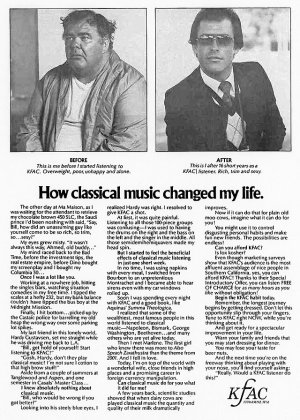
Although it was successful for many decades, one of the problems about the original commercial Classical station in LA, KFAC 92.3. was that during morning and afternoon drive they rarely would play complete works. Just short "ditties" (as my friend's dad used to say) or just movements from larger works. People called in to complain-just like my friends dad did!Similar situation, but not entirely the same: The first station I worked for (1973-77) was MOR in the daytime with a Big Band program on Saturday, and Classical from 8:00pm to midnight every day but Sunday (a program devoted entirely to Opera aired that evening.)
I was the Saturday night "producer" of Great Music To Midnight my entire senior year of high school, and then after graduation was hired full-time to do GMTM on weeknights, plus a short airshift ahead of same. We never aired only excerpts ... it was always the full work. We did run some shorter pieces in the 11:00pm hour for timing purposes, but those were still standalone works.
I have never had any reason to believe Classical should be executed otherwise as a format.

-
Get involved.
We want your input!
Apply for Membership and join the conversations about everything related to broadcasting.
After we receive your registration, a moderator will review it. After your registration is approved, you will be permitted to post.
If you use a disposable or false email address, your registration will be rejected.
After your membership is approved, please take a minute to tell us a little bit about yourself.
https://www.radiodiscussions.com/forums/introduce-yourself.1088/
Thanks in advance and have fun!
RadioDiscussions Administrators
You are using an out of date browser. It may not display this or other websites correctly.
You should upgrade or use an alternative browser.
You should upgrade or use an alternative browser.
K-Mozart is back on 1260
- Thread starter HighStandards
- Start date
Although it was successful for many decades, one of the problems about the original commercial Classical station in LA, KFAC 92.3. was that during morning and afternoon drive they rarely would play complete works. Just short "ditties" (as my friend's dad used to say) or just movements from larger works. People called in to complain-just like my friends dad did!
Some may think consultants only exist in pop formats. But there are consultants for every radio format, including classical. The consultants would advise the stations about the same kinds of things you hear about in pop formats. What you're talking about became a thing at all the major classical stations. You have a lot of quick audience turnover during morning and afternoon drive. So they were told to program to shorter TSL during those times.

I was referring to the programming approach, not the music, per se. As a classically trained musician and aficionado, I could never take the station seriously.I don't recall that at all. I enjoyed that the station played a large number works from Spanish and other related composers not often heard on many other Classical stations.
I've never heard of any Classical station playing a given movement of anything several times a day...I think that would be nuts. Just like back in the day, 1110 KRLA at one point played the Four Seasons "Sherry" every 30 minutes. It almost ruined the tune and the station.It was similar in NYC with WNCN, and in San Francisco with the old and current iterations of KDFC. The concept was/is to treat the music like it was an AOR station, with rotations based on how familiar and popular any piece (or movement, for full symphonies or concertos) was. So for example, they might play the first movement of Beethoven's 5th a few times a day because everyone knows it, but the more obscure second movement might only get aired once or twice a week. Also, shorter pieces provided the ability to break more often, run more spots, and generally have more programming flexibility.
Huh? How so?I've never heard of any Classical station playing a given movement of anything several times a day...I think that would be nuts. Just like back in the day, 1110 KRLA at one point played the Four Seasons "Sherry" every 30 minutes. It almost ruined the tune and the station.
Neither have I. Works are generally well spread out, often over a span of months.I've never heard of any Classical station playing a given movement of anything several times a day
A cardinal rule of Classical Radio is “respect the listeners’ intelligence.”
In the "Classical's Greatest Hits" era of WCRB, "Canon in D" must have been played at least daily, maybe even twice a day. I understand there were only about 300 pieces/excerpts approved for airplay, so it's highly unlikely that any of them would go months between spins.Neither have I. Works are generally well spread out, often over a span of months.
A cardinal rule of Classical Radio is “respect the listeners’ intelligence.”

In the "Classical's Greatest Hits" era of WCRB, "Canon in D" must have been played at least daily, maybe even twice a day. I understand there were only about 300 pieces/excerpts approved for airplay, so it's highly unlikely that any of them would go months between spins.
It makes sense. A station taking a "Greatest Hits" approach would be aiming for the casual listener. The idea would be not unlike any hit-driven radio format---make sure you're playing something familiar and popular whenever anyone tunes in.
Hardcore classical fans would hate it, but they probably weren't enough to keep the station afloat. Snob appeal only gets you so far:

K.M. Richards
Program Director, The Eighties Channel™
I've never heard of any Classical station playing a given movement of anything several times a day...I think that would be nuts. Just like back in the day, 1110 KRLA at one point played the Four Seasons "Sherry" every 30 minutes. It almost ruined the tune and the station.
Huh? How so?
It has been proven time and again that even Power rotations have a threshold time period, that will negate the benefit of a fast rotation because the audience will have a higher percentage chance of a specific song in that rotation playing every time they tune in. (That's what ChannelFlipper would call "burned to a crisp".)
Playing a specific song literally every half-hour is not only overkill, it likely drove listeners over to KFWB.
IIRC, the fastest Power rotation that I remember was when KKHR replaced KNX-FM for a few years. And we all know what happened to them.
It has been proven time and again that even Power rotations have a threshold time period
Yes but that threshold time is limited by the fact that a peak power rotation for a song in CHR usually only lasts a week. So for a week, pop stations played one of Taylor Swift's recent hits every hour, sometimes more frequently than that. But it only lasted a few days, and then they moved on to the next big hit. That's based on short TSL and short attention span of the target demographic. Which is NOT the case in classical music. Very different format, very different audience, and very different rotation.
In public radio, where most of the classical stations reside today, the assumption is for longer TSL and longer attention span, thus care is given to space out the content. Even in news programming, the assumption is the audience is there for the entire show, so stories are not repeated within the two-hour framework of Morning Edition.
K.M. Richards
Program Director, The Eighties Channel™
I agree with you for the most part, A, but I was talking about the historical definition of Power rotations, applying only to current-based formats (last time I checked, there were no currents in Classical 😛) and my examples were from the pre-Internet days, when a song could be in Power rotation for weeks before dropping off.
Public radio, of course, plays by different programming rules, for precisely the reason you cited.
Public radio, of course, plays by different programming rules, for precisely the reason you cited.
XHLNC FM did quite well with a very limited playlist. Was that 400 of the past 400 years?
It seems the best classical stations are playing hundreds of hours of music with likely about 250 hours being the 'hot' rotation. There seems to be a leaning to more orchestral works. Solo piano seems to remain popular. I notice stations minimizing any harpsichord, solo harp, solo flute and certainly hurdy gurdy! The attitude of not going far our of the center lane is best. The exception is some classical listeners want to hear something new to them, or discovery music. I cannot find any research on what percentage that should be. Anyone have any ideas?
What I discovered is Classical has a few barriers:
1) you have casual listeners who know the 300 or 400 selections that listen by mood and are less likely to be listener donors as most are commercial radio listeners.
2) your contributor base that knows the music, wants the entire work versus a movement but expects mainly movements in AM drive. They want announcers that know the music.
3) younger listeners don't find the differing tempos of a work as a positive. It is unlike other musical listening they know. They have to be taught how to listen and about donating.
4) Classical listeners are not dying but rather 'taking a while' to become listeners. Adults in their 40s and 50s have a first serious connection to classical. We can speculate why but generally classical stations are termed by listeners as an oasis. It could be these 40s and 50s adults also like shutting off the world with this radio oasis.
5) Income levels are there. Classical is somewhat of an encouragement for success based on preconceived thoughts of who classical music attracts. Back in the mind some listeners think classical music puts them in the right 'crowd' for that promotion or success. That this can happen by the positive vibe one perceives of classical music or the crowd it gives you access to. Some young ladies think a knowledge of classical music might help them attract a more financially enhanced mate. Personally, I don't think the young ladies factor in today as much as in years past. Classical Music is not part of most music programs in school, only coming out in band or choir.
It seems the best classical stations are playing hundreds of hours of music with likely about 250 hours being the 'hot' rotation. There seems to be a leaning to more orchestral works. Solo piano seems to remain popular. I notice stations minimizing any harpsichord, solo harp, solo flute and certainly hurdy gurdy! The attitude of not going far our of the center lane is best. The exception is some classical listeners want to hear something new to them, or discovery music. I cannot find any research on what percentage that should be. Anyone have any ideas?
What I discovered is Classical has a few barriers:
1) you have casual listeners who know the 300 or 400 selections that listen by mood and are less likely to be listener donors as most are commercial radio listeners.
2) your contributor base that knows the music, wants the entire work versus a movement but expects mainly movements in AM drive. They want announcers that know the music.
3) younger listeners don't find the differing tempos of a work as a positive. It is unlike other musical listening they know. They have to be taught how to listen and about donating.
4) Classical listeners are not dying but rather 'taking a while' to become listeners. Adults in their 40s and 50s have a first serious connection to classical. We can speculate why but generally classical stations are termed by listeners as an oasis. It could be these 40s and 50s adults also like shutting off the world with this radio oasis.
5) Income levels are there. Classical is somewhat of an encouragement for success based on preconceived thoughts of who classical music attracts. Back in the mind some listeners think classical music puts them in the right 'crowd' for that promotion or success. That this can happen by the positive vibe one perceives of classical music or the crowd it gives you access to. Some young ladies think a knowledge of classical music might help them attract a more financially enhanced mate. Personally, I don't think the young ladies factor in today as much as in years past. Classical Music is not part of most music programs in school, only coming out in band or choir.
K.M. Richards
Program Director, The Eighties Channel™
It seems the best classical stations are playing hundreds of hours of music with likely about 250 hours being the 'hot' rotation. There seems to be a leaning to more orchestral works. Solo piano seems to remain popular. I notice stations minimizing any harpsichord, solo harp, solo flute and certainly hurdy gurdy! The attitude of not going far our of the center lane is best. The exception is some classical listeners want to hear something new to them, or discovery music. I cannot find any research on what percentage that should be. Anyone have any ideas?
I guess Russo’s “Three Pieces For Blues Band and Symphony Orchestra” is out, then.

XLNC eventually went kaputski because the avoided using the word "classical." You forgot the station existed and they didn't attract someone to the station if you might remotely be interested in listening.
That is not true. XHLNC did avoid the word classical on air calling it the world's biggest hits. So by your logic, if there was a classic rock station and you didn't call it classic rock on the air, it would fail because people would forget about it and because not calling it classic rock means nobody would be interested in listening..
The station had been set up by the Dad to be a classical station perpetually. It may have been a non-profit. In the end, there was lots of money missed by the frequency being classical versus a mass appeal station. When the station started, they were the only classical on the dial in areas of Southern California.
The station had been set up by the Dad to be a classical station perpetually. It may have been a non-profit. In the end, there was lots of money missed by the frequency being classical versus a mass appeal station. When the station started, they were the only classical on the dial in areas of Southern California.
You're absolutely right, it did drive people to KFWB for a time...including me!It has been proven time and again that even Power rotations have a threshold time period, that will negate the benefit of a fast rotation because the audience will have a higher percentage chance of a specific song in that rotation playing every time they tune in. (That's what ChannelFlipper would call "burned to a crisp".)
Playing a specific song literally every half-hour is not only overkill, it likely drove listeners over to KFWB.
IIRC, the fastest Power rotation that I remember was when KKHR replaced KNX-FM for a few years. And we all know what happened to them.
I think the Four Seasons would work well on a Classical station.I've never heard of any Classical station playing a given movement of anything several times a day...I think that would be nuts. Just like back in the day, 1110 KRLA at one point played the Four Seasons "Sherry" every 30 minutes. It almost ruined the tune and the station.
(closed captioning for those who don't get the joke)

One of the bigger issues the management of a classical station has is that group of self-proclaimed "experts" who get mad when you use the Cleveland Symphony rendition rather than the New York version of a work. Or, heaven forbid, the St. Martin in the Fields version which is just a bit too sappy...And since it is the most recorded classical music work, you could play it all day with all the variations in style ;-)
- Status
- This thread has been closed due to inactivity. You can create a new thread to discuss this topic.