• Get involved.
    We want your input!
    Apply for Membership and join the conversations about everything related to broadcasting.

    After we receive your registration, a moderator will review it. After your registration is approved, you will be permitted to post.
    If you use a disposable or false email address, your registration will be rejected.

    After your membership is approved, please take a minute to tell us a little bit about yourself.
    https://www.radiodiscussions.com/forums/introduce-yourself.1088/

    Thanks in advance and have fun!
    RadioDiscussions Administrators

Little Rock KAAY new modification application

There were a few of the Class A cleared channel AMs which really were too big a facility for their market size. KAAY is one of them. WWVA Wheeling WV another. WOWO Fort Wayne. KXEL Waterloo, Iowa. Twenty years ago WWVA filed to move to Cleveland but DXers raised hell and the owner dismissed the application. In 2006, WOWO gave up its big 50 kW nighttime signal so the 1190 in NYC could improve their nighttime.
 
There were a few of the Class A cleared channel AMs which really were too big a facility for their market size. KAAY is one of them.
That was a huge music station at night all over its north to south coverage area... lots of record store ads and sponsorships.
WWVA Wheeling WV another.
WWVA was enormously successful for decades broadcasting "from out of the hills of West Virginia". They had a show comparable to the Grand Ole Opry that brought in people from as far off as Maryland, New York and PA. It was such an important station that large group operator Storer Broadcasting kept it for many years even though they had moved into much bigger markets elsewhere.
WOWO Fort Wayne.
In its day, it was the regional voice for farmers and business all over the tri-state area.
KXEL Waterloo, Iowa
That, for many decades, was a big farm station. Big revenues.

Twenty years ago WWVA filed to move to Cleveland but DXers raised hell and the owner dismissed the application.
The protests had nothing to do with DXers. Heck, there are only a thousand or so of them in the whole country. The issue was sort of political,, with West Virginia about to lose its only real 50 kw station.
In 2006, WOWO gave up its big 50 kW nighttime signal so the 1190 in NYC could improve their nighttime.
And they did that because the owner of the New York station bought WOWO and reduced the power at night. WOWO is still more than adequate to cover the Ft Wayne Metro Survey Area.

Today, no 50 kw station cares about anything beyond the local rated market. Advertisers quit decades ago buying big signals for their n ight coverage.
 
That [KAAY] was a huge music station at night all over its north to south coverage area... lots of record store ads and sponsorships.
KAAY must have had a really narrow north-south pattern to protect WBAL. When I was living in Stuttgart, AR, only 50 miles southeast of Little Rock, in the late '70s, I got better reception of WHBQ Memphis (560) at night than I did of KAAY. Memphis was about 100 miles away.
 
KAAY must have had a really narrow north-south pattern to protect WBAL. When I was living in Stuttgart, AR, only 50 miles southeast of Little Rock, in the late '70s, I got better reception of WHBQ Memphis (560) at night than I did of KAAY. Memphis was about 100 miles away.
The pattern was very narrow, but opened up by the time it got to the state lines.
 
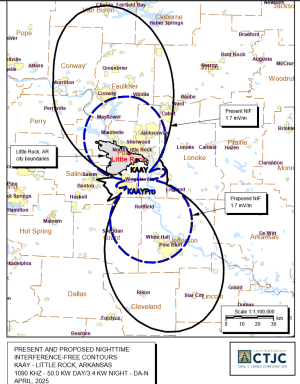
KAAY last week requested their CP to drop to 80 watts ND at night to be cancelled and they have filed a new application for 3400 watts directional at night with two towers.
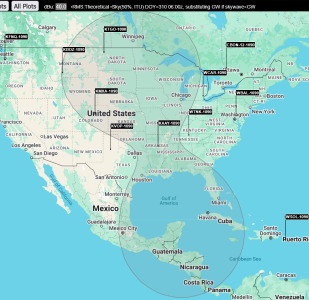
KAAY Little Rock is a 50,000 watt Class A station (originally Class I-B). By day, it is non-directional. But at night, it uses a three-tower array to protect the two other Class A stations on 1090, WBAL Baltimore and XEPRS Tijuana. The towers are off McDonald Road in Wrightsville, Arkansas.

The application was originally to relocate to a single tower nearby. I suppose the site with all that land surrounding the three towers would then be sold. KAAY is a rare brokered religion station held by a major owner, in this case Cumulus. I guess they figured brokered religion has most of its listeners in the daytime? The deal to sell the land was too good to pass up and they'll live without much revenue after sunset?

But unlike some other owners who simply silence the station and sell the land, Cumulus was going to live with an 80 watt nighttime signal? And now it will live with a 3,400 watt nighttime signal.
 
Last edited:
The cancellation of the proposed WWVA move had nothing to do with DXers. I promise you then-Clear Channel didn't even consider DXers in it's business decisions.

At the time, local market managers had a lot of power in the company, and the Cleveland market manager apparently didn't see value in adding a second AM to the cluster at an expense that would have come from the local bottom line on their books.
 
There were a few of the Class A cleared channel AMs which really were too big a facility for their market size. KAAY is one of them.

Keep in mind that AM had clear, regional, and local channels. Those with large signals like KAAY were expected to cover large areas. Arkansas did not have many AM's on at night. Prior to 1980, Washington and Benton Counties in Northwest Arkansas had no AM's on at night. Granted, they weren’t the population hubs they are today, but you could have driven home to Little Rock from the University of Arkansas in Fayetteville and never gone through a town that had an AM operating at night. (Most people would go through Ft. Smith, Russellville, or Conway first, but bypassing those cities is possible.) If you lived in Jonesboro, which was roughly a six hour drive from Fayetteville, you would go through exactly one community with a 24 hour AM station (Mountain Home), and there were two 24 hour AM signals between Little Rock and Ft. Smith (until recently, the largest two communities in the state). KAAY might’ve been large for its market, but Arkansas depended on skywave signals after dark.

In 2006, WOWO gave up its big 50 kW nighttime signal so the 1190 in NYC could improve their nighttime.

I remember it being earlier than that, like around 1996.
 
Last edited:
KAAY is still the assigned EAS Primary Entry Point for national alerts in much of Arkansas. Even at 50kw, impulse noise makes it difficult to reliably receive it for EAS monitoring. At least 3400 watts gets it into Little Rock at night. However, it still doesn't help much in the rest of the state. This is another illustration of why AM shouldn't be a PEP anymore if EAS is expected to work if needed.
 
Back in the early 1970s they had a nighttime signal at Kessler AFB. Biloxi MS. As an ground electronic training base and being a member or poorly paid E1 thru E3s, we weren't a "money demo".
 
There are some azimuths around the edges of the lobes that actually have an Inverse Directional Field higher with the two tower pattern with 3.4 kW than with the three tower pattern with 50 kW. The L2C was granted today.

This is exactly what I thought, and I may have posted somewhere, that they should have done-use the two standing towers and use the maximum power you can use with that. Good thing the center tower didn't collapse.

Once again, Cynthia Jacobson's work is top tier on AM directional applications. Her applications are always very straightforward and complete. I am sad, though, that I can't talk to Glen Clark and Jeremy Ruck anymore.
 
The cancellation of the proposed WWVA move had nothing to do with DXers. I promise you then-Clear Channel didn't even consider DXers in it's business decisions.

At the time, local market managers had a lot of power in the company, and the Cleveland market manager apparently didn't see value in adding a second AM to the cluster at an expense that would have come from the local bottom line on their books.
How ironic for a company originally called "Clear Channel" and whose original station was WOAI 1200, a 50000 Watt Class I-A Clear Channel, and a low hanging fruit for DXers.
 
When did the light finally start turning on in the heads of the nation's radio station owners that there was no bottom-line value in pumping a 50,000-watt signal over 30 states? Did DXers actually figure in business decisions before then? And why? Did advertisers back then actually want to reach listeners hundreds of miles away, or were station owners just assuming they did?
 
There were a few of the Class A cleared channel AMs which really were too big a facility for their market size. KAAY is one of them. WWVA Wheeling WV another. WOWO Fort Wayne. KXEL Waterloo, Iowa. Twenty years ago WWVA filed to move to Cleveland but DXers raised hell and the owner dismissed the application. In 2006, WOWO gave up its big 50 kW nighttime signal so the 1190 in NYC could improve their nighttime.
The owners of WLIB bought WOWO in order to shut it down. Yes, the plan waas to shut WOWO down completely. Another broadcaster stepped in to keep WOWO on the air with reduced night power, then this broadcaster (Federated Media) bought WOWO.
 
When did the light finally start turning on in the heads of the nation's radio station owners that there was no bottom-line value in pumping a 50,000-watt signal over 30 states? Did DXers actually figure in business decisions before then? And why? Did advertisers back then actually want to reach listeners hundreds of miles away, or were station owners just assuming they did?

I don’t know if skywave was ever profitable, but large swaths of this country were totally dependent on it, at least in the average car, after dark even as recently as the early 80’s. It didn’t become just a DX phenomenon until more AM's got to go 24 hours and FM became more available in vehicles.
 
The owners of WLIB bought WOWO in order to shut it down. Yes, the plan waas to shut WOWO down completely.
That sort of thing actually happened to the old 1010 in Little Rock around 30 years ago. WINS in NYC pretty much paid it to go away so that the NYC nighttime directional signal could be loosened up a bit.

The LR 1010 is best remembered as KLRA, though it went through a few call letters changes in its final years. Put a listenable night signal into Central Texas in the 1960s.

I’ve long forgotten the particulars of that transaction.


Back
Top Bottom