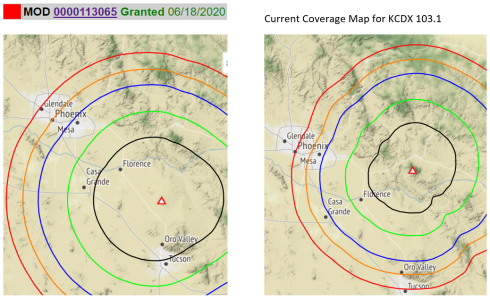
As the OP, here is where I am coming from. The map on the left is the projected coverage map after the move. Note how Glendale is encompassed on the extreme fringe of the signal. The map on the right is the current coverage map which shows that Glendale is out of range altogether. As for downtown Phoenix, note how it progresses from the red line (poorest fringe) up to the orange line (somewhat better penetration).
Tuscon is even more of a marked improvement, with KCDX's signal going from the outer fringe to a rimshot that is nearly within the 60 dbu black circle contour DE often cites in his posts. This will be a significant upgrade for Tuscon, and a slight signal upgrade for Phoenix.
Besides the relocation of the transmitter, much of the improvement may be due to the approved effective radiated power upgrade of the signal from 2.7 kW to 42 kW.
As I stated in my OP, as a fan of the station, I fear that this upgrade, once implemented, will measurably increase the valuation of the signal, possibly making it more attractive for the owner to sell, which would be a loss for the listeners, as this station's current format is unique on the American radio landscape.
The only useful contour on those maps is the black, central one. That defines, for most cases, acceptable in-car listening.
The in-home and at-work listening
is significantly inside the inner black contour. Based on diary returns in markets like Tucson, 95% of all listening is from inside the 65 dbu contour, which is, in rather non-technical terms, about 75% of the inner black contour. The outer colored contours in those maps represent fairly useless contours.
The transmitter power is increased because the HAAT had gone down. In FM, height and power create coverage... more power at lower height is the same as low power and higher elevation. There is plenty of real math behind that, but just know that those 6,000 watt stations on the Empire state building at 1362 feet are exactly the same as 50 kw at 150 meterst, the standard for their class of station. Once a station meets the maximum height for its class, going any higher requires power reductions:
The following table lists the various classes of FM stations, the reference facilities for each station class, and the protected and city grade contours for each station class. A service (or interfering) contour may be visualized by imagining a rough circle surrounding a transmitter site at...

www.fcc.gov
Note that this station is a C1, limited to 100 kw at 300 meters... that means that the potected 60 dbu contour is only 45 miles from the site, and the city grade is 31 miles out. Happy listening for cacti and not much else.

The new 70 dbu covers less than 60,000 persons. The 65 dbu covers 42,000. The 60 dbu covers just over 100 thousand.
The Blue, Orange and Red contours are useless for audience attraction. The green, at best is fair to marginal in-car reception but out of range for decent home or work radios.
The station is a marginal rimshot for Tucson. It is totally useless for Phoenix, as there is not enough signal even in the south-of-Tempe zone, for reasonable reception in most cases.
Listeners are not DXers. The fact that a station can be heard if you try hard enough does not mean it is one that the average listener will ever discover or find to be satisfactory.
If the owner offered to give me the station, I'd turn it down with no thought whatsoever.