
-
Get involved.
We want your input!
Apply for Membership and join the conversations about everything related to broadcasting.
After we receive your registration, a moderator will review it. After your registration is approved, you will be permitted to post.
If you use a disposable or false email address, your registration will be rejected.
After your membership is approved, please take a minute to tell us a little bit about yourself.
https://www.radiodiscussions.com/forums/introduce-yourself.1088/
Thanks in advance and have fun!
RadioDiscussions Administrators
You are using an out of date browser. It may not display this or other websites correctly.
You should upgrade or use an alternative browser.
You should upgrade or use an alternative browser.
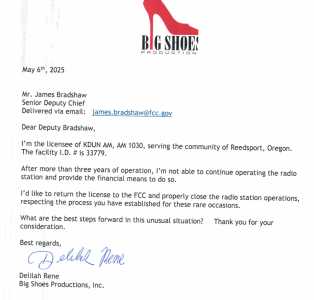
Oregon KDUN cancels license
- Thread starter boiseengineer
- Start date


K.M. Richards
Program Director, The Eighties Channel™
It was 50kW if I'm not mistaken? Electric bill alone would put you in the poorhouse. Doesn't look like it's anywhere near a decent size city where there might be an advertising base.
I get the impression that the electric bill was the least of her problems. I have read that her hometown has fallen on bad times in recent years, with major employers having already left by the time she "rescued" the station. I also read somewhere that she (or her spokesperson) said that every local business that could afford to advertise did; that's a measure of how her hometown felt about her more than anything.
If anything, this proves that she's the same person in real life as she is on her show. She didn't have to do this, but her heart told her to.
Electric bill for KDUN would have been $3000 a month or so. That's only a bit higher than the wages for one full time employee at Oregon's minimum wage ($13.70 per hour in rural counties)
In almost any business, employee payroll is the primary expense.
In almost any business, employee payroll is the primary expense.
Cost depends if they were on a peak demand meter. Still they were only a kilowatt half the time in a year average.
If they had been running MDCL the 50 kw cost could be nearly 25% less.
If they had been running MDCL the 50 kw cost could be nearly 25% less.

I am curious as to why many posters here think the electric bill is the major expense of a radio station.Electric bill for KDUN would have been $3000 a month or so. That's only a bit higher than the wages for one full time employee at Oregon's minimum wage ($13.70 per hour in rural counties)
In almost any business, employee payroll is the primary expense.
Most stations pay more for insurance than the electric bill. Many pay more in music licensing fees. Or office space rental. There are a number of expense categories that are greater expenses at stations than the power bill for the transmitter.
For a short period of time, I trained to work (and then officially worked) in radio advertising. I got paired with someone who had been doing that type of work for decades, and got to learn some of their secrets.
It was an eye opening experience. Selling radio advertising (particularly in a smaller market) is not an easy feat. I can't imagine how difficult it would be somewhere like Coos Bay, which seems to be on pretty tough economic times. Small mom and pop stores, restaurants, and other small businesses are notorious for not being a consistent buyer (or requesting some sort of trade arrangement in lieu of paying for a package). I have no doubt that the Coos Bay and Reedsport communities did whatever they could to rally behind Delilah, but there's only so much money they can spend when they're also trying to stay afloat.
If you're in a community that is primarily composed of small businesses (most of which are already on tough times), it's not a great context for operating a media business. I suspect that Delilah was the only person who possessed the willingness and financial means to keep KDUN alive as long as she did.
It was an eye opening experience. Selling radio advertising (particularly in a smaller market) is not an easy feat. I can't imagine how difficult it would be somewhere like Coos Bay, which seems to be on pretty tough economic times. Small mom and pop stores, restaurants, and other small businesses are notorious for not being a consistent buyer (or requesting some sort of trade arrangement in lieu of paying for a package). I have no doubt that the Coos Bay and Reedsport communities did whatever they could to rally behind Delilah, but there's only so much money they can spend when they're also trying to stay afloat.
If you're in a community that is primarily composed of small businesses (most of which are already on tough times), it's not a great context for operating a media business. I suspect that Delilah was the only person who possessed the willingness and financial means to keep KDUN alive as long as she did.

KDUN wasn’t even a competitive signal in Coos Bay. This was ill fated from the start. Reedsport was never going to be able to support this station. And the programming was…mediocre at best. The same tired 70s and 80s oldies that are heard on stations everywhere. Very little of this station was truly local. Delilah said she couldn’t financially support this station anymore, ever though her net worth in said to be around $50 million.
KDUN had at least 3 different morning hosts during this short time and the rest of the day the station was basically automated.
KDUN had at least 3 different morning hosts during this short time and the rest of the day the station was basically automated.
Maybe because they see their own monthly bills and think, "Wow! I'm paying a hundred bucks a month just to run my TV, computer, lights and appliances. Imagine what WXXX is paying to run a 5,000-watt transmitter 24/7!" Truth be told, I've been guilty of wondering about that, too. So what's the story? Do broadcasters get some sort of special deal from the power company or are they paying at the same rate that us non-corporate working stiffs (or in my case, retired stiffs) are?I am curious as to why many posters here think the electric bill is the major expense of a radio station.
Yes, no, maybe.Maybe because they see their own monthly bills and think, "Wow! I'm paying a hundred bucks a month just to run my TV, computer, lights and appliances. Imagine what WXXX is paying to run a 5,000-watt transmitter 24/7!" Truth be told, I've been guilty of wondering about that, too. So what's the story? Do broadcasters get some sort of special deal from the power company or are they paying at the same rate that us non-corporate working stiffs (or in my case, retired stiffs) are?
There's no one rate for all. Depends on the state PUC regulation, power company, even local government.
Transmitter sites in Idaho I've dealt with are classified as industrial, and have peak demand charges on top of kW/h rates.
Business rates have the same variability.
KDUN is done.
And most of that 50 kW was wasted out over the ocean.
And most of that 50 kW was wasted out over the ocean.
Maybe because they see their own monthly bills and think, "Wow! I'm paying a hundred bucks a month just to run my TV, computer, lights and appliances. Imagine what WXXX is paying to run a 5,000-watt transmitter 24/7!" Truth be told, I've been guilty of wondering about that, too. So what's the story? Do broadcasters get some sort of special deal from the power company or are they paying at the same rate that us non-corporate working stiffs (or in my case, retired stiffs) are?
How much businesses pay can vary greatly from location-to-location based on a variety of factors. Having said that, businesses typically more (a lot more) than residential customers. I've had a couple friends who have either owned or managed restaurants. One of them owned a small sandwich shop/deli that probably isn't much bigger than your living room and dining room put together. His utilities usually ran him about $1,500/month. He ultimately unplugged and got rid of his walk-in cooler because he could get a Sysco truck to his backdoor every day and quickly found out that was his biggest energy hog. That easily cut $500 off of his utilities every month. He found he could generally at least break even if he could keep his utilities below $1,000/month.
Another friend manages a restaurant/brewery. Not sure exactly what the floor space is, but I'd guess it's 2,000-3,000 square feet. His utilities run about $4,500 most months, though they get up to $6,000 the hottest and coldest months of the summer and winter. Again, he deals with a couple walk-in coolers, has multiple fryers, and the brewing equipment.
Radio stations definitely pay the business rates where they operate. I'm sure electric bills fluctuate and are subject to plenty of variability. I know a few of the ones where I've worked have had to content with multiple jurisdictions as the studios were in town, but the towers could sometimes be a couple counties away. The transmitters tended to have different electric companies than the studios. Solid state transmitters should also cost less to run than the older transmitters. Problem is, even in small markets with programming automated, radio stations can easily employ more than 10 people.
All that seems to indicate to me that the electric bill could be a real problem for a radio station, especially with advertising in an apparent death spiral. I'm curious to see how David Eduardo sets me (and you?) straight on this issue.How much businesses pay can vary greatly from location-to-location based on a variety of factors. Having said that, businesses typically more (a lot more) than residential customers. I've had a couple friends who have either owned or managed restaurants. One of them owned a small sandwich shop/deli that probably isn't much bigger than your living room and dining room put together. His utilities usually ran him about $1,500/month. He ultimately unplugged and got rid of his walk-in cooler because he could get a Sysco truck to his backdoor every day and quickly found out that was his biggest energy hog. That easily cut $500 off of his utilities every month. He found he could generally at least break even if he could keep his utilities below $1,000/month.
Another friend manages a restaurant/brewery. Not sure exactly what the floor space is, but I'd guess it's 2,000-3,000 square feet. His utilities run about $4,500 most months, though they get up to $6,000 the hottest and coldest months of the summer and winter. Again, he deals with a couple walk-in coolers, has multiple fryers, and the brewing equipment.
Radio stations definitely pay the business rates where they operate. I'm sure electric bills fluctuate and are subject to plenty of variability. I know a few of the ones where I've worked have had to content with multiple jurisdictions as the studios were in town, but the towers could sometimes be a couple counties away. The transmitters tended to have different electric companies than the studios. Solid state transmitters should also cost less to run than the older transmitters. Problem is, even in small markets with programming automated, radio stations can easily employ more than 10 people.
All that seems to indicate to me that the electric bill could be a real problem for a radio station, especially with advertising in an apparent death spiral. I'm curious to see how David Eduardo sets me (and you?) straight on this issue.
I don't know very many people who would think $3,000/month is peanuts. It is, however, a drop in the bucket for a cluster that bills a few million a year.
When thinking about the expenses of a radio station, a friend of mine is looking at buying an AM/FM combo in a small, unrated market. It's about midway between two larger markets, though neither is in the Top-100. The stations bill fairly well, but the payroll expense is $30,000/month. Payroll in radio adds up a lot faster than the electric bill.
The utility bill is not the only expense. Even with a small staff, employees will be the bigger part of the budget when you include salaries, health plan, social security, etc.All that seems to indicate to me that the electric bill could be a real problem for a radio station, especially with advertising in an apparent death spiral. I'm curious to see how David Eduardo sets me (and you?) straight on this issue.
Then you have property and liability insurance. Legal fees. State, local and federal license and permit fees. Business licenses, telephone, internet, accounting service if you don't have a fulltime office manager, rent, property taxes, music licenses, retainer for FCC attorney, outside engineer, office and bathroom supplies and cleaning, sales commissions...
Then there are occasional items, ranging from the manager's chair broke to the AC unit needs to be replaced.
And then items that are small but add up like Chamber of Commerce membership, NAB dues, trade publication subscriptions, occasional painting or, if you own, a new roof or replacement doors and the like.
It is not just the electric bill... it is dozens of different bills every month or year that all add up.
Commercial consumers typically pay a lower per-kWh rate. For example, in Oregon, the average residential rate is 15.6 cents, the average commercial rate is 10.5 cents, and the average industrial rate is 8.4 cents. Source: US Department of Energy. Electric Power Monthly - U.S. Energy Information Administration (EIA)Having said that, businesses typically more (a lot more) than residential customers
Commericial consumers will typically consume a ton more energy than residential consumers, so the total bill ends up being a lot. And as others have mentioned, there can be demand charges, although I have no way of knowing if KDUN would have hit that threshold with their utility.
It seems like you're applying household economics to a business.All that seems to indicate to me that the electric bill could be a real problem for a radio station, especially with advertising in an apparent death spiral. I'm curious to see how David Eduardo sets me (and you?) straight on this issue.
A business buys things from suppliers, and transforms them into something that is more valuable. A Pizza Hut buys flour, pepperoni, and onions... And electricity. A Pizza Hut probably pays several thousand in electric and/or natural gas charges per month. But the average Pizza Hut unit sells $70k in product per month. So the power bill is paid within a few days.
Similarly in radio, the power bill is usually a tiny fraction of operating expenses. A small town AM/FM combo I worked for in Indiana usually had a power bill of around $600 a month. We'd run enough ads to pay the power bill on the first weekday of the month, even though it was only a breakeven operation. By far the largest single cost was payroll (inclusive of commissions for the sales people, the employer contribution to medical insurance, social security tax, etc).
Will that always be the case, for every radio station in every town across America? Probably not. Reedsport seems like a terrible place to run a radio station, because of its small population and tiny business community.
K.M. Richards
Program Director, The Eighties Channel™
She probably would have had better luck with the KCFM/KCST cluster and buying them out.
As I recall, she chose this station because it was the one she started her career at. Unfortunately, she failed to understand that sentimentality is not a great reason to purchase a radio station.