• Get involved.
    We want your input!
    Apply for Membership and join the conversations about everything related to broadcasting.

    After we receive your registration, a moderator will review it. After your registration is approved, you will be permitted to post.
    If you use a disposable or false email address, your registration will be rejected.

    After your membership is approved, please take a minute to tell us a little bit about yourself.
    https://www.radiodiscussions.com/forums/introduce-yourself.1088/

    Thanks in advance and have fun!
    RadioDiscussions Administrators

KFI Is The #1 Talk Station in the U.S.

If you look at cume ratings, KFI is currently #1 among commercial talk stations. No doubt its ratings were helped by the LA Wildfires. KFI had been #4 before the Holiday ratings, with WSB at #1.

Here are the cume numbers from the January Nielsen ratings for stations with more than 200,000 weekly listeners...

1. KFI Los Angeles ......... iHeart ................ 613,900
2, WSB Atlanta ................ Cox .................... 521,800
3. WABC New York ........ Red Apple ...... 492,100
4. WKXW New Jersey ... Townsquare ... 349,400 (NYC) + 123,500 (Phila.) = 472,900
5. KTRH Houston ........... iHeart ............... 360,900
6. WGN Chicago ............ Nexstar............. 355,400
7. WOR New York .......... iHeart ............... 332,500
8. KTAR-FM Phoenix .... Bonneville ....... 271,200
9. KIRO-FM Seattle........ Bonneville ....... 232,200
10. WLW Cincinnati ....... iHeart ............... 223,300

.
 
If you look at cume ratings, KFI is currently #1 among commercial talk stations. No doubt its ratings were helped by the LA Wildfires. KFI had been #4 before the Holiday ratings, with WSB at #1.

Here are the cume numbers from the January Nielsen ratings for stations with more than 200,000 weekly listeners...

1. KFI Los Angeles ......... iHeart ................ 613,900
2, WSB Atlanta ................ Cox .................... 521,800
3. WABC New York ........ Red Apple ...... 492,100
4. WKXW New Jersey ... Townsquare ... 349,400 (NYC) + 123,500 (Phila.) = 472,900
5. KTRH Houston ........... iHeart ............... 360,900
6. WGN Chicago ............ Nexstar............. 355,400
7. WOR New York .......... iHeart ............... 332,500
8. KTAR-FM Phoenix .... Bonneville ....... 271,200
9. KIRO-FM Seattle........ Bonneville ....... 232,200
10. WLW Cincinnati ....... iHeart ............... 223,300

.
What’s your source for these?
 
What’s your source for these?
Cumes are available by market here:
 
WABC shouldn't really be surprising. The market is 16.3 million population, so that #3 ranking on this list shows only 3% of the population spent at least one quarter hour with WABC.

The AQH data shows most WABC listeners spent much longer than the minimum with the station.
 
If you look at cume ratings, KFI is currently #1 among commercial talk stations. No doubt its ratings were helped by the LA Wildfires. KFI had been #4 before the Holiday ratings, with WSB at #1.

Here are the cume numbers from the January Nielsen ratings for stations with more than 200,000 weekly listeners...

1. KFI Los Angeles ......... iHeart ................ 613,900
2, WSB Atlanta ................ Cox .................... 521,800
3. WABC New York ........ Red Apple ...... 492,100
4. WKXW New Jersey ... Townsquare ... 349,400 (NYC) + 123,500 (Phila.) = 472,900
5. KTRH Houston ........... iHeart ............... 360,900
6. WGN Chicago ............ Nexstar............. 355,400
7. WOR New York .......... iHeart ............... 332,500
8. KTAR-FM Phoenix .... Bonneville ....... 271,200
9. KIRO-FM Seattle........ Bonneville ....... 232,200
10. WLW Cincinnati ....... iHeart ............... 223,300

.

For WKXW we have to add in the central New Jersey ratings, too. It's core is there.
 
However, KFI's cume is half that of KNX, which is where anyone who wants to find out what's happening with the wildfires is likely to go.

Here is the corrected list for top ten news/talk stations by cume (as recorded by ******************).
KQED-FM, San Francisco 751,600
WNYC-FM, New York 687,600
WAMU-FM, Washington 619,700
KFI, Los Angeles 613,900
KPCC-FM, Los Angeles 565,900
WKXW-FM, Trenton 517,600 (Including Middlesex-Somerset-Union cume)
WABC, New York 492,100
KERA-FM, Dallas 422,900
WBEZ-FM, Chicago 418,200
WBUR-FM, Boston 366,800
 
Last edited:
WABC shouldn't really be surprising. The market is 16.3 million population, so that #3 ranking on this list shows only 3% of the population spent at least one quarter hour with WABC.

The AQH data shows most WABC listeners spent much longer than the minimum with the station.
Somehow I thought WOR would do better because of its "national" hosts. Isn't national monolithic programming the future for the US? We will end up like Europe and third world countries. With one only one station for each type of programming.
 
WABC shouldn't really be surprising. The market is 16.3 million population, so that #3 ranking on this list shows only 3% of the population spent at least one quarter hour with WABC.

The AQH data shows most WABC listeners spent much longer than the minimum with the station.
I believe that cume is the total amount of people who listened for at least five minutes during a week although I understand that number has dropped to three.
 
I believe that cume is the total amount of people who listened for at least five minutes during a week although I understand that number has dropped to three.
Actually, the definition is a bit more complex.

Nielsen's smallest amount of listening is the quarter hour. To get credit for a quarter hour a station has to have PPM detection in at least three discreet minutes in the quarter hour ("quarter hours" are those segments starting at :00, :15, :30, and :45).

The reason for allowing only three detections is that the PPM code or signal is only inserted when a station programming has audio at the same frequencies that will mask the code. In many formats, the nature of the audio does not allow coding to be transmitted due to less dense audio, lots of pauses (such as in talk and sports) or nothing in the frequency locations where coding can be done.

So, the minimum listening is "qualifying" for one quarter hour. To earn that quarter hour, the PPM device carried by panelists must detect listening to the station at least 3 times in the quarter hour and in 3 separate clock minutes.
 
Somehow I thought WOR would do better because of its "national" hosts. Isn't national monolithic programming the future for the US? We will end up like Europe and third world countries. With one only one station for each type of programming.
Let's take the closest "third world" nations. Mexico City has over a dozen news/talk stations. It has a total of about 60 stations between AM and FM. Buenos Aires, Argentina, has 11 all talk AM stations, and there are nearly 200 FMs in the Greater B. A. metro, including many neighborhood and suburban stations.

In Europe, what we have a lot of "national" stations where one station has many, many transmitters all over the nation. But today, every nation has lots of independent broadcasters and each has its own format, with the most popular formats having multiple different stations.

I much of Sub-Saharan Africa, there are around 20 to 30 FMs in the larger cities, and proportional number in smaller ones. All are FM.

If you look at the Philippines or Thailand or other S.E. Asian markets, you will also see a huge variety of privately owned independent stations.

Where I owned stations long ago, Ecuador, there are several dozen regional or national FM stations using up to 20 or so transmitters along with what we call translators (low power in shadow areas). Quito has about 40 FM stations, and there is no cross ownership. About a third of them have wide networks, and a number of the others have limited regional networks. While at one time there were over 30 AM stations there, that is down to about 10 now; several are part of news, religious and talk networks.

Yes, a lot of the many private stations are national, but there are lots of them and they have a variety of owners and there is significant format duplication.
 
Let's take the closest "third world" nations. Mexico City has over a dozen news/talk stations. It has a total of about 60 stations between AM and FM. Buenos Aires, Argentina, has 11 all talk AM stations, and there are nearly 200 FMs in the Greater B. A. metro, including many neighborhood and suburban stations.

In Europe, what we have a lot of "national" stations where one station has many, many transmitters all over the nation. But today, every nation has lots of independent broadcasters and each has its own format, with the most popular formats having multiple different stations.

I much of Sub-Saharan Africa, there are around 20 to 30 FMs in the larger cities, and proportional number in smaller ones. All are FM.

If you look at the Philippines or Thailand or other S.E. Asian markets, you will also see a huge variety of privately owned independent stations.

Where I owned stations long ago, Ecuador, there are several dozen regional or national FM stations using up to 20 or so transmitters along with what we call translators (low power in shadow areas). Quito has about 40 FM stations, and there is no cross ownership. About a third of them have wide networks, and a number of the others have limited regional networks. While at one time there were over 30 AM stations there, that is down to about 10 now; several are part of news, religious and talk networks.

Yes, a lot of the many private stations are national, but there are lots of them and they have a variety of owners and there is significant format duplication.
With the FM band spacing rules in the US it would be impossible to have "several dozen" 60 db signals anywhere.

IMHO Radio has concentrated on cost reduction and forgot about entertainment. If it is compelling programming folks will listen. How many people listened to noisey AM signal to listen to Rush?
 
For WKXW we have to add in the central New Jersey ratings, too. It's core is there.
I was under the impression that nearly every NJ county is in either the NYC metro or the Philadelphia metro. So I thought WKXW listeners in those counties are counted in either the New York ratings or the Philadelphia ratings.

Mercer and Hunterdon Counties, including Princeton and Trenton, are about 40 miles north of Philly, 50 miles south of NYC. The Philadelphia FM stations are easy to hear there and the NYC FMs are mostly available. But are Mercer and Hunterdon not in either metro ?
 
Mercer and Hunterdon Counties, including Princeton and Trenton, are about 40 miles north of Philly, 50 miles south of NYC. The Philadelphia FM stations are easy to hear there and the NYC FMs are mostly available. But are Mercer and Hunterdon not in either metro ?
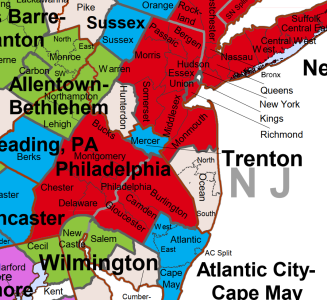
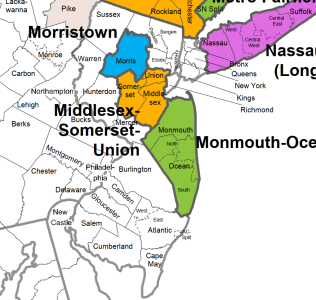
Here are the metro maps (Left with New York City and Philly [in red]... and right with them removed)
Hunterdon is not in any metro; Mercer is the sole county in the Trenton metro.
1740750059766.png1740750071718.png
 
I was under the impression that nearly every NJ county is in either the NYC metro or the Philadelphia metro. So I thought WKXW listeners in those counties are counted in either the New York ratings or the Philadelphia ratings.

Mercer and Hunterdon Counties, including Princeton and Trenton, are about 40 miles north of Philly, 50 miles south of NYC. The Philadelphia FM stations are easy to hear there and the NYC FMs are mostly available. But are Mercer and Hunterdon not in either metro ?
Under the impression? You could have checked the list of Nielsen radio markets.

You also seem to want to ignore the fact that seven out of 10 news/talk stations with the largest cume are public radio stations. Is that your own right-wing bias showing or your bias against public radio?
 
Did KNX have a similar bump in cume?
Yes, KNX had a cume of 1,230,700. It's #2 behind WINS NYC which had a cume of 1,873,200. But WINS and KNX were the only All-News stations over a million weekly listeners.

WBBM, while the #1 station in Chicago overall, had a cume of 827,700. KCBS, while the #2 station in San Francisco overall, had a cume of 675,600.

All-News stations used to be the champs in cume ratings, with so many people tuning in for 15 minutes here and there during the week, even if they weren't all that passionate about news. But not so any more. In San Francisco, KOIT had over a million in cume. In Chicago, four stations had over a million in cume.
 
Under the impression? You could have checked the list of Nielsen radio markets.

You also seem to want to ignore the fact that seven out of 10 news/talk stations with the largest cume are public radio stations. Is that your own right-wing bias showing or your bias against public radio?
I am left of center. But I view NPR stations as a different format. I also view All-News stations as a different format. Just as we consider Classic Rock, Alternative Rock and Active Rock as different formats, even if some artists are common among all three.

I specified commercial talk stations in my remarks.
 
I was under the impression that nearly every NJ county is in either the NYC metro or the Philadelphia metro.
For TV, yes. Definitely not for radio.
So I thought WKXW listeners in those counties are counted in either the New York ratings or the Philadelphia ratings.
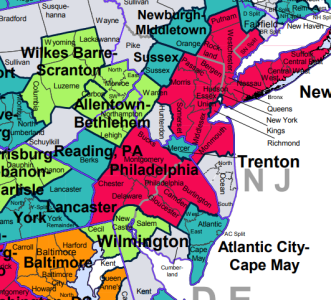
No, the is separate "Trenton" market ranked 147 and 330,000 12+ persons where that station is very dominant. They also get numbers from the Atlantic City market ranked 149. The station also appears in the Allentown, PA, market which includes part of NJ and in the Sussex survey.

A recent market map is at https://www.worldradiohistory.com/A...t-Maps/Nielsen-Radio-Market-Map-Fall-2022.pdf

Or, this close up

1740761497382.png

Mercer and Hunterdon Counties, including Princeton and Trenton, are about 40 miles north of Philly, 50 miles south of NYC. The Philadelphia FM stations are easy to hear there and the NYC FMs are mostly available. But are Mercer and Hunterdon not in either metro ?
Check the map. There are a whole lot of NJ counties not in either Philadelphia or NYC ratings books. They do not show in the "public" reports for all markets, as they don't subscribe to the fringe ones.
 
Status
This thread has been closed due to inactivity. You can create a new thread to discuss this topic.


Back
Top Bottom