• Get involved.
    We want your input!
    Apply for Membership and join the conversations about everything related to broadcasting.

    After we receive your registration, a moderator will review it. After your registration is approved, you will be permitted to post.
    If you use a disposable or false email address, your registration will be rejected.

    After your membership is approved, please take a minute to tell us a little bit about yourself.
    https://www.radiodiscussions.com/forums/introduce-yourself.1088/

    Thanks in advance and have fun!
    RadioDiscussions Administrators

kHz - MHz - Channel number

AFAIK, AM and FM have always used kHz and MHz (although the FCC uses channel numbers in FM translator IDs) and TV has always used channel numbers.

It might have been easier to use channel numbers for AM and FM (although the 10kHz to 9kHz change would have complicated AM channel numbers)

Anyone know why radio (and radio with pictures) ended up being labeled this way?


Kirk Bayne
 
AFAIK, AM and FM have always used kHz and MHz (although the FCC uses channel numbers in FM translator IDs) and TV has always used channel numbers.

It might have been easier to use channel numbers for AM and FM (although the 10kHz to 9kHz change would have complicated AM channel numbers)

Anyone know why radio (and radio with pictures) ended up being labeled this way?


Kirk Bayne
FM technically has a channel system of 200-300, otherwise I don't know why we chose frequency. Perhaps it just appeals better or something.
 
AFAIK, AM and FM have always used kHz and MHz (although the FCC uses channel numbers in FM translator IDs) and TV has always used channel numbers.
Well, before there were kHz and MHz, we used kc’s and Mc’s.😊

In the early days of radio, wavelength was used instead of frequency. Later both would be used together—I recall shortwave stations announcing both frequencies and wavelengths in the 1960s and 70s. The use of wavelength as a descriptor faded away in the 1980s onward.
It might have been easier to use channel numbers for AM and FM (although the 10kHz to 9kHz change would have complicated AM channel numbers)
Probably much less potential for confusion by using actual frequency, especially with different kinds of radios around the world. Channel numbering would likely be inconsistent and arbitrary.
Anyone know why radio (and radio with pictures) ended up being labeled this way?
Channel numbers for TV made sense due to the wide frequency band each channel occupied. And remember in the analog days, each channel had two separate transmitters for audio and video on different frequencies. Numbering was just easier in this case, especially since the TV tuners clicked into place for each channel, unlike radio.
 
FM stations announced channel numbers until at least the mid 1960s, from what I remember. Why, I have no idea, because nobody had a radio dial that showed them by that time. They make sense for translators because a callsign like W300xx is less cumbersome than W1079xx.
 
Before the war, when VHF replaced the 2 MHz band, TV used Roman numerals for channel numbers. That's another one that makes no sense.
And that, I believe, is why some early TV stations had call letters that were the Roman numeral equivalents of the channel number. I doubt that the average person "got" that, just as it takes a lot of explaining for nearly anyone to understand the numbering of Superbowl games.

And what is the Roman numeral for zero? If two gladiators fight, and kill each other, how many gladiators are left?
 
2MHz band???
In the 1928-35 era, mechanical television was assigned 4 channels, each 100 kHz wide, between 2 and 3 MHz. They were 2.0-2.1, 2.1-2.2, 2.75-2.85, and 2.85-2.95 MHz. Sound was usually transmitted on a co-owned or contracted AM station.

A 100 kHz channel bandwidth didn't allow for high definition TV. But mechanical television, mostly using Nipkow disks, couldn't produce more than 60 lines at 24 frames per second, anyway. Since transmissions were full-carrier AM, a maximum video bandwidth of 50 kHz was the best they could do.

The oldest station list that I've been able to find that showed VHF frequencies being used for television was for 1931.
 
This thread has been thoroughly informative and entertaining all at once. I thank you all!

I think I wrote this post in MMXXII, but someone enlighten me ;)
 
Hertz means, and is perfect shorthand for, cycles per second, although the abbreviations KHz, MHz, etc. is only a one character savings over Kcps, Mcps, etc.

Somehow, to me, 54, 60, 66, etc. MHz for TV channels is more awkward than channels 2, 3, 4, etc. although one could make the same argument for 600, 610, 620 etc. KHz for AM radio.
 
Last edited:
In AM & FM broadcast, the band plan is pretty "clean" - continuous with logical increments of 10kHz or 200kHz, and no more than 4 digits to identify a station. So receiver manufacturers and broadcasters didn't find it necessary to create a simplification for their end users.

But the TV band is sort of messy. There's a gap in frequency between (former) Channel 1 and 2, Channels 4 and 5, a big gap between Channels 6 and 7, and a huge gap between 13 and 14. It would be kind of weird to advertise "CBS 205.25 visual and 209.75 aural". "CBS 12" is a whole lot simpler.
 
I think the FCC assigned the channel numbers (200)201~300 to modern FM radio so it did not conflict with television channels (and for that matter AM stations, which many would drop the last zero in their promotions, "Radio 1-2-3" as opposed to 1230, etc. or let's sing... "K-F-W-B Channel 98" or "77 W-A-B-C <ding!>") Or perhaps, someone thought we would someday have TV channels above 83. Oh Molly, look at where we are now.

Some other countries that use the 200 kHz odd decimal method of doing FM (e.g. 88.1, 88.3, 88.5, etc.) have adopted the FCC's channel number format in their regulations, authorizations and data. Canada, Mexico and the Philippines immediately come to mind.
 
I think the FCC assigned the channel numbers (200)201~300 to modern FM radio so it did not conflict with television channels (and for that matter AM stations, which many would drop the last zero in their promotions, "Radio 1-2-3" as opposed to 1230, etc. or let's sing... "K-F-W-B Channel 98" or "77 W-A-B-C <ding!>") Or perhaps, someone thought we would someday have TV channels above 83. Oh Molly, look at where we are now.

Some other countries that use the 200 kHz odd decimal method of doing FM (e.g. 88.1, 88.3, 88.5, etc.) have adopted the FCC's channel number format in their regulations, authorizations and data. Canada, Mexico and the Philippines immediately come to mind.
Channel numbers would help end the awkward confusion with HD subchannels. Channel 250.2 is easier than 97.9-HD2. Though it would take another decade to transition and phase in new radios with channel numbers only.

SiriusXM went with channel numbers since the system was already comprehensible for the average consumer--being akin to being the cable TV of radio.
 
Channel numbers would help end the awkward confusion with HD subchannels. Channel 250.2 is easier than 97.9-HD2. Though it would take another decade to transition and phase in new radios with channel numbers only.
I'm old enough to remember FM stations using channel numbers on-air instead of frequencies. The last time I heard an FM station ID that way was in the mid 1960s. There were a few receivers that labeled channel numbers as well as frequencies for FM, but most of those were made in the 1950s. Outside of translator calls, it just never caught on.
 
Channel numbers would help end the awkward confusion with HD subchannels. Channel 250.2 is easier than 97.9-HD2. Though it would take another decade to transition and phase in new radios with channel numbers only.
I prefer the "HD" suffix. It's gives a little more meaning to the investment in HD Radio the station made and increases awareness of HD Radio with consumers. TV can get away with that because everyone had to change out their receiver.
 
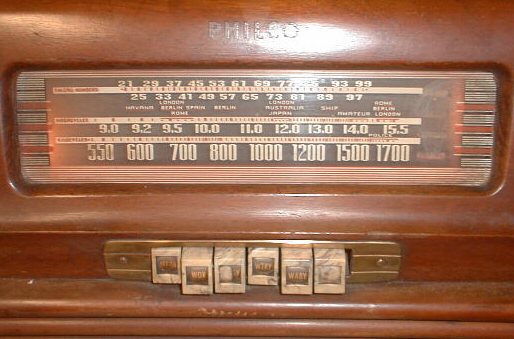
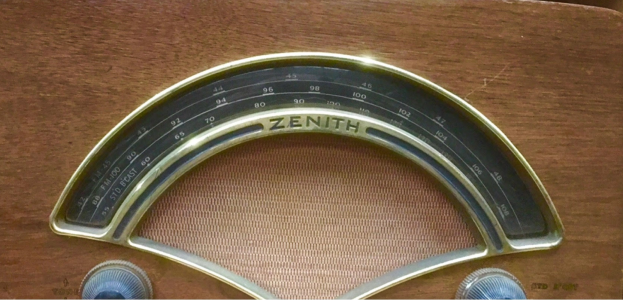
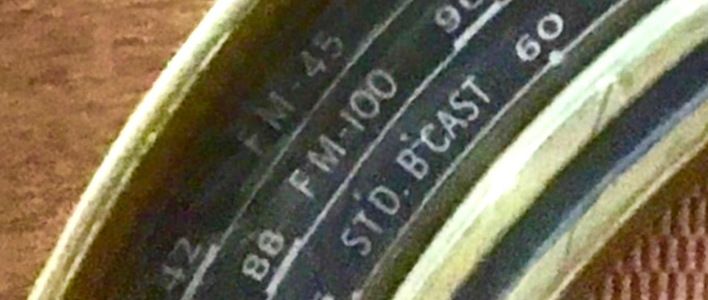
FM radio probably would've ended up primarily using channel numbers if it wasn't for the forced move from the 42-50 MHz Armstrong band to the 88-108 MHz band. The Armstrong band had channels numbered 21 to 99, matching the frequency minus the leading 4 -- i.e., channel 21 was 42.1 MHz. These numbers were printed on the dial of many prewar FM radios:

philco42-355dial.jpg


The channel numbers in the 88-108 MHz band don't match the frequency and are too long; there is no verbal savings by saying "channel 277" instead of "103.3".
 
Status
This thread has been closed due to inactivity. You can create a new thread to discuss this topic.


Back
Top Bottom