• Get involved.
    We want your input!
    Apply for Membership and join the conversations about everything related to broadcasting.

    After we receive your registration, a moderator will review it. After your registration is approved, you will be permitted to post.
    If you use a disposable or false email address, your registration will be rejected.

    After your membership is approved, please take a minute to tell us a little bit about yourself.
    https://www.radiodiscussions.com/forums/introduce-yourself.1088/

    Thanks in advance and have fun!
    RadioDiscussions Administrators

KIIS-FM Falls to #13 in Los Angeles Ratings?

In the latest Nielsen Ratings for Los Angeles, 102.7 KIIS-FM has fallen to #13, tied with KLVE 107.5 and behind Classical KUSC-FM. I wonder what triggered this drop off in listeners? In terms of billing, KIIS-FM, owned by iHeart, is usually #2 in the U.S. Were they not running contests? Is Top 40 hitting a boring time?

BTW, in its final full month on 97.1 FM, KNX is at #5. It will also have some numbers in the ratings released in June. But then it will have to survive on 1070 AM, 97.1-HD 2 and streaming on Audacy.com and iHeart.com.
 
You cannot look at one station in a bubble..

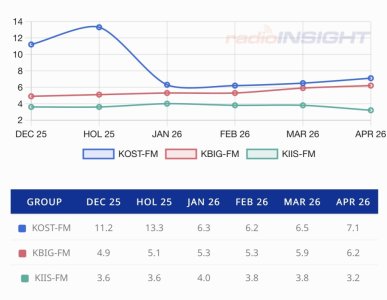
As noted here, KOST and KBIG had massive months. When one goes up something else must go down.

And since the iHeart "Wall of Women" is sold together most of the times and is considered a package, the important factor is to consider the three as a single buy. Add them up, and if the sum is within a one-point range of a multi-book average, nothing has changed.
 
Currently Top 40 is also in doldrums. When that happens, the ACs look more attractive to listeners for the fact it has more familiar and tolerable songs. iHeart was smart to own the CHR/AC formats in L.A.
 
And since the iHeart "Wall of Women" is sold together most of the times and is considered a package, the important factor is to consider the three as a single buy. Add them up, and if the sum is within a one-point range of a multi-book average, nothing has changed.
And moreorless within the margin they're normally at outside of Christmas.

la.jpg
 
We all should congratulate and compliment Lance on the new tables

My observation is that the tables and graphs illustrated cluster strength and that is important now that groups of stations are being sold as packages, not as single stations with separate sales staffs in most situations.
 
We all should congratulate and compliment Lance on the new tables

My observation is that the tables and graphs illustrated cluster strength and that is important now that groups of stations are being sold as packages, not as single stations with separate sales staffs in most situations.
Thank you. When @Huff first proposed the revamped ratings charts we always wanted to add these graphs. It took inspiration at a public radio conference a few weeks to build the platform and I was still making changes to it this morning. I hope to find additional ways to publish and distribute the data.

I'd love to hear suggestions for additional datasets that we could try to implement over time.
 
I love the new line charts @lanceventa. A running yearly average for each station would be cool. Are Eastlan's and Neilsen's margin of errors proprietary or not? It would be cool to have as part of the line chart.
 
I love the new line charts @lanceventa. A running yearly average for each station would be cool. Are Eastlan's and Neilsen's margin of errors proprietary or not? It would be cool to have as part of the line chart.
Margins of error are not "standard" or fixed.

While we can give "one standard error" in research. See http://www.stat.columbia.edu/~gelman/research/published/standarderror.pdf for a relatively straight explanation.

But there are further complications when we get to radio. First, the sample is not perfect. There is weighting, and the weighting for each station and cell is different. So there can not be a table of error variations. For example, a station loses more heavy listeners than Nielsen replaces them with as the panel turns over and the margin of error changes.

Long ago, the print ratings book had a table of error which showed for each increment in share what the actual range could be within one standard error. This is were we learned that a 1 share could be a 1.4 or a 0.6 without anything really changing in actual listening.
 
Thanks for explaining all that, David!
We have a unique group of radio pros, radio and podcast "newbies" and devoted listeners here. One of the hopes I have is that the listener group will find information on how the business works.
 
I love the new line charts @lanceventa. A running yearly average for each station would be cool. Are Eastlan's and Neilsen's margin of errors proprietary or not? It would be cool to have as part of the line chart.
To follow up with what David also said, we'd also have to build a database that can archive further back. And I may have found a tech loophole to do more historical archives (likely behind the paywall if we ever do), but the charts currently only store the past six months for

There would also be potential legal issues with our Nielsen license where if we had archived data from say a Cumulus station who is currently not subscribed to Nielsen and in a lawsuit with them, we may be in violation of our publishing agreement. It would also have gaps where their stations will have gaps while not subscribed.
We have a unique group of radio pros, radio and podcast "newbies" and devoted listeners here. One of the hopes I have is that the listener group will find information on how the business works.
And that has always been the goal here and one I've been trying to build back. When I started the first board in 1997 it was so me as a teenaged listener could learn as much about the industry as possible.

From the early days of the site I now know of "kids" who are station owners, Regional VP's, syndicated personalities, and others in positions across the industry. And that will be the lasting legacy of the site in its educational value to the industry with people being able to learn from @davideduardo, @fybush, @Huff and others that when the tech is done we'll be able to bring in.
 
Currently Top 40 is also in doldrums. When that happens, the ACs look more attractive to listeners for the fact it has more familiar and tolerable songs. iHeart was smart to own the CHR/AC formats in L.A.
This is a good period for mainstream pop music anyway, a lot of beautiful songs, and Z100 in New York is #4


Back
Top Bottom