
• Get involved.
    We want your input!
    Apply for Membership and join the conversations about everything related to broadcasting.

    After we receive your registration, a moderator will review it. After your registration is approved, you will be permitted to post.
    If you use a disposable or false email address, your registration will be rejected.

    After your membership is approved, please take a minute to tell us a little bit about yourself.
    https://www.radiodiscussions.com/forums/introduce-yourself.1088/

    Thanks in advance and have fun!
    RadioDiscussions Administrators

Kkht 100.7

KCTA still comes in like a local in Downtown Houston.

You have an unusually high estimation for weak signals.

A "local" signal today is at least 5 mV/m. In dense, noisy metros like Houston, about 10 mV/m or more is needed to overcome man-made interference.

The 5 mV/m signal for KCTA barely covers half of Matagorda County; it does not touch Barazoria, Wharton or Fort Bend counties at all. Even the 2 mV/m signal does not hit Ft. Bend County, although it does touch a small part of SW Brazoria County.
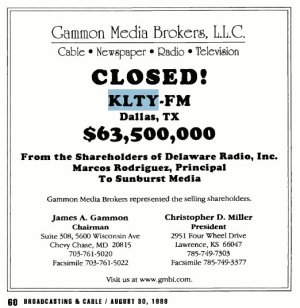
 
I don't remember what Sunburst paid Rodriguez,

There was a complex deal where Heftel got KFNT, KESS and KAND and 94.1 went to on to Sunburst. That total deal was $50 million.

... but I trust David when he said it got $65 million from HBC/Univision since he worked for them at the time.

Still do!
 
3) It certainly may. But then again, maybe it doesn't. I can't find any evidence to say either way. KCTA does very well, but I'm sure at least one Christian station that sells time is struggling.
Are you completely sure Salem is making money with this station?

There are actually quite-a-few brokered Christian stations that are struggling. None, however, are owned by Salem. The ones that are struggling tend to be standalone stations. It's much harder to sell airtime to preachers if you're just a single AM station having to compete with other forms of delivery.

Salem, however, sells most of its religious programming as a network. It's insanely profitable. If you're a well-to-do ministry, you can buy specific time slots across the entire company, which guarantees you'll be heard in nearly every major market in this country. That's a lot better reach than what you'll get just parking your programming on the internet and streaming it. Plus, if you deal with Salem, they'll handle your streaming for you, too, which guarantees you'll be heard on every major online radio platform. The business model for Salem's religious programming is centered around efficiency and mass delivery, and Salem is better at it than almost anybody else in the business. Plus, operating costs at the individual station level are minimal. Love it or hate it, Salem is incredible from a business standpoint.


There was a complex deal where Heftel got KFNT, KESS and KAND and 94.1 went to on to Sunburst. That total deal was $50 million.


In the end, Sunburst got KLTY alone for $63 million and change. KLTY.jpg
 
KCTA does very well, but I'm sure at least one Christian station that sells time is struggling.

In a market where the top biller does $100 thousand a month, KCTA bills about $6 thousand. That is nobody's definition of "very well".
 
Which station does $100k/month in Corpus Christi?

KRYS (slightly over $100 k per month), with KZFM and KMXR coming very close to $100 k monthly billing. KNCN and KKPN both do over $75 k a month.

KCTA is 28th in billings in that market.
 
Last edited:
Thank you. I can pull in KCTA as far east as Breaux Bridge, which is east of Lafayette on the banks of the Atchafalaya Basin.

What can be pulled in and what is viable are two separate things. A small percentage of the listening population may be willing to strain to hear distant programming that's unserved locally, but that doesn't make it viable from a business perspective. No one from a Corpus Christi station is going to hit the streets of Houston to sell its programming, and rent-a-preachers have several different pay models, none of which involve distant or fringe listening.
 
I'm amazed they were able to cover Midland to Hammond.

I'm impressed with the power KCTA has now. You can pull KCTA from Kerrville to Breaux Bridge, LA today.

KCTA still comes in like a local in Downtown Houston.

I guess a few of us buy better radios than the average consumer. I agree that with the single chip IC design - using one very slopply IF ceramic filters, shrinking ferrite bars, homes filled with RFI producing CFL bulbs and badly implemented home networks, insulated walls and attic with foil creating a virtual Faraday cage - it takes a very strong AM signal to even be heard in homes. And the shark fin / stub antennas on cars are completely inadequate for AM reception, and every road and highway is lined with power lines that have bad power factors and it seems every one of them has arc welding going on somewhere along the line - even car listening is deplorable in most locations.

With all of that going against it, KCTA is still a powerhouse, although a shell of its former signal. Too bad the programming is not a format that will ever be highly rated. I don't expect they would put shoes on the ground in Houston and San Antonio, although if they neglected to mention they are actually in Corpus, they could certainly sell to advertisers who wouldn't be the wiser. As long as the advertiser can walk out and tune their radio and hear a clear signal wedged between two other clear signals, I don't think they care where it comes from. Besides, I am hearing very few local commercials these days. Most are national products and services just buying ads across the country. A Geico ad is as valid in Houston as it is in Corpus.
 
I don't expect they would put shoes on the ground in Houston and San Antonio, although if they neglected to mention they are actually in Corpus, they could certainly sell to advertisers who wouldn't be the wiser. As long as the advertiser can walk out and tune their radio and hear a clear signal wedged between two other clear signals, I don't think they care where it comes from.

The station does not show in the Houston ratings. It has a pretty miserable signal indoors where there is man-made interference.

And I've never had a potential client want to tune in my station or stations while I was on a call.
 
What can be pulled in and what is viable are two separate things. A small percentage of the listening population may be willing to strain to hear distant programming that's unserved locally, but that doesn't make it viable from a business perspective. No one from a Corpus Christi station is going to hit the streets of Houston to sell its programming, and rent-a-preachers have several different pay models, none of which involve distant or fringe listening.

Yeah I certainly wouldn't expect Tomball Ford or World Car Kia to buy ads on KCTA.

I would, however, expect the Houston Texans to get upset if the New Orleans Saints Radio Network used KCTA as an affiliate.

You can pull in KNGT and WWL on the eastside of Houston on a fringe basis, but KCTA is indeed listenable enough all across Houston to cause a stir.
 
You can pull in KNGT and WWL on the eastside of Houston on a fringe basis, but KCTA is indeed listenable enough all across Houston to cause a stir.

KCTA is listenable across the metro in your good car radio? Or you think it is adequate on cheapo radio alarmclocks and radios sitting on desk in cube farms?

If I remember correctly, I tried KCTA last time I was visiting family in the Clear Lake area, (where a Corpus AM signal should be best) and it was only so so. This was on a very decent Sangean receiver.
 
I would, however, expect the Houston Texans to get upset if the New Orleans Saints Radio Network used KCTA as an affiliate.

You can pull in KNGT and WWL on the eastside of Houston on a fringe basis, but KCTA is indeed listenable enough all across Houston to cause a stir.

This would make me very happy.


In a market where the top biller does $100 thousand a month, KCTA bills about $6 thousand. That is nobody's definition of "very well".

I can assure you they are doing a lot more than 6k a month.

Is that the BIA estimate? I'm not sure those types of industry revenue estimates are very accurate with a station and format like KCTA.
 
Last edited:
I can assure you they are doing a lot more than 6k a month.

Is that the BIA estimate? I'm not sure those types of industry revenue estimates are very accurate with a station and format like KCTA.

That's very possible with the low billing stations... which likely don't participate in Miller Kaplan. Still, given the dimensions of the market with no station doing over $1,300,000 a year, it's still likely that the whole station is billing less than a General Manager in LA makes in a year-
 
Status
This thread has been closed due to inactivity. You can create a new thread to discuss this topic.


Back
Top Bottom