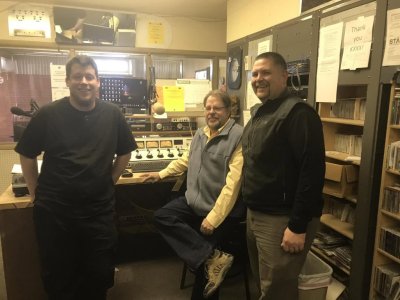
Why is there a mirror above the studio window, and what’s that piece of paper with drawings to the left of the mirror?
dont recall

Why is there a mirror above the studio window, and what’s that piece of paper with drawings to the left of the mirror?
I am surprised. If you have an AM station with a translator that is not "tied" to the AM licence and a class A, B, or C FM in the same town, it would be much cheaper to put the translator on HD 2 rather than pay the electric bill for the AM. The only exception could possibly be in an area where the soil conductivity is excellent and your AM's coverage is strong enough that the translator can legally have coverage farther than the 60 DM of the FM. I don't know if any such an operation but if there is such an operation please chime in.Moreover, HD is not all that common in rural areas
I am not sure of the timing but this station being a class D, they should have had an easy time getting a translator. The engineering would have been easy. Just go to radio-locator* enter Goodland KS and use 100 or 150 miles. Lots of "holes".This station was a part of the collapse of Rocking M Media in 2022, so hopefully the new licensee is better capitalized or has adequate insurance to make repairs.

I am not sure of the timing but this station being a class D, they should have had an easy time getting a translator. The engineering would have been easy. Just go to radio-locator* enter Goodland KS and use 100 or 150 miles. Lots of "holes".
* I know there is FCCdata.org but I believe the average "non radio experienced" person would find this easier. Of course if you are filing something with the FCC would have to use their site. I wish I knew about FCCdata the last time I did due diligence. It would have saved time finding stuff on the FCC site.
Yes, I saw one of those "golf balls" just last weekend during my annual drive through western Kansas on I-70 for the holidays.KLOE and KNAB were big rivals in the 70’s and early 80’s. KLOE was also one of the last AT-40 affiliates on AM with the affiliation lasting into the early 90’s. The friend and former co-worker who had previously worked at KLOE was always proud of his association with the station, even if the bulk of his ideas programming the station didn’t survive his tenure there.
The KKCI calls, by the way, date back to Bott ownership of the facility. The licenses for it and 107.7 were awarded at roughly the same time, and Bott unloaded 102.5 once it was clear that station would also be religious.
I haven’t driven through that area in almost 25 years, but I remember seeing what looked like large golf balls with “730/102.5” written on them every few miles on the north side of I-70 in Sherman County. Are those still around?
Thanks for the info! I've never heard of a station with 20 reel to reel machines before. Was the console linked to every broadcast booth?This is in response to radiofan2023's questions about the KXXX control room. I was an announcer at KXXX many, many years ago, in the 60's and 70's. The stations chief engineer, Vern Snyder, was a perfectionist, and the control room reflected that.
The mirror's purpose was to allow the person at the Collins console to see into the three broadcast booths at the back of the control room. Remember, this was back in the day of hand signals between the on air staff and the person at the console.
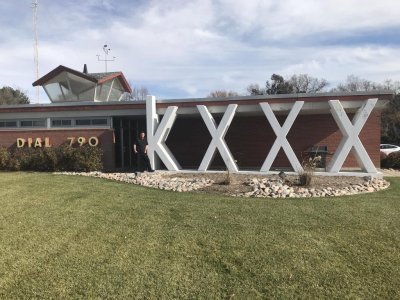
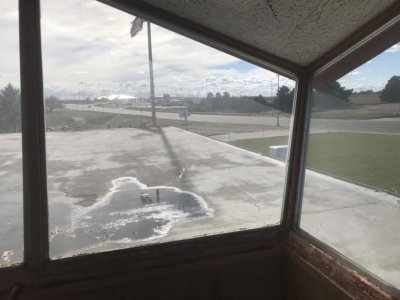
KXXX had six broadcast booths; three to the rear of the control room, a large area to the front of the control room for groups, the cupola seen above the building, and finally a recording/editing area that was not visible at the console.
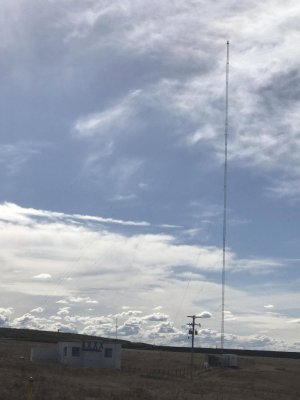
When I was at KXXX, the graphic sheet wasn't present, but I believe it's related to the rather complicated procedure that was required in the event that something brought the remote transmitter down. Vern designed a rotary dial system that used a dedicated phone line to the transmitter to bring the unit up, shut it down, and adjust the frequency.
The entire control room looks very different now. The main thing I noticed is the lack of more than 20 reel to reel machines in the huge rack to the right of the console. Back then, most commercial content was on 1/4" tapes, and had to be mounted and cued on the machines. The console operator then started the machines as needed. Also missing are the two huge turntables that were to the left of the console. They were able to handle the 18-20" vinyl platters that were used for 60 minute syndicated shows back then, as well as the 45's and 33's for music.
KXXX has a rich history, While I was there, we were visited by the likes of Walter Cronkite, Doug Edwards, Harry Reasoner, and Charles Karalt. I was in awe of Cronkite, Edwards, and Reasoner, but Karalt was my favorite. He was just 'one of the guys'.
Interestingly, I also had the opportunity to work at KLOE AM-TV in Goodland for a time, before leaving broadcasting.

 www.nwksradio.net
KLOE's license has officially been turned in for cancellation:
No reason given, but it's pretty obvious.