• Get involved.
    We want your input!
    Apply for Membership and join the conversations about everything related to broadcasting.

    After we receive your registration, a moderator will review it. After your registration is approved, you will be permitted to post.
    If you use a disposable or false email address, your registration will be rejected.

    After your membership is approved, please take a minute to tell us a little bit about yourself.
    https://www.radiodiscussions.com/forums/introduce-yourself.1088/

    Thanks in advance and have fun!
    RadioDiscussions Administrators

KOST 103.5

In the case of KIIS being light on the Blink-182 and Panic! tracks in 2007, that might have been because those songs were being covered well enough by KROQ, Star, and maybe even Jack FM and KBIG (well, maybe NOT KBIG, but I'm not sure) and with stations like Power and The Beat, etc, KIIS was still staying light on the mainstream tracks, dayparting more to times when adults and not kids would be listening more. Now these songs work a little better when mixed with what's playing today, and still have enough familiarity from KIIS and the other stations that played them that they just work.
Remember that KIIS always paid attention, on the air and in research, to Hispanics. It was more than Rick Dees calling himself "Ricardo Díaz" and was based on the knowledge that a slightly rhythmic lean worked a lot better in LA than a rock or alternative lean world and that too much rock-based CHR would blow away the Hispanics.

As you say, there were enough rock voices in the market, too.
 
When we flew out to California quite a few years ago, we had an early flight back the next day so we stayed at a hotel near LAX. The radios in the hotel were terrible, forget the brand, but we had been listening for the days we were there to KOST 103.5 in the rental car. We couldn't get KOST in the hotel room, on the North side of the hotel on the 10th floor, where we probably could have seen the tower if we had known where to look and if it hadn't been hazy. The stations on 103.1, now KDLE, and 103.9, now KRCD, were so strong, and the radio so unselective, that we couldn't get it.
 
When we flew out to California quite a few years ago, we had an early flight back the next day so we stayed at a hotel near LAX. The radios in the hotel were terrible, forget the brand, but we had been listening for the days we were there to KOST 103.5 in the rental car. We couldn't get KOST in the hotel room, on the North side of the hotel on the 10th floor, where we probably could have seen the tower if we had known where to look and if it hadn't been hazy. The stations on 103.1, now KDLE, and 103.9, now KRCD, were so strong, and the radio so unselective, that we couldn't get it.
103.1 was Santa Monica and 103.9 was Inglewood, so they probably overwhelmed that hotel room radio. Even in upscale hotels , the radio, when there is one, is usually crap.
 
103.1 was Santa Monica and 103.9 was Inglewood, so they probably overwhelmed that hotel room radio. Even in upscale hotels , the radio, when there is one, is usually crap.
Yep!

Those two A's were literally on top of you in the Baldwin Hills. Depending where Mr. Cat was staying, those hills shadow the Mt Wilson FMs rather well.

LAX is 28 miles from Mt Wilson, while the transmitter sites of 103.1 and 103.9 are a literal stone's throw away.
 
My recollection is that it was a Holiday Inn, about 10 stories high. It overlooked a subdivision of stucco sided single family houses that looked like they were built in the 1950s or 1960s. It seems like the sub was in LA, and the hotel was on the border, possibly in Inglewood, overlooking (not a giant car wash) the sub. It looks like on the satellite view they may have been torn down and some replaced, as their are many vacant lots. I remembered the street names were numbers in the sub. All I can think of is 103rd Street, because of the Charles Wright Band, but it wasn't. It was a mile or so East of the entrance to LAX.

I guess it's KDLD 103.1. I suspect that's a cochannel simulcast?
 
Last edited:
Remember that KIIS always paid attention, on the air and in research, to Hispanics. It was more than Rick Dees calling himself "Ricardo Díaz" and was based on the knowledge that a slightly rhythmic lean worked a lot better in LA than a rock or alternative lean world and that too much rock-based CHR would blow away the Hispanics.
That was generally the thought process behind the station I worked for in the 80s, KDON-FM. We more-or-less patterned ourselves after KIIS and Q-106/San Diego, with jingles from Z-100s Warp Factor. We were mainstream Top 40, with a bit more rhythmic lean. The station was based in Salinas, which percentage-wise has a higher concentration of Hispanic listeners than many markets. Watsonville, Castroville and the towns down the Salinas Valley, plus Hollister and Gilroy made it a high concentration of Hispanic listeners as well. But then you had Monterey (upscale, mixed race), Seaside (more Black/Filipino/Asian listeners but not a high percentage) and Santa Cruz (college town, bohemian, alternative). By 1989 our consultant (from LA) and the PD decided to drop all of the pop, rock and most of the non-dancy alternative pop tracks and go Churban. The station continues today as a "Rhythmic" Top 40, playing a lot of hip hop and R&B and for the most part ignores the more mainstream tracks unless they make a super dent on the charts, at which point they reluctantly play them a little bit. I'm glad that KIIS at least stayed truer to the format when a lot of others did not.
 
My recollection is that it was a Holiday Inn, about 10 stories high. It overlooked a subdivision of stucco sided single family houses that looked like they were built in the 1950s or 1960s. It seems like the sub was in LA, and the hotel was on the border, possibly in Inglewood, overlooking (not a giant car wash) the sub. It looks like on the satellite view they may have been torn down and some replaced, as their are many vacant lots. I remembered the street names were numbers in the sub. All I can think of is 103rd Street, because of the Charles Wright Band, but it wasn't. It was a mile or so East of the entrance to LAX.
It's probably still the Holiday Inn at 9901 S. La Cienega. The subdivision was between Arbor Vitae on the north and Century on the south. The streets were 93rd through 99th place. Google Street view now has the ability to toggle between capture dates---it looks like they took most of the houses out prior to 2008, with the few remaining taken down between then and 2015.
 
Actually, they were on the ropes before KFRC debuted. KYA had them (KEWB) on the run for a few years prior to that. In fact, Crowell-Collier sold it to Metromedia before KFRC went Top 40 and Billboard March 26, 1966 issue has a piece about KFRC going Top 40 and KEWB likely going MOR---which they did under the calls KNEW.
At one point before Bill Drake and Co started programming KFRC, they couldn't use "Boss Radio" like the other Drake/Chenault stations because upon hearing about LA's KHJ's success, KEWB dropped "Color Radio" and started calling themselves "Boss Radio" effectively ruining it for BD. (KEWB would run themselves into the ground). KFRC then had call to themselves "The Big 610". Fortunately, KFRC got to use the Johnny Mann Singers like the rest of the "Boss Radio" stations, and of course they were a huge success.
 
At one point before Bill Drake and Co started programming KFRC, they couldn't use "Boss Radio" like the other Drake/Chenault stations because upon hearing about LA's KHJ's success, KEWB dropped "Color Radio" and started calling themselves "Boss Radio" effectively ruining it for BD. (KEWB would run themselves into the ground). KFRC then had call to themselves "The Big 610". Fortunately, KFRC got to use the Johnny Mann Singers like the rest of the "Boss Radio" stations, and of course they were a huge success.


KEWB did pick up "Boss Radio" and "Boss 30" beginning in September of 1965, but KYA had been using "The Boss of the Bay" since 1960. So "Boss" was pretty well played out in San Francisco. In fact, it was an accident that it was used at KHJ. Clancy Ismuslind, the station's promotion director, had been ordered by RKO to get promotions going before Drake and Ron Jacobs got in the building. When Jacobs saw "Boss Radio", he exploded "Aw, man! That sh*t's 1960, man!"

KHJ was actually the only RKO station that used "Boss Radio". Besides KFRC, WOR-FM, New York, WRKO, Boston, CKLW, Detroit and WHBQ, Memphis did not. Two non-RKO stations that Drake consulted, KYNO, Fresno and KGB, San Diego, did.
 
Yep!

Those two A's were literally on top of you in the Baldwin Hills. Depending where Mr. Cat was staying, those hills shadow the Mt Wilson FMs rather well.

LAX is 28 miles from Mt Wilson, while the transmitter sites of 103.1 and 103.9 are a literal stone's throw away.
Before Santa Monica's KSRF 103.1 xmitter was moved to the Baldwin Hills, they were literally right above the hillside near the so-called California Incline. It was interesting that as you drove up the PCH it seemed like you would drive right under the antenna. (Almost but not quite) In this general location you could tune to 103.3 and hear KRUZ from SB without any interference, because you were about 200 feet below the center of radiation. (Of course only a radio idiot like myself would even remember something like this!)
 
KEWB did pick up "Boss Radio" and "Boss 30" beginning in September of 1965, but KYA had been using "The Boss of the Bay" since 1960. So "Boss" was pretty well played out in San Francisco. In fact, it was an accident that it was used at KHJ. Clancy Ismuslind, the station's promotion director, had been ordered by RKO to get promotions going before Drake and Ron Jacobs got in the building. When Jacobs saw "Boss Radio", he exploded "Aw, man! That sh*t's 1960, man!"

KHJ was actually the only RKO station that used "Boss Radio". Besides KFRC, WOR-FM, New York, WRKO, Boston, CKLW, Detroit and WHBQ, Memphis did not. Two non-RKO stations that Drake consulted, KYNO, Fresno and KGB, San Diego, did.
Michael,

You have been BRINGING IT on the topic of LA and California Radio history of late. Very interesting stuff. Thanks.
 
KEWB did pick up "Boss Radio" and "Boss 30" beginning in September of 1965, but KYA had been using "The Boss of the Bay" since 1960.
KEWB did pick up "Boss Radio" and "Boss 30" beginning in September of 1965, but KYA had been using "The Boss of the Bay" since 1960. So "Boss" was pretty well played out in San Francisco. In fact, it was an accident that it was used at KHJ. Clancy Ismuslind, the station's promotion director, had been ordered by RKO to get promotions going before Drake and Ron Jacobs got in the building. When Jacobs saw "Boss Radio", he exploded "Aw, man! That sh*t's 1960, man!"

KHJ was actually the only RKO station that used "Boss Radio". Besides KFRC, WOR-FM, New York, WRKO, Boston, CKLW, Detroit and WHBQ, Memphis did not. Two non-RKO stations that Drake consulted, KYNO, Fresno and KGB, San Diego, did.
T
So "Boss" was pretty well played out in San Francisco. In fact, it was an accident that it was used at KHJ. Clancy Ismuslind, the station's promotion director, had been ordered by RKO to get promotions going before Drake and Ron Jacobs got in the building. When Jacobs saw "Boss Radio", he exploded "Aw, man! That sh*t's 1960, man!"

KHJ was actually the only RKO station that used "Boss Radio". Besides KFRC, WOR-FM, New York, WRKO, Boston, CKLW, Detroit and WHBQ, Memphis did not. Two non-RKO stations that Drake consulted, KYNO, Fresno and KGB, San Diego, did.
Thanks for the info...I guess I always mistakenly though that KFRC was the only Drake station that did not use "Boss Radio"!

93KHJ and 136KGB were nearly carbon copies of each other, the only difference was that KGB's playlist seemed to be about 2 weeks or so behind KHJ's.

And I remember back in the day I thought it was cool that KYA, KRLA, and KCBQ seemed to copy each other in terms of their overall stations sound and similar promotions they ran. I frequently traveled to the three cities and at times it felt like you were listening to the same station!
 
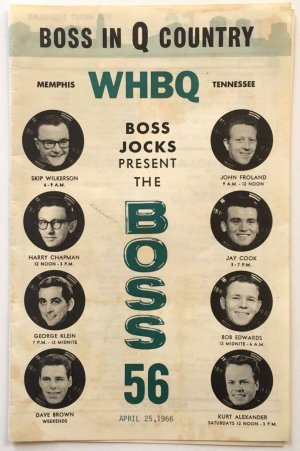
For a brief period in 1966, WHBQ here in Memphis was Boss Radio. By 1967, they were playing the Now 30.
 

Attachments

  • 1A2385CD-4999-40EF-A73A-63EDF04123CF.jpeg
    1A2385CD-4999-40EF-A73A-63EDF04123CF.jpeg
    190.3 KB · Views: 3
Thanks for the info...I guess I always mistakenly though that KFRC was the only Drake station that did not use "Boss Radio"!

93KHJ and 136KGB were nearly carbon copies of each other, the only difference was that KGB's playlist seemed to be about 2 weeks or so behind KHJ's.

And I remember back in the day I thought it was cool that KYA, KRLA, and KCBQ seemed to copy each other in terms of their overall stations sound and similar promotions they ran. I frequently traveled to the three cities and at times it felt like you were listening to the same station!
Drake worked out the format basics at KGB before getting KHJ (on the recommendation of KGB's owner, Willet Brown, who was on the Board of Directors at RKO). KGB didn't start using "Boss" until it worked for KHJ.

Not surprising that KGB would be a bit behind. San Diego is a more conservative market and L.A. was much more about what's new musically.

As for KYA, KRLA and KCBQ, there weren't a lot of ways to counter-program Drake, so it's natural they sort of followed similar paths.
 
For a brief period in 1966, WHBQ here in Memphis was Boss Radio. By 1967, they were playing the Now 30.
RKO didn't give WHBQ to Drake until '67. Same with WRKO, which was also "Now". I'm thinking Drake made the change in Memphis. He liked "Now" and "Big" (The Big 610, KFRC, The Big 8, CKLW, The Big Town Sound OR-FM).
 
Before Santa Monica's KSRF 103.1 xmitter was moved to the Baldwin Hills, they were literally right above the hillside near the so-called California Incline. It was interesting that as you drove up the PCH it seemed like you would drive right under the antenna. (Almost but not quite) In this general location you could tune to 103.3 and hear KRUZ from SB without any interference, because you were about 200 feet below the center of radiation. (Of course only a radio idiot like myself would even remember something like this!)

KSRF...KDLD History Card.


In the days when stations used Horizontally Polarized Only Bays, there was a very deep null straight up and straight down. When they started using "Circularly Polarized" Bays, CP was an approximation, and there was a certain substantial straight upward and straight downward radiation, much weaker than in the Horizontal direction, but still strong right below the tower. If a single CP Bay ERP is 6 kW for example, a 20 dB/0.1 relative field null would be 60 watts ERP. The other variables are the number of bays and the electrical distance between the Bays. For full wavelength spacing, this also results in a low radiation level null/minimum at between 20 to 30 degrees from straight down in most cases, depending once again on number of bays and spacing of bays.
 
Last edited:
Thanks, ChannelFlipper. As I tell people, it's not so much that I know stuff as that I know where to look it up.
Care to tell us your "secret source" recipe?
 
KSRF...KDLD History Card.


In the days when stations used Horizontally Polarized Only Bays, there was a very deep null straight up and straight down. When they started using "Circularly Polarized" Bays, CP was an approximation, and there was a certain substantial straight upward and straight downward radiation, much weaker than in the Horizontal direction, but still strong right below the tower. If a single CP Bay ERP is 6 kW for example, a 20 dB/0.1 relative field null would be 60 watts ERP. The other variables are the number of bays and the electrical distance between the Bays. For full wavelength spacing, this also results in a low radiation level null/minimum at between 20 to 30 degrees from straight down in most cases, depending once again on number of bays and spacing of bays.
That reminds me of the antenna system we developed and built in Ecuador around 1965/66 for the first FMs in that country. We had a hilltop location about 800 feet above the center of Quito, and we put up towers with masts at the top. On the mast, we had four vertical elongated "loops", one every 90° and separated by a full wavelength square "shield" that looked like jail cell bars.

There was no horizontal polarization. We had tested, and found that in our "deep up in the Andes" location, that was vastly better than horizontal.

The studios for the FMs was just under the two towers, about 60 feet high. So we put down chain link fencing, spot welded it together and covered the roof with it.

Almost everything was built with materials available in an auto supppy store (copper and aluminum tubing) a farm supply store (fencing) and a plumbing supply shop (tubing to make our own tower and mast. We hired a welder to put it all together.
 
Status
This thread has been closed due to inactivity. You can create a new thread to discuss this topic.


Back
Top Bottom