• Get involved.
    We want your input!
    Apply for Membership and join the conversations about everything related to broadcasting.

    After we receive your registration, a moderator will review it. After your registration is approved, you will be permitted to post.
    If you use a disposable or false email address, your registration will be rejected.

    After your membership is approved, please take a minute to tell us a little bit about yourself.
    https://www.radiodiscussions.com/forums/introduce-yourself.1088/

    Thanks in advance and have fun!
    RadioDiscussions Administrators

Central Coast KPYG applies to downgrade

KPYG (Cayucos), which rebroadcasts the legendary Monterey Bay-area station KPIG, has applied to move its transmitter site to near Atascadero, the current location of co-owned station KXDZ, and downgrade from B1 to A status with 5 kw. KPYG currently has minimal coverage in northern San Luis Obispo County. (None in Paso Robles, in my experience.) This move will remedy that situation, at the cost of losing coverage in the Baywood-Los Osos area. San Luis Obispo would continue to be covered. Judging by the resulting contours, reception in Morro Bay and Cambria would be affected, but not Cayucos just to the north-northwest of Morro Bay. The net result, according to Dimes' filing, is an increase in potential audience of just under 6%. Dimes estimates that it would save $23,500 in costs as a result of this move.

Accompanying this application is a request to swap cities of license for KPYG and KWWV (Santa Margarita), both owned by Dimes Media Corporation. Dimes' request states, "KPYG's proposed collocation with commonly owned station KXDZ will allow KPYG to continue serving a substantial portion of its existing 60 dBµ service contour and will avoid wasting much of its signal over water as is currently the case."

An accompanying application for KWWV would increase its power and coverage slightly.

Paso Robles and Templeton ("wine country") would seem to be a natural audience for KPYG's programming; AAA KKAL may feel some effect once KPYG is available in those communities.
 
KPYG (Cayucos), which rebroadcasts the legendary Monterey Bay-area station KPIG, has applied to move its transmitter site to near Atascadero, the current location of co-owned station KXDZ, and downgrade from B1 to A status with 5 kw. KPYG currently has minimal coverage in northern San Luis Obispo County. (None in Paso Robles, in my experience.) This move will remedy that situation, at the cost of losing coverage in the Baywood-Los Osos area. San Luis Obispo would continue to be covered. Judging by the resulting contours, reception in Morro Bay and Cambria would be affected, but not Cayucos just to the north-northwest of Morro Bay. The net result, according to Dimes' filing, is an increase in potential audience of just under 6%. Dimes estimates that it would save $23,500 in costs as a result of this move.

Accompanying this application is a request to swap cities of license for KPYG and KWWV (Santa Margarita), both owned by Dimes Media Corporation. Dimes' request states, "KPYG's proposed collocation with commonly owned station KXDZ will allow KPYG to continue serving a substantial portion of its existing 60 dBµ service contour and will avoid wasting much of its signal over water as is currently the case."

An accompanying application for KWWV would increase its power and coverage slightly.

Paso Robles and Templeton ("wine country") would seem to be a natural audience for KPYG's programming; AAA KKAL may feel some effect once KPYG is available in those communities.
What about Pismo Beach, I can get it in my truck but not my house? Many times it's a weak signal to that truck and my G.F.'s car too
 
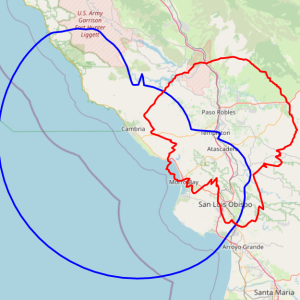
Here's the map from fccdata.org. Blue is the existing signal, red is the changed facilities applied for.

1756145243196.png

It looks to me like the signal will be reduced further in your direction, but Pismo Beach has always been at the limit of the protected signal contour anyway. Obviously, the idea is to get a signal into Paso Robles, which is a higher-populated area.

It's not uncommon for FMs to be received in car radios in fringe signal areas better than indoors. Building infrastructure kills most weak signals.
 
I first got turned on to the Pig...or then the Otter when I was framing house in Santa Maria in the way back years, maybe 1998 or before. It wasn't even showing up down here in Pismo. The station reminded me so very much of the 1969 or so just showing up F.M. station of which one was very good down in San Diego. Wild stuff like playing "Alice's Restraunte" for like three times because the disk jocky said that he was on acid! No selling anything, just music that wasn't on A.M radio.
 
Thanks so much for the graphic. Sounds like they are also trying to get their pay steaming stuff on us down here. I've bought an omni antenna to try to pick up my fav station. Not working out so well. Any thing to be able to pick it up...direct direction one? I' working on getting it up higher but is their mapping figures for the relay repeater? Thanks so much
 
I' working on getting it up higher but is their mapping figures for the relay repeater?

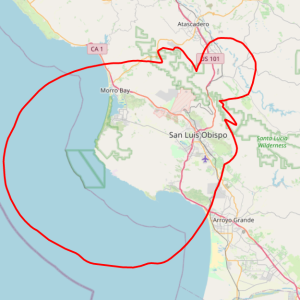
This is the present service contour for the on-channel booster (the proper term).

1756179892166.png

But if you were hoping that the booster would be reoriented toward Pismo Beach, I am afraid that is not possible under FCC regulations. The booster's signal has to be within the primary station's protected contour.
 
The nice thing about boosters is that when the contour spills over into open waters the booster contour can exceed the primary station contour. In this case they'll have to throttle back the booster ERP because of the reduced southwest footprint.
 
The nice thing about boosters is that when the contour spills over into open waters the booster contour can exceed the primary station contour. In this case they'll have to throttle back the booster ERP because of the reduced southwest footprint.

And/or reorient the directional antenna, which is allowed for translators to remain within the primary station footprint.

It's also possible the new transmitter site will not be terrain shielded from the area the booster was designed to fill in.
 
After the move is complete, would a low power translator just for Cambria and San Simeon be feasible? Or would there be too much fringe signal covering those towns for the capture effect to fully overcome the main signal?
 
After the move is complete, would a low power translator just for Cambria and San Simeon be feasible? Or would there be too much fringe signal covering those towns for the capture effect to fully overcome the main signal?

No. Commercial stations are not allowed to be rebroadcast on a translator with coverage outside the originating station's primary contour. (Non-comms can, however.)
 
It's also possible the new transmitter site will not be terrain shielded from the area the booster was designed to fill in.
Based on the maps and my knowledge of the area, it will be terrain-shielded from the Los Osos-Baywood area, which is most of the booster's coverage area except for San Luis Obispo proper. A cautionary note: maps don't always tell the whole story.

I'm not so sure that reception of the new KPYG signal in San Luis Obispo will be so great, for that matter. The new KPYG site is the present KXDZ site; KXDZ simulcasts KXTZ in Pismo so the reduced south county coverage isn't an issue for that station. As fpr KPYG, its booster could still be in place but coverage would have to be limited to SLO. I suspect they'd want to move it into town (today it's on Cuesta Peak) if Dimes wanted to keep using it.

One assumption that's been present in this discussion...and, to be fair, I've made that assumption, too...is that Dimes will retain the KPIG simulcast on KPYG. Something else could be planned, though.
 
No. Commercial stations are not allowed to be rebroadcast on a translator with coverage outside the originating station's primary contour. (Non-comms can, however.)
Thanks. I am surprised an exception does not exist for this specific situation. It seems reasonable to let a translator be placed to retain previous coverage lost following an adjustment to a primary pattern whose new footprint basically still serves most of the same area previously covered.
 
Thanks. I am surprised an exception does not exist for this specific situation. It seems reasonable to let a translator be placed to retain previous coverage lost following an adjustment to a primary pattern whose new footprint basically still serves most of the same area previously covered.

Been there, done that. FCC doesn't make exceptions for boosters, because they are specifically defined as on-channel simultaneous transmissions designed to fill in areas of the primary station contour that are terrain shielded.

Found this out way back in 1987, when the station I was both on-air talent and Chief Operator of moved its primary transmitter to a different location and found that they had lost an area with significant listening (a co-channel station from an adjacent market suddenly came in to that area as if it were a local). Owner tried to get an exemption to reorient a directional booster that was now at the edge of the new contour using that same argument, and the Media Bureau's response was essentially "you should have thought of that before you filed to move" and politely suggested that since there was no license to cover yet, they could move back to where they were if it was that important.

As near as I can tell, the attitude toward on-channel boosters has not changed in the intervening four decades. I'm sure @fybush can shed more light on the subject.


Back
Top Bottom