
Your "25.6" is referring to the stats in Huff's post (#14) on the first page. And in that excerpt from the ratings, it says (rather unclearly, due to smudging) that those are average quarter hour shares. Most people don't limit their listening to one and only one station, and teens were notorious for switching between stations whenever the music stopped (like for news). So that 25.6 average number for KFRC is made up of a larger number of actual teens (for argument sake, let's say it was 40.0) that were also part of KYA's 10.1 and KLIV's 9.9 and KIOI's 5.0 and KSAN's 4.8. (One thing that's also likely is that KYA's nighttime audience had very little overlap with KLIV's, due to their respective impaired nighttime signals.)Well, a 25.6 in teens means just over a quarter of them did. If you add up KYA, KLIV and KSFX (then doing a Top 40), you get a 26 there.
KFRC had the largest single teen audience, but a lot of them were listening to other stations.

-
Get involved.
We want your input!
Apply for Membership and join the conversations about everything related to broadcasting.
After we receive your registration, a moderator will review it. After your registration is approved, you will be permitted to post.
If you use a disposable or false email address, your registration will be rejected.
After your membership is approved, please take a minute to tell us a little bit about yourself.
https://www.radiodiscussions.com/forums/introduce-yourself.1088/
Thanks in advance and have fun!
RadioDiscussions Administrators
You are using an out of date browser. It may not display this or other websites correctly.
You should upgrade or use an alternative browser.
You should upgrade or use an alternative browser.
KSAN vs KFRC The Golden Years
- Thread starter MasterDJ
- Start date

Well, they were 22nd by that point---not sure that counts as acceptable, much less impressive.It's impressive that both stations held on with acceptable ratings as long as they did. As you mentioned, KFRC had terrain on its side. Terrain isn't an issue in Chicagoland. For WLS to maintain, even as an AC, in 1987....impressive. They did something right.
Those AM stations---especially the giants---were kind of like a jet cruising at 35,000 feet. Once you cut the engines, unless you point the nose straight down, it'll take a while before you hit the ground.
KFRC peaked with an 8.4 in the spring of '78. If you look at year-over-year spring books from there to spring of '84, the trend is clear:
8.4-5.8-4.4-4.8-4.2-4.2-3.4
....and after falling out of the top ten:
2.8-1.9-1.6
And after that, the flip to Standards, where they did very well.
Last edited:
That was also the fate of WNBC. They fired Howard Stern in 1985, and the music mellowed after that.
By that stage, the thinking was the only audience for music on AM was 25-54, so the move to AC was logical. Except that those folks were migrating to FM fast, too.
They were AC in 1987. But the final blow came in 1988 when the station was sold to Emmis and the new owners transferred the sports talk format from 1050 to 880.
660. 880 is
Emmis also bought NBC's KYUU San Francisco, and changed the station to X-100.
And that was a disaster. Two and a half years, never breaking a three share, never in the top ten, always getting beaten by not only KMEL but by KITS before it went Modern.
Sold to Bedford, flipped to Oldies as KFRC-FM and did very well.
Last edited:
660. 880 is WINS.
Actually it's WCBS. WINS is 1010. But you're right about 660, and I fixed it in my post.
Your "25.6" is referring to the stats in Huff's post (#14) on the first page. And in that excerpt from the ratings, it says (rather unclearly, due to smudging) that those are average quarter hour shares. Most people don't limit their listening to one and only one station, and teens were notorious for switching between stations whenever the music stopped (like for news). So that 25.6 average number for KFRC is made up of a larger number of actual teens (for argument sake, let's say it was 40.0) that were also part of KYA's 10.1 and KLIV's 9.9 and KIOI's 5.0 and KSAN's 4.8. (One thing that's also likely is that KYA's nighttime audience had very little overlap with KLIV's, due to their respective impaired nighttime signals.)
Average quarter-hour shares are the percentage of a demographic tuned to a station in any given quarter-hour averaged out over the whole week (Monday through Sunday 6AM to Midnight).
In the Jan/Feb 1974 Arbitron Huff posted, in teens, KFRC has a 25.6.
Using that same yardstick, KYA has a 10.1, KLIV has a 9.9 and KSFX has a 4.0. I didn't mention KIOI or KSAN, but just used stations then doing top 40. If you want to fold them in, there's an extra 9.8 for a total of 33.8.
Would some of those stations have shared audience? Absolutely. Those aren't exclusive listening numbers and they don't need rounding up or guessing that maybe KFRC had a 40. That would be inaccurate. Arbitron gave us a clear measurement.
My comment was directly to Tomas Estefan's comment that:
"...like the ratings show (and like I always thought) every kid listened to KFRC !"
And my point was----no, they didn't. But KFRC did as well as any major-market (NY, LA, Chicago, Philadelphia, SF) Top 40 station in January/February 1974 in teens. A quick check of the ARB breakouts in R&R (worldradiohistory-dot-com) shows:
KFRC: 25.6
WLS: 25.6
WCFL: 22.2
WABC: 22.1
WFIL: 21.7
KHJ: 19.5
WIBG: 14.8
KKDJ: 13.5
KYA: 11.1
KLIV: 10.9
Yes, the average percentage of the universe of listeners who listened during the week. That's an important distinction.Average quarter-hour shares are the percentage of a demographic tuned to a station in any given quarter-hour averaged out over the whole week (Monday through Sunday 6AM to Midnight).
Yes, on average 256 out of every 1000 teens who listened to radio had KFRC on. On average.In the Jan/Feb 1974 Arbitron Huff posted, in teens, KFRC has a 25.6.
Same comment. KYA had an average of 101 out of every thousand, KLIV an average of 99, etc.Using that same yardstick, KYA has a 10.1, KLIV has a 9.9 and KSFX has a 4.0. I didn't mention KIOI or KSAN, but just used stations then doing top 40. If you want to fold them in, there's an extra 9.8 for a total of 33.8.
But I was commenting on cume. What was the total number of teens (expressed as a percentage, not a raw number the way Arbitron displayed it) that listened to KFRC in the ratings period, out of the universe of all teens that listened to the radio in that same period? I took a SWAG of 40%, and my number could be wrong. But my point was that the total percentage of all teens who turned on KFRC at some point in the survey period, for some minimum number of minutes over the survey period, was a bigger number that the average number of teens listening during that same period. (I hope that's clearer.)Would some of those stations have shared audience? Absolutely. Those aren't exclusive listening numbers and they don't need rounding up or guessing that maybe KFRC had a 40. That would be inaccurate. Arbitron gave us a clear measurement.
It's the difference between a pie chart and a bar chart. The pie will always be 100%. The bar chart could add up to a bigger total because I may be listening to KFRC for a couple of hours, KYA for another hour, and KIOI and KLIV for a half hour each, and I'd be reflected as a +1 in each of those bars, so the total is very likely to be bigger than 100%. (Unless the bars represented the percentage of my listening that went to each station, in which case I could be a +0.4 in one, +0.3 in another, 0.15 in the other two, etc.
Not disputing that. But even the ones never listening to KFRC (or possibly even KYA, because they'd broken the AM-FM switch off their radios) were still flipping between KMEL, KIOI, KSFX and/or KSAN, so they'd be tallied as +1 in each of those cume columns on the bar chart.My comment was directly to Tomas Estefan's comment that:
"...like the ratings show (and like I always thought) every kid listened to KFRC !"
And my point was----no, they didn't. But KFRC did as well as any major-market (NY, LA, Chicago, Philadelphia, SF) Top 40 station in January/February 1974 in teens. A quick check of the ARB breakouts in R&R (worldradiohistory-dot-com) shows:
KFRC: 25.6
WLS: 25.6
WCFL: 22.2
WABC: 22.1
WFIL: 21.7
KHJ: 19.5
WIBG: 14.8
KKDJ: 13.5
KYA: 11.1
KLIV: 10.9
But I was commenting on cume.
Which is not shown anywhere in Huff's screenshot, and given that quarter-hour share, the only number we do have, is a factor of cume and time spent listening, I don't know how you'd extrapolate cume from it.
What was the total number of teens (expressed as a percentage, not a raw number the way Arbitron displayed it) that listened to KFRC in the ratings period, out of the universe of all teens that listened to the radio in that same period? I took a SWAG of 40%, and my number could be wrong. But my point was that the total percentage of all teens who turned on KFRC at some point in the survey period, for some minimum number of minutes over the survey period, was a bigger number that the average number of teens listening during that same period. (I hope that's clearer.)
Okay, that's clearer. But I'm not sure it's meaningful, helpful or accurate. And even if it were a reliable number, it gives KFRC a plurality of teens, not a majority and certainly not all of 'em.
Stations with lower cume can beat ones with higher cume if their audience listens significantly longer.
KFRC's teen cume in that book could have been more than, less than or equal to KYA's.
I'd bet on KFRC having higher cume, not lower or equal, but we can't know unless we obtain the actual cume numbers (anyone got the actual Jan/Feb '74 ARB for San Francisco handy?).

The nearest cume example I have is Apr/May 1973:I'd bet on KFRC having higher cume, not lower or equal, but we can't know unless we obtain the actual cume numbers (anyone got the actual Jan/Feb '74 ARB for San Francisco handy?).
12+
KFRC: 952,100
KYA: 676,200
P12-17
KFRC: 334,900
KYA: 286,700
In that book, KFRC had a 26.7 share of teens, which equaled a 3.1 rating.; KYA had a 20.1 share, 2.3 rating.
The total teen cume was 505,200... which in theory means KFRC had 66% reach, KYA had 57%.
In other words, at any given time in the Spring of '73, nearly 27% of teens were listening to KFRC. Over the course of a week, 2/3 of teens sampled KFRC.
Also interesting—-on a percentage basis, teens made up more of KYA’s total audience than they did KFRC’s.The nearest cume example I have is Apr/May 1973:
12+
KFRC: 952,100
KYA: 676,200
P12-17
KFRC: 334,900
KYA: 286,700
In that book, KFRC had a 26.7 share of teens, which equaled a 3.1 rating.; KYA had a 20.1 share, 2.3 rating.
The total teen cume was 505,200... which in theory means KFRC had 66% reach, KYA had 57%.
In other words, at any given time in the Spring of '73, nearly 27% of teens were listening to KFRC. Over the course of a week, 2/3 of teens sampled KFRC.
The nearest cume example I have is Apr/May 1973:
12+
KFRC: 952,100
KYA: 676,200
P12-17
KFRC: 334,900
KYA: 286,700
In that book, KFRC had a 26.7 share of teens, which equaled a 3.1 rating.; KYA had a 20.1 share, 2.3 rating.
....and now that I've had sleep and coffee, that stat jumps out at me. KFRC's teen AQH share in April/May '73 was 26.7, and KYA's was 20.1.
Eight months later (Jan/Feb '74), KFRC's teen AQH share was 25.6 (off by 1.1), but KYA's had plunged to a 10.1---a ten-point and almost 50% drop.
KYA's freefall in the early 70s was pretty dramatic.. from just 0.1 shy of KFRC at the end of 1970 to below a 2 share five years later.Eight months later (Jan/Feb '74), KFRC's teen AQH share was 25.6 (off by 1.1), but KYA's had plunged to a 10.1---a ten-point and almost 50% drop.
KFRC 12+shares = blue, KYA = red
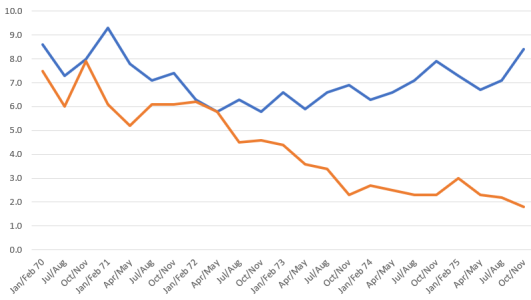
KYA's freefall in the early 70s was pretty dramatic.. from just 0.1 shy of KFRC at the end of 1970 to below a 2 share five years later.
KFRC 12+shares = blue, KYA = red
View attachment 6199
KYA doesn't get enough credit for how big a fight it put up. They kept it close despite a weaker signal and some of the best PDs RKO could transfer into KFRC (Ted Atkins, Paul Drew, Sebastian Stone).
As David has said, changing methodology (a wider survey area playing to KFRC's superior signal) played a part, but if you look at the trend line, KFRC's rise and KYA's decline coincide with the arrival of Michael Spears as PD and, a few months later, Dr. Don Rose in mornings.
As I failed to note, they did tie KFRC in Apr/May '72.KYA doesn't get enough credit for how big a fight it put up. They kept it close despite a weaker signal and some of the best PDs RKO could transfer into KFRC (Ted Atkins, Paul Drew, Sebastian Stone).
Credit for that goes to KYA’s PD, Julian Breen, who arrived in late ‘71.As I failed to note, they did tie KFRC in Apr/May '72.
One other note: Drake was gone from RKO by the time KFRC could claim decisive victory. One of the few stations in the chain that was considerably stronger post-Drake.
Mike, you've got to stop doing that, dude. Save the clear-headed thinking for the newscasts.....and now that I've had sleep and coffee,

With 50 years of retrospect, there came a point where signal strength trumped everything else, and 1973-74 seems to have been it in the SFBA market. KYA's little penny-whistle night signal not only couldn't compete with KFRC's not-exactly-flamethrower on 610, but the new competition from FM was mostly taking listeners from KYA (and KNEW, KLIV, etc.), not KFRC. At least not for another half dozen-or-so years....that stat jumps out at me. KFRC's teen AQH share in April/May '73 was 26.7, and KYA's was 20.1.
Eight months later (Jan/Feb '74), KFRC's teen AQH share was 25.6 (off by 1.1), but KYA's had plunged to a 10.1---a ten-point and almost 50% drop.
The same phenomenon happened a few years earlier in New York City. Up till about 1968, WMCA was viable. WOR-FM, WNEW-FM, WABC-FM, and a bit later WCBS-FM, WPIX and WBLS ate their lunch. WABC was able to ride out the trend for another decade, but it eventually knocked them off their perch too. So 50,000 watts was sustainable against all the new FM choices, but 5,000 just wasn't (as Southern & Pacific discovered with WWDJ a couple of years later).
I'm no expert on most other markets, but as I understand it, the story repeated, with localized mutations, all over the country. Prime example: KHJ.

5 kw on 610 is equal to something over 60 kw on 1260.KYA's little penny-whistle night signal not only couldn't compete with KFRC's not-exactly-flamethrower on 610.
The main reason is that the "new" Arbitron survey covered a much larger metro where WMCA had no signal. You could hear WABC and you could hear the FMs.The same phenomenon happened a few years earlier in New York City. Up till about 1968, WMCA was viable. WOR-FM, WNEW-FM, WABC-FM, and a bit later WCBS-FM, WPIX and WBLS ate their lunch.
WWDJ was killed by a much higher frequency and a horribly restricted directional patternWABC was able to ride out the trend for another decade, but it eventually knocked them off their perch too. So 50,000 watts was sustainable against all the new FM choices, but 5,000 just wasn't (as Southern & Pacific discovered with WWDJ a couple of years later).
The big issue was the expanded metro area that agencies saw once they adopted Arbitron and abandoned Pulse and Hooper. Most AMs do not cover their whole market.I'm no expert on most other markets, but as I understand it, the story repeated, with localized mutations, all over the country. Prime example: KHJ.
50,000 watts was sustainable against all the new FM choices, but 5,000 just wasn't
Now 50 years later, those FMs aren't sustainable either. Which is why those 50K AMs are all just dead meat.
With 50 years of retrospect, there came a point where signal strength trumped everything else, and 1973-74 seems to have been it in the SFBA market. KYA's little penny-whistle night signal not only couldn't compete with KFRC's not-exactly-flamethrower on 610, but the new competition from FM was mostly taking listeners from KYA (and KNEW, KLIV, etc.), not KFRC. At least not for another half dozen-or-so years.
The same phenomenon happened a few years earlier in New York City. Up till about 1968, WMCA was viable. WOR-FM, WNEW-FM, WABC-FM, and a bit later WCBS-FM, WPIX and WBLS ate their lunch. WABC was able to ride out the trend for another decade, but it eventually knocked them off their perch too. So 50,000 watts was sustainable against all the new FM choices, but 5,000 just wasn't (as Southern & Pacific discovered with WWDJ a couple of years later).
I'm no expert on most other markets, but as I understand it, the story repeated, with localized mutations, all over the country. Prime example: KHJ.
Pretty much. The difference with KHJ was multiple competitors, and some not even in the same format. KHJ was always defending against KGFJ, and after 1974, against KDAY, because R&B records were big in that market at that time. And KLOS's rise after launching the Rock n' Stereo format in fall of '71 prompted KHJ to adjust to defend against them for the rest of that year and most of 1972.
That's in addition to direct Top 40 competition from KBLA (1965-67), KFWB (1965-1968), KRLA (1965-1971), KDAY (1968-1971), KGBS (1968-1974)*, KKDJ (1971-1975), KROQ-AM (1972-74), KIQQ (1973-1980) and KIIS-FM (1975-1980), as well as occasional intrusions into the L.A. ratings from KEZY in Anaheim.
As a result, KHJ never really had a moment in the 70s where they had vanquished the competition and saw their numbers climb prior to the big crash as KFRC did once KYA finally faded. Arguably, KHJ's moment came in 1968 when KFWB went news and KRLA automated for the better part of a year. That gave KHJ a 13.0 (12+ total audience) in the fall '68 book.
They held a 12.8 for fall '69, then slipped to a 9.0 in the fall of '70. Fall '71 was a 9.3.
From there, a 6 share was aspirational. 5.8 in fall '72. 5.4 in fall '73. A 6.3 in fall '74.
Then it became about staying above a 5.
Fall '75---5.4. A 5.3 in fall '76. Then a 3.5 in the fall of '77 and a 2.7 in the fall of '78---but still number one within the format (KFI had a 2.6, KIIS-FM and KTNQ a 2.1, and KIQQ a 1.8). KHJ fell to KFI in the fall of '79, 3.3 to 2.4 .
What happened in L.A. that didn't happen in San Francisco is that there was a gap of about two years between the death of a dominant AM Top 40 (KFI only enjoyed a year in the top ten and never got anywhere near top five, much less number one) and the arrival of a dominant FM.
That said, there were two FMs that damaged KHJ most. KMET, which took its teens and young adult males, and KRTH, which took its young adult females. KMET was AOR and KRTH, KHJ's sister station, was, according to RKO, a Gold-based AC, but R&R didn't buy that argument and listed KRTH alongside KHJ as a CHR (at that time R&R's term for Top 40).
*KGBS swore it wasn't Top 40, but the more I listen to the tapes, the more I have to disagree. Even a Hot AC (a term that didn't really exist yet) was not gonna be playing Steppenwolf's "Born to Be Wild".
Last edited:
If memory serves, WNBC was running a lot of oldies and talk (ie Alan Colmes and the WNBC Time Machine) shortly after WPLJ and WHTZ Z-100 came onto the scene as CHRs in 1983. So the NYC area was without a CHR or AC AM station fairly early.By that stage, the thinking was the only audience for music on AM was 25-54, so the move to AC was logical. Except that those folks were migrating to FM fast, too.
660. 880 isWINS.WCBS (oops).
And that was a disaster. Two and a half years, never breaking a three share, never in the top ten, always getting beaten by not only KMEL but by KITS before it went Modern.
Sold to Bedford, flipped to Oldies as KFRC-FM and did very well.
WICC in Bridgeport, Conn. was a Hot AC well into the late 1980s. At 600 on the dial they have a pretty good signal.
- Status
- This thread has been closed due to inactivity. You can create a new thread to discuss this topic.