• Get involved.
    We want your input!
    Apply for Membership and join the conversations about everything related to broadcasting.

    After we receive your registration, a moderator will review it. After your registration is approved, you will be permitted to post.
    If you use a disposable or false email address, your registration will be rejected.

    After your membership is approved, please take a minute to tell us a little bit about yourself.
    https://www.radiodiscussions.com/forums/introduce-yourself.1088/

    Thanks in advance and have fun!
    RadioDiscussions Administrators

KSL Daytime Signal

While taking several trips out west, I am always amazed at the strength of KSL's daytime signal. At first, I thought that was due to KSL not having close co-channel and adjacent channel signals. However, I realized that their daytime signal is very strong when measuring the signal strength on my CC Radio Plus. For instance, the signal of KFI is 2 on my CC Radio Plus meter at 30 miles. KSL is 6 at the same distance from their tower. In fact, KSL is 2 at 100 miles north in Southern Idaho - as strong as KFI at 30 miles. KSL's daytime signal seems to be as good as the low on the dial stations such as the Chicago clears, as well as WHAS, WLW, WSM, etc. In fact, KSL is better than KALL at 700 in SLC. I suspect that KSL benefits by the good ground conductivity near the Great Salt Lake where their tower is located, whereas the other SLC towers are located away from the lake. Perhaps their signal degrades rapidly as you travel away from the Great Salt Lake.

I believe the signal strength of KSL is underestimated on radio locator as per the link below:


I am curious if a KSL engineer actually measured the 2.0, 0.5 and 0.15 mV/m contours in the field. That would be interesting to see.
 
Just imagine what that signal would have been like if they went through with their proposal in 1936 to bump it up to 500kW! (Of course that power level would have only lasted so long...)
 
Just imagine what that signal would have been like if they went through with their proposal in 1936 to bump it up to 500kW! (Of course that power level would have only lasted so long...)
Those clear channel stations (with no capitalization) continued through the 60's trying to get higher power in the 500 to 750 kw range.

https://worldradiohistory.com/WSM_Clear_Channels.htm has extensive correspondence of the Clear Channel Broadcasting Service in its efforts to get the FCC to allow higher power.
 
Great Salt Lake has a conductivity that is three times that of sea water.

Divide the values on this chart by 10 to get mS/m, so more than 15000 mS/m. So any AM BC signal traveling across it will be better than going across the Ocean.


It would be interesting to measure Short-wave signals across Great Salt Lake.
 
Not too many people or AM stations on three sides of the Great Salt Lake. That really puts a governor on comparisons.
Via plain ol' ocean water, a decent portable on Cape Hatteras can get both WBZ Boston and Jacksonville's 690 at middays. The GSL should make for fantastic enhanced reception. Perhaps someone could set up one of those wee Ramsey 10 AM transmitters as a test?
 
Those clear channel stations (with no capitalization) continued through the 60's trying to get higher power in the 500 to 750 kw range.

https://worldradiohistory.com/WSM_Clear_Channels.htm has extensive correspondence of the Clear Channel Broadcasting Service in its efforts to get the FCC to allow higher power.
I can remember WSM's stated objection to the breakdown of the clears was distant listeners being deprived of the Grand Ole Opry
 
While taking several trips out west, I am always amazed at the strength of KSL's daytime signal. At first, I thought that was due to KSL not having close co-channel and adjacent channel signals. However, I realized that their daytime signal is very strong when measuring the signal strength on my CC Radio Plus. For instance, the signal of KFI is 2 on my CC Radio Plus meter at 30 miles. KSL is 6 at the same distance from their tower. In fact, KSL is 2 at 100 miles north in Southern Idaho - as strong as KFI at 30 miles. KSL's daytime signal seems to be as good as the low on the dial stations such as the Chicago clears, as well as WHAS, WLW, WSM, etc. In fact, KSL is better than KALL at 700 in SLC. I suspect that KSL benefits by the good ground conductivity near the Great Salt Lake where their tower is located, whereas the other SLC towers are located away from the lake. Perhaps their signal degrades rapidly as you travel away from the Great Salt Lake.

I believe the signal strength of KSL is underestimated on radio locator as per the link below:


I am curious if a KSL engineer actually measured the 2.0, 0.5 and 0.15 mV/m contours in the field. That would be interesting to see.
Radio-locator, despite usually being accurate, does not a count for the insane ground Conductivity of the Great Salt Lake. As others on here have said, the lake is 3x more conductive than the ocean itself , and the land around it is also fairly decent. In addition, KSL's facilities maybe kept better than other Salt Lake City stations. As for KALL, they intentionally null to their north at all times (to protect 690 KEII, as well as provide better ESPN coverage to the center of Utah)
 
I you look at the daytime coverage of 1160, WYLL, Chicago, it looks very similar to the daytime coverage of KSL.
 
Radio-locator, despite usually being accurate, does not a count for the insane ground Conductivity of the Great Salt Lake. As others on here have said, the lake is 3x more conductive than the ocean itself , and the land around it is also fairly decent. In addition, KSL's facilities maybe kept better than other Salt Lake City stations. As for KALL, they intentionally null to their north at all times (to protect 690 KEII, as well as provide better ESPN coverage to the center of Utah)
But, basically, the Great Salt Lake is like a large ground system. Once you get away from it, you have rather typical desert conductivity. As Frank said, it covers about like the daytime coverage of WYLL in Chicago.
 
I you look at the daytime coverage of 1160, WYLL, Chicago, it looks very similar to the daytime coverage of KSL.

WYLL is the only chicago station ive heard in my part of alaska.. and shockingly better then some might expect
 
Looking at the Radio-Locator.com map for WYLL nights, it is directional to the north. But I find it interesting that WYLL 1160 is the only Chicago station you've gotten in Alaska.

On the other hand, all the major Chicago 50,000 watt stations are on the same frequency as Alaskan Class A stations: 670, 720, 780 and 890. But there's no Alaskan Class A on 1180. So maybe that's the reason WYLL comes in?

(There's also no Alaskan Class A on 1000, which where WMVP Chicago broadcasts at 50,000 watts around the clock. But there is a 50,000 watt station on 1000 in Seattle, so maybe that cancels out WMVP in Alaska?)
 
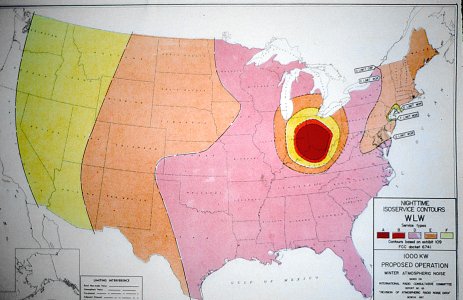
Anybody have the legend and Document which explains the different colors for the WLW Map?
Let's see... red is 2, orange is 3, yellow is 4, green is 5...

And 6 is, uh, well I have a cheat sheet in my plastic pocket protector.
 
Looking at the Radio-Locator.com map for WYLL nights, it is directional to the north. But I find it interesting that WYLL 1160 is the only Chicago station you've gotten in Alaska.

On the other hand, all the major Chicago 50,000 watt stations are on the same frequency as Alaskan Class A stations: 670, 720, 780 and 890. But there's no Alaskan Class A on 1180. So maybe that's the reason WYLL comes in?

(There's also no Alaskan Class A on 1000, which where WMVP Chicago broadcasts at 50,000 watts around the clock. But there is a 50,000 watt station on 1000 in Seattle, so maybe that cancels out WMVP in Alaska?)
The WMVP/WCFL 1000 pattern doesn't go that well toward Alaska, due to the null toward KNWN/KOMO. WYLL/WJJD 1160 has a narrow lobe to the North, and really isn't at maximum toward Alaska.
 
Without going into off color mnemonics, ROYGBIV explains much of the Resistor Code and the Spectrum Rainbow colors.
The resistor code is BBROYGBVGW, or black, brown, red, orange, yellow, green, blue, Violet, gray, white. I learned the acronym from a phrase I cannot repeat here.
 
Looking at the Radio-Locator.com map for WYLL nights, it is directional to the north. But I find it interesting that WYLL 1160 is the only Chicago station you've gotten in Alaska.

On the other hand, all the major Chicago 50,000 watt stations are on the same frequency as Alaskan Class A stations: 670, 720, 780 and 890. But there's no Alaskan Class A on 1180. So maybe that's the reason WYLL comes in?

(There's also no Alaskan Class A on 1000, which where WMVP Chicago broadcasts at 50,000 watts around the clock. But there is a 50,000 watt station on 1000 in Seattle, so maybe that cancels out WMVP in Alaska?)
I've only ever heard Seattles 1000 in Alaska.

but we do have other Class A in Alaska on the same channel as lower 48 class A's

1160 comes in, in part due to its directional pattern, going north and shooting over the pole
 
1160 comes in, in part due to its directional pattern, going north and shooting over the pole
Central Alaska is at approximately 325-330 degrees on an Azimuthal map from Lockport IL (WYLL's nighttime transmitter). That nighttime signal is pretty strong at that angle, but not quite as strong as due north. It covers most of the Chicago metro well, and with the lack of D-layer at night, should cover most of the northern tier of states and much of Canada.

The following link has come in very handy for me in my ham activity: https://ns6t.net/azimuth/azimuth.html
Enter the following for the WYLL transmitter coordinates: 41.573087, -87.993668
 
According to the FCC map that many of you may be familiar with, the ground conductivity west of the Great Salt Lake is a 15. Extending to just west of the Nevada state line. Well above average for the continental United States. And cerrtainly better than most desert areas. Having driven through that area a few times (The Great Salt Lake Desert), I think it's probably safe to attribute that to the lake having been significantly larger than it is now. Presumably, salt residue from what was once lake bottom enhances what the ground conductivity would be otherwise. So what you have is a large body of salt water with conductivity far greater than ocean water, bordered by a land area to the west with enhanced conductivity of its own. 570 and 700 are other Salt Lake City daytime signals that come to mind that get out better than might otherwise be expected.
 
Status
This thread has been closed due to inactivity. You can create a new thread to discuss this topic.


Back
Top Bottom