• Get involved.
    We want your input!
    Apply for Membership and join the conversations about everything related to broadcasting.

    After we receive your registration, a moderator will review it. After your registration is approved, you will be permitted to post.
    If you use a disposable or false email address, your registration will be rejected.

    After your membership is approved, please take a minute to tell us a little bit about yourself.
    https://www.radiodiscussions.com/forums/introduce-yourself.1088/

    Thanks in advance and have fun!
    RadioDiscussions Administrators

KXEN 1010 IN THE PAST

I have very limited knowledge of KXEN. As I understand it, it's been a religious station almost since it's inception until the recent sale.

How well did the station do? I'm talking the 1980s, 1990s. Maybe you worked there?

In the 1990s I was selling paid religion (national ministries and locals) at an AM daytimer in Houston. It was just before national ministries all decided they'd no longer buy time but offer a 'share' of donations. Focus On The Family, Love Worth Finding and a few others were already going that way. I was station #5 in the format, was the newest in the format and one of the worst signals. We were easily pulling in $20,000 a month and eventually with some non-religious additions in afternoon hours when ministries didn't want time, we had about $5,000 in commercials. We aired the 5pm KHOU TV News and I had some features like Katy and Tomball Chamber reports. We had a grocery store that sponsored a quarter hour weekdays that required us to find churches in his trade area to so a free 15 minute program weekly.

My station was no KXEN. I'm just curious how well the station did and how St. Louis perceived the station. The impression I had was KXEN was the market leader in religious programming. I know of KUFO but that was the Missouri Synod Lutheran Church owned station making it entirely different from KXEN. If I had to guess, the likely billed about $30,000 to $35,000 a month and may have has as much as a 1.0 in the ratings which is pretty much 'good' for a preaching and teaching station.
 
For a brief time I worked at KXEN. The station did a lot of Southern Gospel, and paid religion that was popular before the rise of "Christian Teaching" formatted stations appeared.

Ratings were not a factor with KXEN. Cash and billing were, and for that they were successful.

KXEN's 50 kW daytime signal put a strong signal to the southwest, giving it an ERP of 250 kW. Its transmitter and six tower array were located on US 66 in Mitchell, IL. When I would walk in the studio or transmitter room, I felt like I stepped into the 1950s.

The owner was Bert Kaufmann, and the station was brokered by Harold Schwartz. Schwartz brokered several other Christian stations in the 1970s, including XEG Monterrey, NL, Mexico. He is now best known for starting up The Villages retirement community in Florida.
 
Thank you for the post. Like the station I was with, ratings were a non-factor. Unsold hours at first were family friendly country and Christian Country billed as "Kind Country" as we were KYND, a 3kw three tower directional. When I started the studio had ancient equipment that was replaced after a couple of months. I recall the cart machines with the engage lever to move the roller in to place.
 
For a brief time I worked at KXEN. The station did a lot of Southern Gospel, and paid religion that was popular before the rise of "Christian Teaching" formatted stations appeared.

Ratings were not a factor with KXEN. Cash and billing were, and for that they were successful.

KXEN's 50 kW daytime signal put a strong signal to the southwest, giving it an ERP of 250 kW. Its transmitter and six tower array were located on US 66 in Mitchell, IL. When I would walk in the studio or transmitter room, I felt like I stepped into the 1950s.

The owner was Bert Kaufmann, and the station was brokered by Harold Schwartz. Schwartz brokered several other Christian stations in the 1970s, including XEG Monterrey, NL, Mexico. He is now best known for starting up The Villages retirement community in Florida.

KXEN found a niche with down-home gospel and was very successful at it. I think the show that got the most attention was Slim and Zella Mae Cox. The signal was *very* directional; it was rather noisy in St. Charles County which was in the null.
 
It was largely perceived as a "dollar a holler" station with programming coming largely from Pentecostal and "prosperity gospel" televangelists. For many years, KSTL at 690 had run a similar format on weekday mornings, moving to local talk in the afternoon. It eventually fizzled out. Crawford Broadcasting bought it in the 90s along with the old KXOK, running black-oriented Christian shows on the 690 frequency. When that group folded, it was sold to the Church of God in Christ denomination which maintained the urban Christian format with a bit more music.
 
It was largely perceived as a "dollar a holler" station with programming coming largely from Pentecostal and "prosperity gospel" televangelists. For many years, KSTL at 690 had run a similar format on weekday mornings, moving to local talk in the afternoon. It eventually fizzled out. Crawford Broadcasting bought it in the 90s along with the old KXOK, running black-oriented Christian shows on the 690 frequency. When that group folded, it was sold to the Church of God in Christ denomination which maintained the urban Christian format with a bit more music.

Crawford didnt fold and is still very much in business
 
As has been stated, KXEN prospered up until a few years ago when LPFM stations began running a 24/7 religious format from a central control point. Local studios were no longer reguired by the FCC. KXEN is still on 1010 AM but on extremely low power 160 Watts Daytime and 14 Watts at Night from an antenna mounted on the side of an old TV tower in downtown St. Louis, Missouri. It's programming is Conservative Talk. KXEN does have a low power translator on 100.7. KXEN and co-owned WGNU both found their Ilinois transmitters sites were quite valuable and decided to sell their properties along the Mississippi River for real estate development. Both stations moved their transmitters to Missouri.
 
As has been stated, KXEN prospered up until a few years ago when LPFM stations began running a 24/7 religious format from a central control point. Local studios were no longer reguired by the FCC. KXEN is still on 1010 AM but on extremely low power 160 Watts Daytime and 14 Watts at Night from an antenna mounted on the side of an old TV tower in downtown St. Louis, Missouri. It's programming is Conservative Talk. KXEN does have a low power translator on 100.7. KXEN and co-owned WGNU both found their Ilinois transmitters sites were quite valuable and decided to sell their properties along the Mississippi River for real estate development. Both stations moved their transmitters to Missouri.

Theres no visible "antenna" on the side of that TV tower in downtown, using google street view... plus a whip style antenna wouldnt be allowed permanently for Am.. theres probably a skirt/unipole type thing going up the legs of that tower/.. but even thats hard to see on google street view
 
Crawford didnt fold and is still very much in business
Let's just say they apparently redirected their energies elsewhere as they seemed to have left rather abruptly at the time. One day it was Crawford and the next BBN had taken over. Good to know they didn't completely die out; they seemed to be a very well-run chain of stations.
 
Theres no visible "antenna" on the side of that TV tower in downtown, using google street view... plus a whip style antenna wouldnt be allowed permanently for Am.. theres probably a skirt/unipole type thing going up the legs of that tower/.. but even thats hard to see on google street view
I know you know how to read FCC apps, Paul.

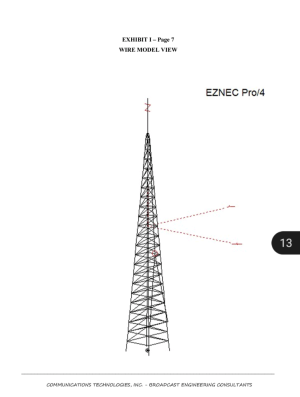
In the time it took you to speculate, you could have looked up the facts, which are these: there's a half-wave wire dipole mounted to one of the tower faces that serves as a shunt feed for the AM.

There's even a handy diagram.

Screenshot_20240721-184835.png
 
I know you know how to read FCC apps, Paul.

In the time it took you to speculate, you could have looked up the facts, which are these: there's a half-wave wire dipole mounted to one of the tower faces that serves as a shunt feed for the AM.

There's even a handy diagram.
The best post I’ve read all weekend.
 
Looking at KXEN Schedules up to almost 30 years back, they were what I call the 'top 40 ministries' or the ministries everybody opts for with a few locals I am not familiar with. Certainly in the final years, all those big ministries going to share of coverage area donations versus buying time, likely meant lots less cash but by then you could run 24/7 on computer and lower expenses.

At one point about $150-$200 an hour for airtime was the norm for KXEN. I never knew them to be dollar a holler or charismatic or prosperity based. Maybe that came in later years or early years until they sold the bigger ministries.
 
First, KXEN had a highly directional signal. It was probably shooting 250,000 watts or more to the southwest; in St. Charles County, where I went to high school, we maybe got 1,000 of that. In 1979, I drove to Rolla for a job interview. Rolla is southwest of St. Louis on Interstate 44. I was amazed that a station that was hard to pick up at home in O'Fallon, maybe just 40 miles away from the transmitting site, was strong all the way to Rolla on I-44, which was much farther away.

The station's big appeal consisted of preachers of the type you'd find in a rural Missouri Baptist church and southern gospel music. In south St. Louis County, there were quite a few folks who had moved in from the farms of southeast Missouri or even Arkansas to take jobs in auto plants and other manufacturing facilities. KXEN appealed to some of those folks. Especially well known as performers on KXEN were Slim and Zella Mae Cox, who had come from Arkansas originally. They sang gospel duets in live remotes from Slim's furniture store in south St. Louis. Slim (who wasn't, and he admitted it) passed away in 2012; Zella Mae a couple of years later. Slim got a substantial obit in the St. Louis Post-Dispatch. That obit quoted a neighbor as saying, "I liked him because they weren't the nasty kind of religious people. He just had his gospel music, and that's why people liked him". The Coxes also appeared on the Rev. Larry Rice's TV stations in St. Louis and Jefferson City. (Larry Rice is a whole other story.) There were also remotes from the Black churches on St. Louis' north side; though once St. Charles' KIRL went to Black gospel in 1979, some of those churches went to KIRL, one of whose owners was a well-known local preacher, Rev. Columbus Gregory. There was very little "prosperity gospel" on KXEN, and no politics.
 
Thank you, Mark Roberts, for you programming explanation. There were only a handful of times I got to listen to KXEN, mostly as a kid living in Kansas City when traveling to Nashville via St. Louis. I was certainly not into the programming but I always listened to KXEN, KSTL, WEW, WOKZ and on the FM, WMRY. After that it was whatever top 40 station I landed on. As an adult I'd check the same stations (1570 has different calls and mostly local talk days while WMRY is totally gone). I used to think WMRY 'wouldn't make it' because I never heard any commercials.
 
Thank you, Mark Roberts, for you programming explanation. There were only a handful of times I got to listen to KXEN, mostly as a kid living in Kansas City when traveling to Nashville via St. Louis. I was certainly not into the programming but I always listened to KXEN, KSTL, WEW, WOKZ and on the FM, WMRY. After that it was whatever top 40 station I landed on. As an adult I'd check the same stations (1570 has different calls and mostly local talk days while WMRY is totally gone). I used to think WMRY 'wouldn't make it' because I never heard any commercials.
WMRY was an interesting operation. It was put on the air in 1966 by the Roman Catholic Oblates of Mary Immaculate, which ran Our Lady of the Snows shrine in Belleville, Illinois. The station transmitted from there until around 1990 on a fairly short tower, which caused coverage issues in some western parts of the St. Louis metro. WMRY was supported at first by donations, but went to a commercial license in 1969. Still, you're right, I also recall very little advertising on the station. During the daytime, it aired automated light rock music - with the tapes often out-of-phase - along with brief motivational messages. The station explicitly avoided what it called "stained-glass windows" religious programming; it was all very soft-sell. Starting in 1974, evenings were the domain of Leo Chears, "The Man in the Red Vest", a noted jazz DJ in the St. Louis area who had been at KSD earlier in his career. WMRY was probably best known for Chears' show. In 1985, the station went to a free-form album-rock format, and Chears went to WRTH. The station also spun up a sales operation at that time. There was a modest level of success, but in 1989, there was yet another format change, to easy listening as "Sunny 101", WSNL, and that basically flopped. The station was put up for sale shortly after that, and the fathers were out of the broadcasting business. What's now on the frequency broadcasts from the original KCFM tower in the Central West End on DeBaliviere.

WOKZ was always an Alton-oriented station. Even though Alton was actually fairly close to St. Louis County and even St. Louis City, it always felt isolated to me. The owners of KATZ bought WOKZ-FM and flipped it to all-disco on New Year's Day 1979. It later transitioned to a Black-oriented format. Between WZEN and KMJM, Majic 108 - plus KIRL for Black gospel - St. Louis had some fine Black-oriented radio programming in the 1980s.
 
Also WESL was famous for being one of the first stations to play hip hop and it is believed they were the first to ever play Rapper’s Delight.

Even in the 1970s, Dr. Jockenstein at WESL was known for playing funk and was a huge supporter of acts like Parliament.
 
Also WESL was famous for being one of the first stations to play hip hop and it is believed they were the first to ever play Rapper’s Delight.
That was a tough haul for me in St. Charles County - a "graveyard" station separated by two big rivers from me. I did try to listen occasionally, and that was the first place I heard Rapper's Delight.

Even in the 1970s, Dr. Jockenstein at WESL was known for playing funk and was a huge supporter of acts like Parliament.
Dr. Jockenstein was best known for his work at WZEN/KATZ-FM. When he did afternoon drive, he would put high-schoolers on the air to rap...as long as they rapped about staying in school and getting an education. I got a chance to speak with him once; he struck me as one of the most positive people that I had encountered.
 
Status
This thread has been closed due to inactivity. You can create a new thread to discuss this topic.


Back
Top Bottom