• Get involved.
    We want your input!
    Apply for Membership and join the conversations about everything related to broadcasting.

    After we receive your registration, a moderator will review it. After your registration is approved, you will be permitted to post.
    If you use a disposable or false email address, your registration will be rejected.

    After your membership is approved, please take a minute to tell us a little bit about yourself.
    https://www.radiodiscussions.com/forums/introduce-yourself.1088/

    Thanks in advance and have fun!
    RadioDiscussions Administrators

Fresno / Central Valley KYNO's transmitter turning on and off for some reason

Ooo, this is fun! Not many stations make such investments in the quality of their AM equipment anymore!

Just for fun, I checked out the specs of the transmitter they're installing, and it apparently has built in AM Stereo!

It would be totally neat if they could switch that on! I mean, it would literally cost nothing if it comes as a standard feature! Just think of the slogan they could use: "America's most powerful oldies station -- now in STEREO!" I would totally listen if they did that, as it come in quite well at my location at night.

Is there any good reason for it? Not really, but they're already defying the odds by daring to care about quality over ratings and actually being successful because of it, so why not dare to go stereo too?

Is there some place where one can ask them about things like this directly? Other than Facebook, X, etc....

c
 
Ooo, this is fun! Not many stations make such investments in the quality of their AM equipment anymore!

Just for fun, I checked out the specs of the transmitter they're installing, and it apparently has built in AM Stereo!

It would be totally neat if they could switch that on! I mean, it would literally cost nothing if it comes as a standard feature!
There is a fee to iBiquity. HD is a proprietary system.
 
Right. I should've explained that I mean't analog stereo, as in Motorola C-QuAM.

Unless I misunderstood the specs somehow? Although I'm pretty sure that "built-in AM stereo" does not equal "HD."
I believe it does mean HD. Nobody would want analog stereo, which pretty much died in the 1980's and earlier 90's.
 
I just checked the spec sheet again, and on the second page, under "Digital Broadcasting Inputs" in the "Audio Performance" section, there's a line item for "Optional HD Radio Generator (Exgine™)." Wouldn't that imply that "Built-in AM stereo" in this context does indeed mean analog and that "HD" is separate, or am I totally off base?

c
 
My understanding was that the Exgine was needed for both C-Quam and IBOC HD. I know there is a licensing fee for the IBOC HD. Not sure about the C-Quam.

I would just keep it simple and run Mono with MDCL and then play with how much compression. In the Nautel menu for your Preset. Select, Dynamic Carrier Control, set to AMC (Its what most people use.) I have heard that you can run up to 5DB of MDCL with no effect on your Sellable contour.
 
Last edited:
NX series can have the C-QUAM option.
Also has MDCL inside.
Local AM with an NX5 was testing MDCL options for the NRSC. He said that C-QUAM was in the menu and selectable.
 
Huh, OK. To me, AM Stereo means "Motorola C-QUAM" and HD means "HD."

I guess everyone in the industry knows that "AM Stereo" now means "HD," but I find it confusing.

c
I doubt if many in the industry even utter the words “AM Stereo” in the third decade of the 21st Century. Even better, “dial this number”, “live in color” “taped in front of a life studio audience”or “call me on the request line”. Lol
 
Yes there it is in the Preset menu>Analog Settings, under Format, Stereo C-QUAM. Not sure if that is all that is needed and no I'm not going to activate it to find out.

But that in it's self is a good question. Is any one out there running a Nautel NX series with Stereo C-QUAM enabled and was that all was needed, Just enabling it.
 
NX series can have the C-QUAM option.
Also has MDCL inside.
Local AM with an NX5 was testing MDCL options for the NRSC. He said that C-QUAM was in the menu and selectable.
Now the big question - no matter how great it might sound - how many receivers remain that will hear it? I used to have AM stereo in my 1990 Chevy pickup. But the radio croaked a few years ago and it now has an after-market unit with no AM stereo. Yeah, I realize I'm a sample of one. But I'm a radio enthusiast, outlier, or whatever else we call us radio geeks on this board. Realistically, how many people reading this still have a way to decode a C-Quam AM stereo signal?

Dave B.
 
Ooo, this is fun! Not many stations make such investments in the quality of their AM equipment anymore!

Just for fun, I checked out the specs of the transmitter they're installing, and it apparently has built in AM Stereo!

It would be totally neat if they could switch that on! I mean, it would literally cost nothing if it comes as a standard feature! Just think of the slogan they could use: "America's most powerful oldies station -- now in STEREO!" I would totally listen if they did that, as it come in quite well at my location at night.

Is there any good reason for it? Not really, but they're already defying the odds by daring to care about quality over ratings and actually being successful because of it, so why not dare to go stereo too?

Is there some place where one can ask them about things like this directly? Other than Facebook, X, etc....

c
I might have to buy another radio!
 
Are there any radios that can be purchased today, that have AM stereo? Nothing on Amazon or C Crane. The only time I ever heard or even saw one, was back in 1993. A friend who worked as an engineer for a small business in Sacramento that manufactured magnetic tape degaussers, had one. It was small, portable, and there wasn't that great a difference in sound quality when we listened to KCTC-AM, which at the time, was in AM stereo. I may be wrong, but I think the manufacturer of the radio was GE.
 
Now the big question - no matter how great it might sound - how many receivers remain that will hear it? I used to have AM stereo in my 1990 Chevy pickup. But the radio croaked a few years ago and it now has an after-market unit with no AM stereo. Yeah, I realize I'm a sample of one. But I'm a radio enthusiast, outlier, or whatever else we call us radio geeks on this board. Realistically, how many people reading this still have a way to decode a C-Quam AM stereo signal?

Dave B.
I do, FWIW. I still have a (slightly dusty) Sony SRF-42 on my desk, and every so often I turn it on to listen to something with earbuds. Usually that's FM, but occasionally it's an AM station. AM sound quality was noticeably better back when C-QUAM was still a thing and a station was encoding, but today most stations are nearly as bad as listening to shortwave through a POTS line. ("Almost" because there is still one AM in the market with tolerable fidelity, all-news KCBS San Francisco. Probably because they need to maintain fidelity for their FM simulcast, so they don't let the AM degrade through neglect.)
 
("Almost" because there is still one AM in the market with tolerable fidelity, all-news KCBS San Francisco. Probably because they need to maintain fidelity for their FM simulcast, so they don't let the AM degrade through neglect.)
The FM does not take the audio from the AM signal. It sends studio audio to separate processing chains for AM and FM.
 
The FM does not take the audio from the AM signal. It sends studio audio to separate processing chains for AM and FM.
I wasn't trying to imply that, David. I meant -- though could have worded it a bit better -- that they keep the studio sound and audio chain at peak performance going from microphones through to transmitters. They're not cheaping on the engineering.
 
Now the big question - no matter how great it might sound - how many receivers remain that will hear it? I used to have AM stereo in my 1990 Chevy pickup. But the radio croaked a few years ago and it now has an after-market unit with no AM stereo. Yeah, I realize I'm a sample of one. But I'm a radio enthusiast, outlier, or whatever else we call us radio geeks on this board. Realistically, how many people reading this still have a way to decode a C-Quam AM stereo signal?

Dave B.
I can increase your sample size by 100% :)

I have a 1994 GMC 2500* and a 1997 Ford F150, and both have functional stock radios, complete with C-QUAM capability (and I recently replaced the speakers in the Ford with ones that aren't blown, so it sounds about as good as it can without going to an aftermarket setup).

I also have a pair SRF-A100s and a CFS-6000 (I can even record it to cassette if I want, because I meticulously refurbished the tape deck so it works almost perfectly).

So if a station wants to use it, I'll be able to hear it!

*When I used the GMC to test out my Part 15 station when I was experimenting with a stereo transmitter, I noticed something interesting. When it flipped to stereo and had a good signal, not only was it in stereo, but the frequency response opened up and it sounded really good compared to normal AM. The Ford's radio, unfortunately, doesn't seem to do this.

c
 
All that matters is whether there are any performance penalties to mono listeners when C-QUAM encoding is enabled. If there aren't any, and if the transmitter already offers C-QUAM for free, why not press the extra 5 keystrokes and enable it for the 200 listeners with classic cars who'll hear it? As long as the rest of the audience isn't t affected negatively, there's no reason to withhold it other than curmudgeonliness.
 
128K AAC Plus would be fine. Unless you have great speakers, you wont notice the difference between 128 and 256.. except the owner will see a higher bill for streaming.
Psychoacoustics is a contemptible subject because some people hear its artifacts at certain bitrates/settings while others don't -- even when both people's hearing tests the same. All I can say is that I consistently hear the difference between those bitrates on average speakers, and that if allowed to do instantaneous A/B comparisons, they even stand out to me with some speech and music on absolutely cruddy speakers. Then again, I'm one of those unlucky individuals for whom Voltair's watermarking enhancement has made PPM markets unlistenable.

There are other considerations, too. For one, many people use equalizers or treble controls. This means that when you employ "streaming cost optimized" bitrates that only barely conceal coding artifacts, the changes made by your listeners to your audio's spectral balance can dramatically unmask those artifacts. This can he worsened by any radios or software streaming players that process your audio's dynamics in any way.

Another consideration is decoder quality variability. Many people in the industry have long been keenly aware that encoders vary widely in their quality levels. For example, a 128 kbit/s MP3 made by specific LAME versions with specific encoding parameters can sound surprisingly good, while Xing codec-produced MP3s sound horrible even at their highest bitrates. But often overlooked is that different decoders -- especially older ones built from older codec library code bases -- produce varying quality output given the same bitrates. So, sending lossy audio whose artifacting is only barely concealed through inferior decoders can also result in the sudden audibility of artifacting ... which if equalized or processed can become even more objectionable.

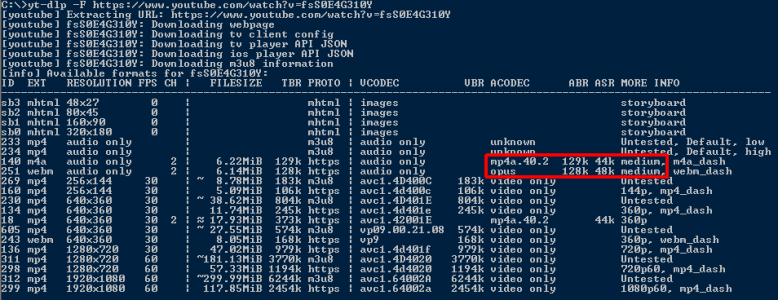
The general rule of thumb I've followed from personal experience with different musical genres, hardware setups, and software decoders, has been to make MP3 encodings at a minimum of 256-320 kbit/s, AAC-LC encodings at a minimum of 192-256 kbit/s, and Opus encodings at a minimum of 160-192 kbit/s, to achieve "transparency under duress." And there seems to be an industry consensus to these rates as well, with, for example, iTunes selling all its music at 256 kbit/s AAC-LC, and with the premium versions of Spotify and Youtube Music streaming at 256 kbit/s in AAC-LC or 160 kbit/s Opus. Using tools like yt-dlp to peek under the hoods of different streaming platforms, I only see 128 kbit/s AAC-LC in use by the non-premium versions of most services. (FYI: Youtube internally labels 128 kbit/s AAC-LC "medium" quality.) I haven't bought any downloadable music from Amazon in a while, come to think of it, but when I last did, everything they were offering was also at 256 (or maybe 320 kbit/s) in the MP3 format. Even in the warez scene, where all the young ears are, the former norm of 128 kbit/s has been deemed something of a pariah relic of the Napster days. 320 kbit/s is now their universal standard for ripped CDs.

In any case, my logic is simple. If radio is to compete with subscription music streaming services, why use bitrates any lower than the ones your competitors do?

I used Starlink and 128K AAC plus to feed KSKO audio from a music festival at a park.. it was flawless and sounded GREAT
Be careful with that. With HE-AAC (a.k.a. AAC Plus), the boundary between the real audio and the SBR syntho-treble region differs in frequency depending on the encoder you're using, and even on whether you're using version 1 or 2. At bitrates like 128 kbit/s, some encoders will produce real audio up to 16 kHz and SBR above that. Because of the limitations of FM, this backfires, as bits that would have been used to encode the transmittable <16 kHz portion of your audio get wasted being diverted to encoding SBR cues that won't even reach your transmitter. With some other HE-AAC encoders I've tested, on the other hand, such as the aac_he profile of ffmpeg's libfdk_aac codec library (which is used to encode a tremendous amount of internet-based streaming material), the boundary for the real audio versus the SBR syntho-treble never goes higher than 8600 Hz when encoding in v2 mode, no matter how high your bitrate setting. That means the HE-AAC SBR will end up making your audio sound worse (more gritty and lacking in treble tonality) with some encoders at bitrates above ~96 kbit/s than if you just used straight AAC-LC.

Long story short: make sure to carefully compare your encoder's AAC-LC audio quality to its HE-AAC audio at that bitrate, if you haven't already. It's kind of instinctive to think HE-AAC will improve things at higher bitrates since it does so at lower bitrates. But in general, 80-96 kbit/s is the consensus I see around the internet for people coding audio with or without SBR, and my own ears have always agreed.

 

Attachments

  • med.png
    med.png
    22.5 KB · Views: 9


Back
Top Bottom