• Get involved.
    We want your input!
    Apply for Membership and join the conversations about everything related to broadcasting.

    After we receive your registration, a moderator will review it. After your registration is approved, you will be permitted to post.
    If you use a disposable or false email address, your registration will be rejected.

    After your membership is approved, please take a minute to tell us a little bit about yourself.
    https://www.radiodiscussions.com/forums/introduce-yourself.1088/

    Thanks in advance and have fun!
    RadioDiscussions Administrators

Largest FM Signal (U.S)

When folks mention the largest signal FMs, they should include many of the Denver, Colorado Springs and Pueblo stations. They have towers 2200 feet (630 m) in height above average terrain. But they also are often 9000 feet above sea level.

As Eastern stations go, it's hard to beat WHOM Mt. Washington-Portland. It sometimes says it's the largest signal FM in the country, hitting five states (NH, ME, VT, MA and NY) and two provinces (Que. and Ont.). It is atop the fabled Mount Washington, tallest peak in the Northeast. So windy, the transmitter building is tied down using chains. I've been to the top of Mt. Washington several times. Just amazing. As you drive up, the trees get shorter and shorter until they're nothing more than scrubs.

Same for Pikes Peak near Denver where I was once. Also above the tree line. That's why Denver, Colo Springs and Pueblo stations should be on any list of the largest FM coverage.
 
i remember traveling to Austin and my hotel was on a ridge near the airport area. I parked in the hotel parking lot and scanned the FM dial and I got a few stations in Dallas, about 185 miles away. I don't think I got anything in Houston, which was 140 miles away, but there may have been terrain preventing me from receiving from there. It was 2007 so I don't really remember.
In Texas east of the I-35 corridor tropospheric ducting can greatly enhance the range of stations in late evenings and early mornings during warm, humid weather. But such signal coverage is the exception, not the rule.

Stations in DFW are not normally heard in Austin. Houston is a bit more common there when tropo is favorable.
 
The OP was talking about largest land area.

As I read many of these comments I see peope saying this station "should" be on the list or this mountain has five stations that "go an amazing distance" and therefore are some of the biggest coverage stations out there. If you are in a place like Denver, you will never cover the most land area because the mountains pretty well eliminate half of the land area- specifically all of the land area to the west of the Front Range. If you are near an ocean, you are sending a lot of signal out over non-land by definition. To get the most land coverage by square miles, you need a high location surrounded by a very large and flat basin or plateau, hopefully considerably lower than your transmitter.

Outisde of a few select locations in the west, you are going to run into more mountains sooner rather than later. In the midwest and and south, no mountains but you can only build a tower so high. Which leaves us with places like Mt. Washington and Mt. Mitchell which allow for transmission from the higest point for many hundreds/thousands of miles...in ALL directions.

EDIT: Mark Roberts beat me!
 
Could you get WKJF near Chicago? My in laws live near Union Grove, WI, and I could get WKJF, and WCXT 105.3 Hart, MI, which was Z-Rock, when WZRC 106.7 Des Plaines was Z-Rock, on a very good Panasonic.
No. In fact, the only WKJF I've ever heard of was in Pittsburgh, and it was a short-lived TV station on Channel 53. 92.9 would have been impossible in the NW 'burbs with 92.7 in Arlington Heights there, even though it was a Class A.
 
When folks mention the largest signal FMs, they should include many of the Denver, Colorado Springs and Pueblo stations. They have towers 2200 feet (630 m) in height above average terrain. But they also are often 9000 feet above sea level.
The reason they don't mention that is that it's not true.

Most Denver stations transmit either from Lookout Mountain or Mt. Morrison. Heights above average terrain run around 360-370m, or around 1,200 feet.

One can drive up to Lookout, on a nice paved road. Easily.


Same for Pikes Peak near Denver where I was once.
And clearly you weren't paying attention because Pikes Peak is not "near" Denver. It's in the vicinity of Colorado Springs, where stations transmit from Cheyenne Mountain.

Also above the tree line. That's why Denver, Colo Springs and Pueblo stations should be on any list of the largest FM coverage.
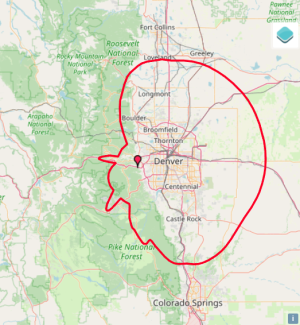
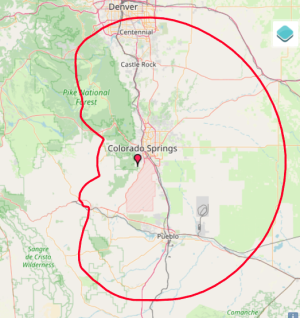
You forget about one thing. (Actually you forget about many things, but to do justice to that, I would have to violate this site's terms of service.) The mountains to the west are higher than the sites for Denver and Colorado Springs. Therefore, every station broadcasting has very little coverage to the west. It's a natural directional antenna. See below for KQMT (99.5); other stations have similar coverage areas: with a strong resemblance to a cardioid with a primary lobe to the east.

(Maps from fccdata.org)

1770699717157.png

For the Springs, KILO (94.3):

1770699903781.png

KILO puts in just barely enough of a signal in eastern Denver to interfere with the KOA translator at 94.1 (which is on Lookout).

Just so we are clear here, there are no mountains east of Denver or Colorado Springs in the state of Colorado. East of downtown Denver, the terrain is mostly flat, maybe rising a little bit as you go into Aurora (which, also to be clear, is east of Denver). To the west, that's where you get the "fourteeners".
 
Last edited:
No mention in here about KRUZ/103.3 in Santa Barbara

That's because of the two words that I have taken the liberty to quote below in bold face.

Here is the list compiled by famed radio researcher James Duncan in 1998. This is based on predicted contour coverage over land.

And obviously @powers missed my post in the Mount Everest thread where that was previously clarified:
 
No. In fact, the only WKJF I've ever heard of was in Pittsburgh, and it was a short-lived TV station on Channel 53. 92.9 would have been impossible in the NW 'burbs with 92.7 in Arlington Heights there, even though it was a Class A.
92.9 is WJZQ now. Originally, it was WWTV-FM. The Panasonic would probably have received it, at least occasionally. Certainly with a McIntosh MR-80, before IBOC anyway.
 
KPQ-FM Wenatchee? KXRX Walla Walla? (which can be heard 200 miles away on a regular basis)
Thos both have some amazing signals, and I worked for one of them! :p But in total land area they won't even come close. KPQ is limited by terrain to the north and west, and KXRX (along with similar 95.7 Walla Walla) is limited by terrain to the east and south. They both do a great job of covering a vast amount of the Columbia Basin, that's for sure.
 
No. In fact, the only WKJF I've ever heard of was in Pittsburgh, and it was a short-lived TV station on Channel 53.

Which almost became part of the ill-conceived Overmyer Network:

It did go back on the air from January 1969 to August 1971, under the same call letters -- WPGH-TV -- that it has had since returning to the air for good in January 1974. (I checked the history cards, just to be sure, and today's channel 53 is the same 1953 CP.) Given that it also had the earlier brief operation from August 1953 to July 1954, it could be said it was twice short-lived.
 
I lived in the Los Angeles area (Tujunga, to be exact) until 1972 when I was 9 years of age. We then visited the area regularly every Christmas through 1978 (my mom's mom had the big Christmas get together at her Tunjunga house every year), and I lived on campus while I attended Loyola Marymount University between 1981 and 1985. I'm letting you know this to tell you that I never found any differences between how far away I could pick up KPFK versus other signals from Los Angeles radio stations, especially those on Mt. Wilson where I believe (@K.M. Richards or others will correct me if I'm wrong) KPFK's transmitter is located. In fact, it wasn't until the age of the Internet that I learned that KPFK had a higher power output than the other Los Angeles stations. In fact, the FM stations with the most distance I've ever heard from Los Angeles have been, and continue to be, KRTH (101.1), KLOS (95.5), and KBIG (104.3).
KPFK had major problem in its 12 bay (IIRC) antenna which was fill of nulls and deficiencies. It never sounded to me like its rated power.
 
That’s a good one. KRBE also comes to mind. According to posts on this website, it acts like a local in Austin (~170 miles)!
40 years ago. Austin has a 104.3 now, and KRBE Isn't even receivable in Austin, much less like a local.

I'll mention a glaring omission on this list, because it was created in 1998, and that is KNOR Krum. Moved from Oklahoma to the massive Era tower, and it is now a whopper of a signal due to the sheer tower height. Heard, easily, all over north Texas and southern Oklahoma in a vehicle. Couldn't tell you the square mileage covered, but it would likely be north of 9-10,000k.
 
Why does KILO insist on calling itself "kee lo" instead of "kill o"? Yes, I've heard it on Sporadic E Skip in Michigan. I recorded it. Female DJ. I also heard and taped KIIQ.
The original licensee of the radio station called his service "Key-lo-land". "Kill-lo-land" sounds like a battlefield.
 
The original licensee of the radio station called his service "Key-lo-land". "Kill-lo-land" sounds like a battlefield.
"Kilo" is also pronounced "key-lo" when used as the phonetic for the letter "K" in two-way radio communications. Some radio amateurs use "kilowatt,"(kill-o) but the proper phonetic is "kilo." "Key-lo" is also how "kilo" is pronounced when used as a short form of "kilogram," even though the "i" in "kilogram" is short.
 
All of the Phoenix FM stations with 100kW and with transmitters and antennas on South Mountain have a range of approximately 120 miles or so using a good receiver. This is true especially if you're going west where, though there are some mountains, most aren't high enough to block the South Mountain signals.

The thing about FM reception of course is that mountains do block signals, especially if those mountains are higher than the spaces on which the stations' transmitters and antennas are perched. However, there are spots when driving through central and northern Arizona (which is very mountainous) where those South Mountain FM signals become quite listenable, at least for a minute. One such area is on Arizona State Route 260 around Woods Canyon Lake and going northeastwards until one crosses over the Mogeollon (not sure of spelling) Rim into the town of Heber. An even shorter space is when you are driving down Interstate 17 from Flagstaff and you are about to enter the Verde Valley from the north side--there is a two to three-minute window where all of those South Mountain transmitters come in nicely. And I've been told (I haven't visited to check myself) that there is a point on the south Rim of the Grand Canyon where all of those South Mountain transmitters come in strong and clear.

I hope you realize that the point I am making is that FM distance reception is not only determined by transmitter location and antenna height (or even by the atmosphere) but also by any objects in the distance, including mountains, that could quite easily block even the best of FM signals.
I've heard some of the Bradshaw Mountain signals (like 104.3 and 101.1) with clarity on I-8 just east of Yuma. Some of them almost make it to Tucson too.
 
I've heard some of the Bradshaw Mountain signals (like 104.3 and 101.1) with clarity on I-8 just east of Yuma. Some of them almost make it to Tucson too.

Yes. And both Yuma and Tucson have stations licensed on the exact same frequencies as a couple of the Bradshaw stations (95.1 in Yuma and 98.3 in Tucson--actually licensed to Marana, some 20 miles northwest of the city).
 
40 years ago. Austin has a 104.3 now, and KRBE Isn't even receivable in Austin, much less like a local.

I'll mention a glaring omission on this list, because it was created in 1998, and that is KNOR Krum. Moved from Oklahoma to the massive Era tower, and it is now a whopper of a signal due to the sheer tower height. Heard, easily, all over north Texas and southern Oklahoma in a vehicle. Couldn't tell you the square mileage covered, but it would likely be north of 9-10,000k.

One of my regrets about my time living in the Houston area, in a radio sense that is, is I never listened closely enough on work or family trips to Austin and Dallas to see where the Houston FM giants gave out. KKRW vs KLBJ probably would have been most noticeable to me since I listened to Houston's 93.7 in its Arrow incarnation.
Years ago, a poster claimed that Houston's 106.9 has been heard well enough in the Metroplex to be listenable. I tend to doubt that one given the distance alone. Too much for even the strongest FM to cover.
 
40 years ago. Austin has a 104.3 now, and KRBE Isn't even receivable in Austin, much less like a local.

I'll mention a glaring omission on this list, because it was created in 1998, and that is KNOR Krum. Moved from Oklahoma to the massive Era tower, and it is now a whopper of a signal due to the sheer tower height. Heard, easily, all over north Texas and southern Oklahoma in a vehicle. Couldn't tell you the square mileage covered, but it would likely be north of 9-10,000k.
I don't think this is a glaring omission at all. KNOR is a class C0, not even a full class C. It is limited to 43,000 watts due to indeed being on a rather tall tower. But there's no way it will cover more ground than a class C. I am sure it is a very nice big signal.


Back
Top Bottom