• Get involved.
    We want your input!
    Apply for Membership and join the conversations about everything related to broadcasting.

    After we receive your registration, a moderator will review it. After your registration is approved, you will be permitted to post.
    If you use a disposable or false email address, your registration will be rejected.

    After your membership is approved, please take a minute to tell us a little bit about yourself.
    https://www.radiodiscussions.com/forums/introduce-yourself.1088/

    Thanks in advance and have fun!
    RadioDiscussions Administrators

Last vehicle with an AM-only radio?

Thats awesome that cars that new only had AM!!!

It was frustrating if you were a new car buyer who wanted AM and FM. For nearly a decade, there were brands that offered AM/FM stereo as standard equipment, but others where you had to pay extra---about $500 in today's dollars---to get it.

And---because most buyers had started choosing AM/FM---there was a phase near the end where American brand dealers ordered the vast majority of their stock with the option. Meaning those who were okay with just AM couldn't easily find cars equipped that way and had to order them from the factory (where and when that was available) or pay extra for what they didn't want.

Standard AM/FM stereo was one of the many things that helped Japanese brands (Toyota, Honda, Nissan) capture buyers in their 20s, 30s and 40s back in the 1980s and early 90s.

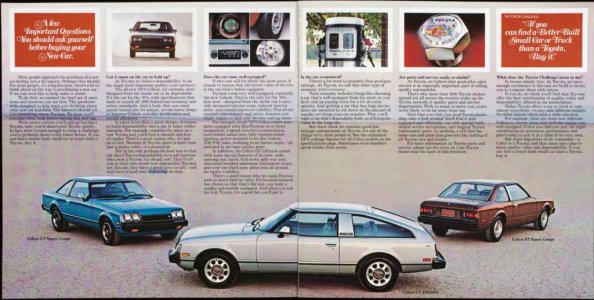
To illustrate how far ahead of the curve they were, here's a page from the brochure for the 1978 Toyota Celica---all-new that year. Introduced in the fall of 1977, the cheapest trim level (Celica ST Coupe) came standard with an AM/FM mono radio, while GT Coupe and GT Hatchback trims got AM/FM stereo standard:
Screenshot 2026-06-30 at 3.56.28 AM.jpeg

I used the phrase "ahead of the curve"---and that's true in terms of American vehicles. The Japanese (and especially Toyota) were actually exactly in sync with where then-young Boomers were.
 
Last edited:
In the 1970's-2000's my father always drove an American land yacht with air conditioning and an AM/FM radio with cassette player. My mom's car was always old and 2nd hand had only an AM radio in it if it had one at all.
 
In the 1970's-2000's my father always drove an American land yacht with air conditioning and an AM/FM radio with cassette player.

This could easily turn into an article, but luxury cars were the early adopters when it came to audio systems.

FM, FM stereo, tape---all were offered first as options on luxury cars (Cadillac, Lincoln, Imperial) and then became standard equipment on the luxury vehicles as the audio systems trickled their way down the chain---as extra-cost-options--- to upper-trim models of full-size cars (Buick Electra, Chevrolet Caprice, Chrysler New Yorker, Dodge Monaco, Ford LTD, Mercury Marquis, Pontiac Grand Prix/GrandVille, Oldsmobile 98), and eventually to lower trim levels.

Part of the boom in Beautiful Music ratings in the mid-70s was that the target audience (adults over 50) were buying cars that, either as standard equipment or an extra-cost option, had FM radios in them. I was suggesting as early as 1981 that the then-new crop of Standards stations should have been on FM, not AM, because most of the audience had the receivers.

For younger buyers, it was more difficult. There were popular vehicles for our ages and budgets that didn't offer FM at all or only as an expensive option. That's what helped drive the explosion in aftermarket stereo installations from the early-mid-70s well into the 80s.

But again---that was added expense. And Toyota (and later Honda, who at first only offered audio systems as dealer-installed options---even basic AM radios) were geniuses for making AM/FM standard equipment in the mid-late 70s on many of their models.
 
This could easily turn into an article, but luxury cars were the early adopters when it came to audio systems.
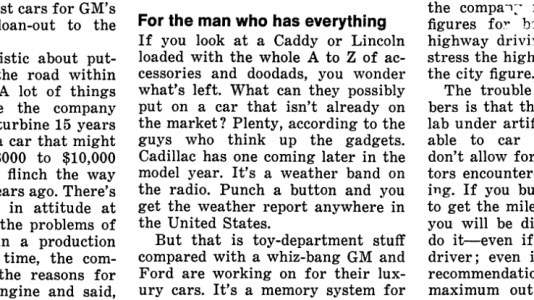
I was surprised to discover that Cadillac offered the 162 MHz VHF weather band on their radios on the 1976 models. Unfortunately, it was a one-year-only option; in 1977, it got displaced by the option of a then-trendy CB radio transceiver built into the car radio.

As mentioned in Popular Mechanics, December 1975:

1975-12 pm cadillac weather.png
 
I was surprised to discover that Cadillac offered the 162 MHz VHF weather band on their radios on the 1976 models. Unfortunately, it was a one-year-only option; in 1977, it got displaced by the option of a then-trendy CB radio transceiver built into the car radio.

As mentioned in Popular Mechanics, December 1975:

View attachment 12263
While traveling in Germany in the early 80s, I rode to meeting with a local who had a shortwave receiver in his car. It was a higher end vehicle, probably either a BMW or Audi. He said it was original equipment.
 
I was surprised to discover that Cadillac offered the 162 MHz VHF weather band on their radios on the 1976 models. Unfortunately, it was a one-year-only option; in 1977, it got displaced by the option of a then-trendy CB radio transceiver built into the car radio.

As mentioned in Popular Mechanics, December 1975:

View attachment 12263

I had completely forgotten that. And I imagine the take rate for the CB option in '78 was pretty low. Not exactly in sync with Cadillac owners.

I've been waiting for live weather radar within satellite navigation for several years now. We seem to be stuck at real-time weather alerts (which is better than nothing).
 
While traveling in Germany in the early 80s, I rode to meeting with a local who had a shortwave receiver in his car. It was a higher end vehicle, probably either a BMW or Audi. He said it was original equipment.

Becker, Blaupunkt and Phillips all made them, both as original equipment for German carmakers and as aftermarket units, from the 1950s into the 80s.

 
While traveling in Germany in the early 80s, I rode to meeting with a local who had a shortwave receiver in his car. It was a higher end vehicle, probably either a BMW or Audi. He said it was original equipment.
Decades ago a number of European broadcasters had domestic and regional shortwave outlets, usually on the lower frequency bands (75, 49, 41 meters). A few were in what were then East and West Germany, as well as Austria, Italy, The Netherlands, Luxembourg, Switzerland, Albania, Bulgaria, Portugal, and perhaps a few others that escape my mind. Powers tended to be pretty modest, mostly 10kw or less, though there were a few higher powered exceptions.

Those in-car shortwave receivers tuned those lower bands as the stations provided fill-in and extended coverage for various broadcasters. All those stations have disappeared over the years as part of the overall demise of shortwave.
 
Becker, Blaupunkt and Phillips all made them, both as original equipment for German carmakers and as aftermarket units, from the 1950s into the 80s.

That model actually only has longwave, AM (mediumwave), and FM ("ultra-shortwave").

The model with shortwave (Kurzwelle) is a collector's item:

Apparently some European Mercedes models had shortwave as late as 2008!
 
While traveling in Germany in the early 80s, I rode to meeting with a local who had a shortwave receiver in his car. It was a higher end vehicle, probably either a BMW or Audi. He said it was original equipment.

Becker, Blaupunkt and Phillips all made them, both as original equipment for German carmakers and as aftermarket units, from the 1950s into the 80s.


That model actually only has longwave, AM (mediumwave), and FM ("ultra-shortwave").

The model with shortwave (Kurzwelle) is a collector's item:

Apparently some European Mercedes models had shortwave as late as 2008!
There are still Pioneer aftermarket car radios with shortwave:
 
As I recall, the dashboard slot for car radios was a standard size for a long time, and that's something that has to be kept in mind in the discussion of what kind of radio was standard in vehicles in the 70s, 80s, 90s, and the early years of the 2000s. It was relatively easy for a dealer to swap out a standard AM radio for an upgraded AM/FM or AM/FM/cassette model -- at a healthy markup, of course. And if you bought a car that only had an AM radio (or no radio at all), there was an abundance of after-market options that could be installed into that slot provided that the car had the necessary wiring for power and antenna. That said, stereo was more complex since it involved adding speaker wiring and installing two or more speakers.

Since car radios are now integrated into multi-function touch screens in modern cars, the ease with which a radio could be swapped out is now a distant memory.


Back
Top Bottom