and the high-VHF antenna would still work for WKRC given it still broadcasts on RF channel 12.Yes, if you go back a block or two on Rose Street on Google Street View, you can see it:
View attachment 8515
Yet one more reason to take a trip up that way (that and Sir Pizza 🍕). I have to think there are others in Lexington.
Just guessing, it looks like the two antennas facing west are for WAVE and WHAS, and the one facing north is for WCPO (or maybe WLWT, hard to tell if those elements are cut for 5 or 9 from that angle). The WHAS antenna would still be usable.
(The emoticon for Sir Pizza isn't quite right, as they cut it in squares instead of wedges.)

-
Get involved.
We want your input!
Apply for Membership and join the conversations about everything related to broadcasting.
After we receive your registration, a moderator will review it. After your registration is approved, you will be permitted to post.
If you use a disposable or false email address, your registration will be rejected.
After your membership is approved, please take a minute to tell us a little bit about yourself.
https://www.radiodiscussions.com/forums/introduce-yourself.1088/
Thanks in advance and have fun!
RadioDiscussions Administrators
You are using an out of date browser. It may not display this or other websites correctly.
You should upgrade or use an alternative browser.
You should upgrade or use an alternative browser.
Lexington, KY (December 7, 1981)
- Thread starter Bluenoser
- Start date
The high-VHF antenna aimed at Cincinnati would still work given WKRC broadcasts on RF channel 12.Yes, if you go back a block or two on Rose Street on Google Street View, you can see it:
View attachment 8515
Yet one more reason to take a trip up that way (that and Sir Pizza 🍕). I have to think there are others in Lexington.
Just guessing, it looks like the two antennas facing west are for WAVE and WHAS, and the one facing north is for WCPO (or maybe WLWT, hard to tell if those elements are cut for 5 or 9 from that angle). The WHAS antenna would still be usable.
(The emoticon for Sir Pizza isn't quite right, as they cut it in squares instead of wedges.)
The high-VHF antenna aimed at Cincinnati would still work given WKRC broadcasts on RF channel 12.
You're right. Even though it's not cut for channel 12 (compare it to the antenna I'm assuming is for WHAS, the other west-facing antenna is clearly for WAVE), it would still work. Cut-to-channel antennas are designed for optimal performance on the desired channel, but that's not to say they won't work on other channels in the same band.
I honestly can't tell whether it's cut for channel 5 or 9. It looks a little too narrow for 5, but a little too wide for 9. (I'm talking about the topmost antenna on the mast.)
While it may be harder to discern from just the photo, but the topmost antenna is definitely for channel 5 given the (longer) length of the elements on the low-band VHF antenna compared to the (shorter) length of the elements on the high-band VHF antennas on the tower.You're right. Even though it's not cut for channel 12 (compare it to the antenna I'm assuming is for WHAS, the other west-facing antenna is clearly for WAVE), it would still work. Cut-to-channel antennas are designed for optimal performance on the desired channel, but that's not to say they won't work on other channels in the same band.
I honestly can't tell whether it's cut for channel 5 or 9. It looks a little too narrow for 5, but a little too wide for 9. (I'm talking about the topmost antenna on the mast.)
MATV towers in Lexington typically had the low-band VHF antennas mounted on the top, with the high-band VHF antennas side mounted on the tower. (The UHF antennas for Lexington were side mounted or below the high-band VHF antennas.)
While it may be harder to discern from just the photo, but the topmost antenna is definitely for channel 5 given the (longer) length of the elements on the low-band VHF antenna compared to the (shorter) length of the elements on the high-band VHF antennas on the tower.
MATV towers in Lexington typically had the low-band VHF antennas mounted on the top, with the high-band VHF antennas side mounted on the tower. (The UHF antennas for Lexington were side mounted or below the high-band VHF antennas.)
Yes, I can see it now, also, the elements are more widely spaced, whereas for high-VHF, I imagine they would be a bit closer together and more evenly spaced. WLWT would have been highly coveted for Reds baseball back in the day, they were the flagship station and AFAIK carried all games, at least the home ones. (And don't forget Bob Braun and Paul Dixon.)
For any newbies who might be reading this, the lower the channel, the longer the elements, and the higher the channel, the shorter they are. I have to think that the Televes DATBOSS with the low-VHF add-on is suboptimal because there is only a single element. So far I haven't seen any DX on low-VHF using it, but it's still there just in case there would ever be a huge e-skip opening or something. I got it in part in hopes of being able to pick up WCES-20 on OTA 6, but nothing so far, it's just too far away and I am beyond even the Longley-Rice fringe. The other Augusta full-power stations give Richland County a light dusting of signal per their Longley-Rice heat maps.
Yes, WLW-T (back in the day) probably helped sell a lot of antenna packages in Lexington, and they carried Reds games from the late 1940s to the early 1990s. In the 1960s and 1970s, I know some of my friends’ fathers were big Reds fans and spoke of just that being the reason for their home antenna installations.Yes, I can see it now, also, the elements are more widely spaced, whereas for high-VHF, I imagine they would be a bit closer together and more evenly spaced. WLWT would have been highly coveted for Reds baseball back in the day, they were the flagship station and AFAIK carried all games, at least the home ones. (And don't forget Bob Braun and Paul Dixon.)
For any newbies who might be reading this, the lower the channel, the longer the elements, and the higher the channel, the shorter they are. I have to think that the Televes DATBOSS with the low-VHF add-on is suboptimal because there is only a single element. So far I haven't seen any DX on low-VHF using it, but it's still there just in case there would ever be a huge e-skip opening or something. I got it in part in hopes of being able to pick up WCES-20 on OTA 6, but nothing so far, it's just too far away and I am beyond even the Longley-Rice fringe. The other Augusta full-power stations give Richland County a light dusting of signal per their Longley-Rice heat maps.
Last edited:
Yes, WLW-T (back in the day) probably helped sell a lot of antenna packages in Lexington, and they carried Reds games from the late 1940s to the early 1990s. In the 1960s and 1970s, I know some of my friends’ fathers were big Reds fans and spoke of just that being the reason for their home antenna installations.
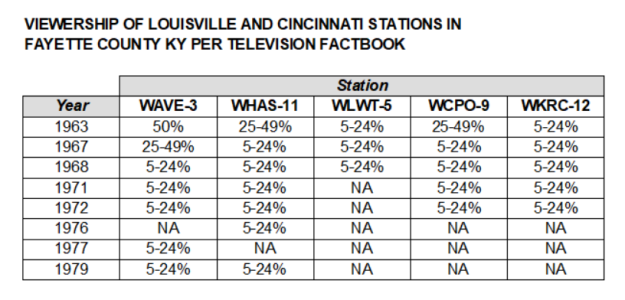
Not surprised. I'd also be interested to know the relative preferences for the major Cincinnati and Louisville VHFs (3/5/9/11/12) in Lexington during the 1960s and 1970s. Were some stations more widely viewed than others? I'll look that up in Television Factbook and see what I find out (though TVFB just listed three large tranches, 50%+, 25-49%, and 5-24%).
As I recall, there was an FCC report issued in the early (?) 1960s in which it broke out “significantly viewed” stations in the Lexington market at the time. I seem to recall WAVE had the lion’s share amongst the “out-of-town” stations, followed by WHAS and Cincinnati, but I’ll have to go back and look at that report when I have time.Not surprised. I'd also be interested to know the relative preferences for the major Cincinnati and Louisville VHFs (3/5/9/11/12) in Lexington during the 1960s and 1970s. Were some stations more widely viewed than others? I'll look that up in Television Factbook and see what I find out (though TVFB just listed three large tranches, 50%+, 25-49%, and 5-24%).
Here's what I found. There was no data in any of the years for WLKY, WDRB, or WXIX. In the case of WLKY, it may have been "who cares about a hard-to-get UHF ABC affiliate in Louisville?", and in the case of WDRB and WXIX, it might have been "we'd like to get them, but it's just too hard, especially WXIX which is right beside WLEX". Viewers would have learned about them from TV Guide and possibly the Herald-Leader listings, but getting them, that's another story. by 1981, there were no viewership percentages for any Louisville or Cincinnati stations.
I didn't gather data for the surrounding counties, but there were various levels of viewership, and Clark County (Winchester) glommed onto WXIX early, with 25-49% viewership as early as 1971. Evidently Winchester cable picked them up right away.
I didn't gather data for the surrounding counties, but there were various levels of viewership, and Clark County (Winchester) glommed onto WXIX early, with 25-49% viewership as early as 1971. Evidently Winchester cable picked them up right away.
I'm not sure when Rose Towers was built but it used to be called "Christian Towers" and was a church run solely senior citizen complex.Yes, if you go back a block or two on Rose Street on Google Street View, you can see it:
View attachment 8515
Yet one more reason to take a trip up that way (that and Sir Pizza 🍕). I have to think there are others in Lexington.
Just guessing, it looks like the two antennas facing west are for WAVE and WHAS, and the one facing north is for WCPO (or maybe WLWT, hard to tell if those elements are cut for 5 or 9 from that angle). The WHAS antenna would still be usable.
(The emoticon for Sir Pizza isn't quite right, as they cut it in squares instead of wedges.)
As someone who lived in Lexington for the first 33 years of my life, I just always remember it being there but can't remember exactly when it was built.
An antenna array like that suggest pre 1968, two station market era.
Although if constructed in the early 70s, an array like that may have still been desirable.
It's all concrete construction and even in the analog era, reception of the Lexington stations may have been difficult.
My dad was one of those Reds fans.Yes, WLW-T (back in the day) probably helped sell a lot of antenna packages in Lexington, and they carried Reds games from the late 1940s to the early 1990s. In the 1960s and 1970s, I know some of my friends’ fathers were big Reds fans and spoke of just that being the reason for their home antenna installations.
That's why we had the Finco 400 A and was aimed at Cincinnati most of the time. And Ch. 5 was on in our home a lot during the spring and summer months.
How was the reception on channel 5? At 80-plus miles, did it suffer from that low-VHF interference-ridden “mush” that tended to inflict channels 2-6 at long distances? (We had a farm on the fringes of the Louisville TV market, and WAVE tended to suffer from it at times, even at 60-70 miles.)My dad was one of those Reds fans.
That's why we had the Finco 400 A and was aimed at Cincinnati most of the time. And Ch. 5 was on in our home a lot during the spring and summer months.the reception on channel
Last edited:
I'm not sure when Rose Towers was built but it used to be called "Christian Towers" and was a church run solely senior citizen complex.
As someone who lived in Lexington for the first 33 years of my life, I just always remember it being there but can't remember exactly when it was built.
An antenna array like that suggest pre 1968, two station market era.
Although if constructed in the early 70s, an array like that may have still been desirable.
It's all concrete construction and even in the analog era, reception of the Lexington stations may have been difficult.
Prior to the creation of detent tuners, UHF reception was a pain in general, that coupled with the special antennas needed, and the use of 300 ohm ribbon wire, which, if not twisted into a double helix, acted as its own antenna, muddling reception even more. I have to imagine that a lot of seniors didn't want to fiddle with all that (though the 300 ohm problem would have been obviated by what I am assuming was the use of coax in the MATV system), and often just preferred to watch something that was at least somewhat clear and accessible just by clicking to the channel. I'm not clear whether the Christian/Rose Towers MATV system converted the Lexington stations to an unused VHF channel or not, that's what they did with WDCA and WETA in the high-rise where I lived in the DC area.
Well, my best memory, it was the worst of the Louisville and Cincinnati stations but watchable. OK but not "clear" like the locals. The "best" of those five stations were 11 & 12.How was the reception on channel 5? At 80-plus miles, did it suffer from that low-VHF interference-ridden “mush” that tended to inflict channels 2-6 at long distances? (We had a farm on the fringes of the Louisville TV market, and WAVE tended to suffer from it at times, even at 60-70 miles.)
As I mentioned before B&W TV was more forgiving of weaker signals.
We got a color TV in 1973 and by this time our tower and VHF antenna were approaching 20 years old.
We connected the VHF and UHF antennas but the Cincinnati and Louisville stations were watchable but worse, in color, so we basically watched the Lexington stations mainly at this point.
Around 1966 or so WLEX began carrying Reds games locally so Dad watched them on 18.
A year later Dad took down the Finco and 2 corner reflector bowties that were corroded.
He bought two 4 bay bowties, from Mr. Wiggs and mounted them near the top of the tower. One for WLEX, the other for WKYT/WBLG. (We lived near Rosemont Gdn. and you had to have 2 UHF antennas to insure a ghost free picture on a color TV in that part of Lexington)
WXIX would come in after WLEX sign off. I could stay up late on Friday and Saturday nights to watch their thriller movies.
Signal strength varied.
It took a little tropo enhancement to get a decent pic which, that late at night, was common.
Most MATV systems did convert the UHF stations to an unused VHF channel.Prior to the creation of detent tuners, UHF reception was a pain in general, that coupled with the special antennas needed, and the use of 300 ohm ribbon wire, which, if not twisted into a double helix, acted as its own antenna, muddling reception even more. I have to imagine that a lot of seniors didn't want to fiddle with all that (though the 300 ohm problem would have been obviated by what I am assuming was the use of coax in the MATV system), and often just preferred to watch something that was at least somewhat clear and accessible just by clicking to the channel. I'm not clear whether the Christian/Rose Towers MATV system converted the Lexington stations to an unused VHF channel or not, that's what they did with WDCA and WETA in the high-rise where I lived in the DC area.
Back in 1980, I wanted a color TV.
19 inch table models were still in the 350 to 400 dollar range.
Around this time, Barney Miller's had a "side hustle" of leasing TVs to the local hotels and hospitals.
Every so often, they would sell these off lease TVs to the public. Cheap. As 75.00 cheap.
There was a catch.
These TVs were single knob VHF only, purpose built TVs designed specifically for MATV systems. No UHF tuners.
The salesman said they will only work with cable, which we just had Telecable installed a few months earlier. Played well on cable as all you need was channel 4 for the cable box.
So, i plunked down my 75.00 for a Magnavox with a "White Wood" finish made in 1975. Mine came from the Campbell House.
There was a sticker on top that read:
Welcome to The Campbell House Inn, As Modern as Tomorrow "
"This TV receives to following channels:
And it listed the channels available and the Lexington stations were on a VHF position. Wish I had saved the sticker.
Well, my best memory, it was the worst of the Louisville and Cincinnati stations but watchable. OK but not "clear" like the locals. The "best" of those five stations were 11 & 12.
As I mentioned before B&W TV was more forgiving of weaker signals.
We got a color TV in 1973 and by this time our tower and VHF antenna were approaching 20 years old.
We connected the VHF and UHF antennas but the Cincinnati and Louisville stations were watchable but worse, in color, so we basically watched the Lexington stations mainly at this point.
Around 1966 or so WLEX began carrying Reds games locally so Dad watched them on 18.
A year later Dad took down the Finco and 2 corner reflector bowties that were corroded.
He bought two 4 bay bowties, from Mr. Wiggs and mounted them near the top of the tower. One for WLEX, the other for WKYT/WBLG. (We lived near Rosemont Gdn. and you had to have 2 UHF antennas to insure a ghost free picture on a color TV in that part of Lexington)
WXIX would come in after WLEX sign off. I could stay up late on Friday and Saturday nights to watch their thriller movies.
Signal strength varied.
It took a little tropo enhancement to get a decent pic which, that late at night, was common.
Mr Wiggs, now there's a blast from the past! Yes, at that time, depending on where you were in Lexington, you would have needed two antennas, one pointing at Russell Cave Pike (WLEX) and another pointing towards Winchester Pike going east (WKYT/WBLG). I can see how WLEX going off the air at night would make WXIX much easier to get, at least with a continuous tuner.
Most MATV systems did convert the UHF stations to an unused VHF channel...
There was a sticker on top that read:
Welcome to The Campbell House Inn, As Modern as Tomorrow "
"This TV receives to following channels:
And it listed the channels available and the Lexington stations were on a VHF position. Wish I had saved the sticker.
Too bad there weren't smartphones back then, so you could have simply taken a picture of it on the spot.
I use mine to take pictures of anything and everything. I will even take pictures of labels and UPC codes in stores, for later reference or to help me shop online.
We did have two for that reason.Mr Wiggs, now there's a blast from the past! Yes, at that time, depending on where you were in Lexington, you would have needed two antennas, one pointing at Russell Cave Pike (WLEX) and another pointing towards Winchester Pike going east (WKYT/WBLG). I can see how WLEX going off the air at night would make WXIX much easier to get, at least with a continuous tuner.
Again that was necessary for a ghost free color picture.
And during the 70s, the standard outdoor antenna package became two corner reflector bowties on a chimney mount, aimed exactly as you described.
I'll try to find a pic of a surviving two bowtie set up like that.
Thanks! Yes, that was my experience, too, as the high-VHF’s always had better picture quality, with less interference than the low-VHF’s at the same fringe distance. On our family farm, WHAS-11 was superior to WAVE-3.Well, my best memory, it was the worst of the Louisville and Cincinnati stations but watchable. OK but not "clear" like the locals. The "best" of those five stations were 11 & 12.
As I mentioned before B&W TV was more forgiving of weaker signals.
We got a color TV in 1973 and by this time our tower and VHF antenna were approaching 20 years old.
We connected the VHF and UHF antennas but the Cincinnati and Louisville stations were watchable but worse, in color, so we basically watched the Lexington stations mainly at this point.
Around 1966 or so WLEX began carrying Reds games locally so Dad watched them on 18.
A year later Dad took down the Finco and 2 corner reflector bowties that were corroded.
He bought two 4 bay bowties, from Mr. Wiggs and mounted them near the top of the tower. One for WLEX, the other for WKYT/WBLG. (We lived near Rosemont Gdn. and you had to have 2 UHF antennas to insure a ghost free picture on a color TV in that part of Lexington)
WXIX would come in after WLEX sign off. I could stay up late on Friday and Saturday nights to watch their thriller movies.
Signal strength varied.
It took a little tropo enhancement to get a decent pic which, that late at night, was common.
And very interesting about WXIX!
I grew up in the Zandale area, and even though we didn’t have a VHF antenna on our roof (to my dismay), WKRC-12 was the most likely to appear at night on my 12-inch B&W TV with its built-in antenna.
And Mr. Wiggs had an awesome TV antenna department towards the back of the store, with antennas for sale hanging from the ceiling, even a giant conical array (!).
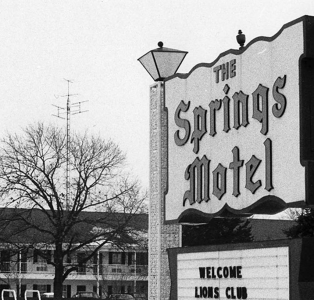
BTW, here’s the MATV array for The Springs Motel, circa 1985 according to the cutline in the Lexington Herald-Leader. As you can see, VHF antennas aimed towards Louisville and Cincinnati, plus UHF corner reflectors lower on the tower (and obscured by the tree in the photo) for the Lexington stations.This discussion on antenna arrays and MATV systems got me to thinking how commonplace they were in Lexington, back then.
All the department stores that sold TVs had them. When Turfland Mall opened in 1967, the 3 anchor stores (McAlpins, Grants and Wards) all sold TVs and all had large arrays on towers. All the display TVs were connected and you could watch Louisville Cincinnati and Lexington stations on them.
While Mom and Dad shopped, I would usually hang out in the Wards TV dept. The TV salesmen knew me by name and were cool with me hanging out and watching TV.
The older hotels had MATV systems as well. The Campbell House array was up until the mid 90s and the Springs Motel array was up until it was demolished a few years ago. And of course all the local hospitals at the time had them, as well.
Even all the Fayette County schools had mini MATV systems installed in all the schools in 1967 when educational TV became a thing.
Most had a parabolic UHF for WKLE, WLEX and WKYT. CBS came via WCPO with a small high band VHF at the top of the mast. All the UHF stations were remodulated onto VHF dial positions .
All the classrooms had wall plates for the antenna connections. The limited number of TVs at the time were on large carts and shared among classrooms. Watched a lot of Apollo missions and things like inaugurations ect, during the school day.