• Get involved.
    We want your input!
    Apply for Membership and join the conversations about everything related to broadcasting.

    After we receive your registration, a moderator will review it. After your registration is approved, you will be permitted to post.
    If you use a disposable or false email address, your registration will be rejected.

    After your membership is approved, please take a minute to tell us a little bit about yourself.
    https://www.radiodiscussions.com/forums/introduce-yourself.1088/

    Thanks in advance and have fun!
    RadioDiscussions Administrators

Lexington, KY (December 7, 1981)

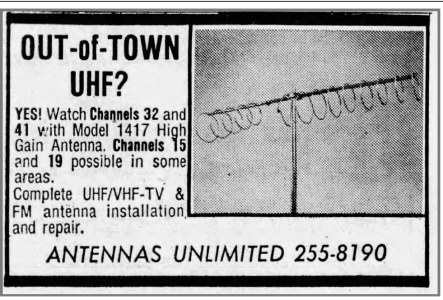
and speaking of fringe UHF in Lexington (i.e., WLKY and WDRB), this ad appeared in the Lexington newspaper in March 1974. I remember at the time thinking that I’d never seen THAT type of UHF antenna before that was pictured in the ad. Is anyone familiar with this type of “loop” antenna, or was it simply a mockup for advertising purposes?

1738971216707.png
 
and speaking of fringe UHF in Lexington (i.e., WLKY and WDRB), this ad appeared in the Lexington newspaper in March 1974. I remember at the time thinking that I’d never seen THAT type of UHF antenna before that was pictured in the ad. Is anyone familiar with this type of “loop” antenna, or was it simply a mockup for advertising purposes?

View attachment 8550
I remember that company. But the life of me, I have never seen THAT antenna anywhere in Lexington or even in the outlying counties.

Another funny story:

In 1980 I was dating girl who lived with her parents out in Monticello subdivision off Clays Mill Rd past Jessie Clark School.
When I pulled up in front of the house, their antenna array caught my eye.
30 ft tower, a large VHF fringe antenna at the top. Below was one of the coveted Channel Master 4251 parabolic antennas, and below that 3 cut to channel UHF yagis for the Lexington channels.
The VHF and the parabolic were fixed towards Louisville. No rotor. There were a couple of preamps and splitters.
It was the only time that I saw 32 & 41 in Lexington crystal clear, local grade. I was impressed and I hit it off with her dad. He proudly showed me the whole setup. She was mad because I spent more time talking to her dad than her...
So goes life.
 
BTW, here’s the MATV array for The Springs Motel, circa 1985 according to the cutline in the Lexington Herald-Leader. As you can see, VHF antennas aimed towards Louisville and Cincinnati, plus UHF corner reflectors lower on the tower (and obscured by the tree in the photo) for the Lexington stations.

View attachment 8545
That array was in place until the hotel was demolished around 7 or 8 years ago. I serviced their kitchen.
 
I remember that company. But the life of me, I have never seen THAT antenna anywhere in Lexington or even in the outlying counties.

Another funny story:

In 1980 I was dating girl who lived with her parents out in Monticello subdivision off Clays Mill Rd past Jessie Clark School.
When I pulled up in front of the house, their antenna array caught my eye.
30 ft tower, a large VHF fringe antenna at the top. Below was one of the coveted Channel Master 4251 parabolic antennas, and below that 3 cut to channel UHF yagis for the Lexington channels.
The VHF and the parabolic were fixed towards Louisville. No rotor. There were a couple of preamps and splitters.
It was the only time that I saw 32 & 41 in Lexington crystal clear, local grade. I was impressed and I hit it off with her dad. He proudly showed me the whole setup. She was mad because I spent more time talking to her dad than her...
So goes life.
What a great story — and local grade on 32/41 to boot with the legendary CM 4251! Even now, my wife rolls her eyes when I slow the car down to gaze at an antenna array. 😃
 
I remember that company. But the life of me, I have never seen THAT antenna anywhere in Lexington or even in the outlying counties.

Another funny story:

In 1980 I was dating girl who lived with her parents out in Monticello subdivision off Clays Mill Rd past Jessie Clark School.
When I pulled up in front of the house, their antenna array caught my eye.
30 ft tower, a large VHF fringe antenna at the top. Below was one of the coveted Channel Master 4251 parabolic antennas, and below that 3 cut to channel UHF yagis for the Lexington channels.
The VHF and the parabolic were fixed towards Louisville. No rotor. There were a couple of preamps and splitters.
It was the only time that I saw 32 & 41 in Lexington crystal clear, local grade. I was impressed and I hit it off with her dad. He proudly showed me the whole setup. She was mad because I spent more time talking to her dad than her...
So goes life.
I'll bet the 4251 did perform pretty well with 32 and 41. Just out of curiosity, did the Louisville or Cincinnati stations come in better, generally speaking, in Lexington? The distance is roughly the same, but I am wondering if the terrain between Lexington and Cincinnati presented challenges that Louisville didn't. It's all rolling country, not exactly flat, in fact, Frankfort kind of sits down in a bowl and its terrain reminds me more of Madison or Estill counties. WBLG even had to have a translator on channel 58 in Frankfort.

To the east, when you get to the Pottsville escarpment (through Lewis and Rowan counties), you basically lose Lexington altogether, and by the time you get to the Rowan/Carter county line, Lexington is totally gone. The coverage map I got when I visited WKYT around 1972, at the height of their OTA coverage, showed their Grade B contour slicing through Soldier just east of the Carter County line (though with improved technology such as Longley-Rice heat maps, we know that contours don't mean much). I once got WLEX with a loop (or maybe it was a bowtie) on a hillside near West Union, Ohio (Adams County).

 
I'll bet the 4251 did perform pretty well with 32 and 41. Just out of curiosity, did the Louisville or Cincinnati stations come in better, generally speaking, in Lexington? The distance is roughly the same, but I am wondering if the terrain between Lexington and Cincinnati presented challenges that Louisville didn't. It's all rolling country, not exactly flat, in fact, Frankfort kind of sits down in a bowl and its terrain reminds me more of Madison or Estill counties. WBLG even had to have a translator on channel 58 in Frankfort.

To the east, when you get to the Pottsville escarpment (through Lewis and Rowan counties), you basically lose Lexington altogether, and by the time you get to the Rowan/Carter county line, Lexington is totally gone. The coverage map I got when I visited WKYT around 1972, at the height of their OTA coverage, showed their Grade B contour slicing through Soldier just east of the Carter County line (though with improved technology such as Longley-Rice heat maps, we know that contours don't mean much). I once got WLEX with a loop (or maybe it was a bowtie) on a hillside near West Union, Ohio (Adams County).
For my household, the Louisville stations were somewhat "better" (in B&W) living in the South end. . WAVE was actually decent unless tropo conditions kicked up.
In the summer, it would either be flat unwatchable at times or a distant ch. 3 would "replace" WAVE temporarily. . Memphis 3 (WREC), Wichita 3 (KSNW) and (my Mom's hometown) Springfield Mo. 3 (KYTV) were all seen at my house at one time or another. KYTV was the most frequent visitor on ch. 3. Tropo does some odd things. High band VHF seemed to be less affected by tropo, it still happened.

Which since we are discussing MATV systems, I'll bet tropo played havoc with some of the. VHF channels especially with all those high gain antennas mounted up high. Might have been fun to try and DX off one of those systems.
 
I'll bet the 4251 did perform pretty well with 32 and 41. Just out of curiosity, did the Louisville or Cincinnati stations come in better, generally speaking, in Lexington? The distance is roughly the same, but I am wondering if the terrain between Lexington and Cincinnati presented challenges that Louisville didn't. It's all rolling country, not exactly flat, in fact, Frankfort kind of sits down in a bowl and its terrain reminds me more of Madison or Estill counties. WBLG even had to have a translator on channel 58 in Frankfort.

To the east, when you get to the Pottsville escarpment (through Lewis and Rowan counties), you basically lose Lexington altogether, and by the time you get to the Rowan/Carter county line, Lexington is totally gone. The coverage map I got when I visited WKYT around 1972, at the height of their OTA coverage, showed their Grade B contour slicing through Soldier just east of the Carter County line (though with improved technology such as Longley-Rice heat maps, we know that contours don't mean much). I once got WLEX with a loop (or maybe it was a bowtie) on a hillside near West Union, Ohio (Adams County).
I believe WLEX and WKYT were carried on cable, for many years, in the Ohio counties that hug the Ohio River across from Kentucky.

Back in the analog days, ( late 90s) I ran a service call to the New Richmond (Ohio) high school to service their kitchen. New Richmond is about 20 miles east of Cincinnati out US 52.

The kitchen ladies had one of those cheap Samsung B&W TVs with a loop antenna, sitting up in a window ledge in the kitchen.
It was early in the morning and the were watching "The Young and the Restless" while they were cooking. To my surprise it was a watchable picture from WKYT.
I asked them about it and they said: "We watch Y&R outta Lexington every day". That's cause they gots Y&R in the morning"
I'm not surprised as Lexingtons high power FMs are quite listenable on the east side of Cincinnati.
 
For my household, the Louisville stations were somewhat "better" (in B&W) living in the South end. . WAVE was actually decent unless tropo conditions kicked up.
In the summer, it would either be flat unwatchable at times or a distant ch. 3 would "replace" WAVE temporarily. . Memphis 3 (WREC), Wichita 3 (KSNW) and (my Mom's hometown) Springfield Mo. 3 (KYTV) were all seen at my house at one time or another. KYTV was the most frequent visitor on ch. 3. Tropo does some odd things. High band VHF seemed to be less affected by tropo, it still happened.

Which since we are discussing MATV systems, I'll bet tropo played havoc with some of the. VHF channels especially with all those high gain antennas mounted up high. Might have been fun to try and DX off one of those systems.
Yes, tropo can do some jaw-dropping things. The first house I bought was in southeast Lexington off of Todds Road in the early 1990s. I had an old 12-inch B&W TV in my workout room, and one summer night I pulled in KOAA-5 out of Pueblo, Colorado via the (broken) VHF rod that was on the set!

(Funny thing is, I now live not too far from Pueblo.)
 
Yes, tropo can do some jaw-dropping things. The first house I bought was in southeast Lexington off of Todds Road in the early 1990s. I had an old 12-inch B&W TV in my workout room, and one summer night I pulled in KOAA-5 out of Pueblo, Colorado via the (broken) VHF rod that was on the set!

(Funny thing is, I now live not too far from Pueblo.)

That was probably e-skip, not tropo. When there is an e-skip opening, very strange things can happen. I once got KTWO-2 from Casper WY in the basement of my home in Kentucky with a single rabbit ear!
 
I believe WLEX and WKYT were carried on cable, for many years, in the Ohio counties that hug the Ohio River across from Kentucky.

Back in the analog days, ( late 90s) I ran a service call to the New Richmond (Ohio) high school to service their kitchen. New Richmond is about 20 miles east of Cincinnati out US 52.

The kitchen ladies had one of those cheap Samsung B&W TVs with a loop antenna, sitting up in a window ledge in the kitchen.
It was early in the morning and the were watching "The Young and the Restless" while they were cooking. To my surprise it was a watchable picture from WKYT.
I asked them about it and they said: "We watch Y&R outta Lexington every day". That's cause they gots Y&R in the morning"
I'm not surprised as Lexingtons high power FMs are quite listenable on the east side of Cincinnati.

They were indeed, Ripley, Aberdeen, Manchester, and WLEX was carried on cable in West Union. The first three cities were served by cable out of Maysville, so it was probably just easier to carry everything from Lexington. It's simply not all that far, and that WKYT coverage map I mentioned showed their contours getting into that part of far southern Ohio.
 
For my household, the Louisville stations were somewhat "better" (in B&W) living in the South end. . WAVE was actually decent unless tropo conditions kicked up.
In the summer, it would either be flat unwatchable at times or a distant ch. 3 would "replace" WAVE temporarily. . Memphis 3 (WREC), Wichita 3 (KSNW) and (my Mom's hometown) Springfield Mo. 3 (KYTV) were all seen at my house at one time or another. KYTV was the most frequent visitor on ch. 3. Tropo does some odd things. High band VHF seemed to be less affected by tropo, it still happened.

Which since we are discussing MATV systems, I'll bet tropo played havoc with some of the. VHF channels especially with all those high gain antennas mounted up high. Might have been fun to try and DX off one of those systems.

During the early summer in the 1970s, WSAZ-3 Huntington WV would carry a crawler along the bottom of the screen sometimes, saying that atmospheric conditions were causing distant stations to interfere with WSAZ, and there was nothing they could do about it.
 
They used to be, but the WLW translator has ruined reception of 94.5. I used to regularly listen to 94.5 when it was WLAP-FM.

WLW sure didn't need a translator, but it got one anyway.
50KW WLW, "The Big One", with a translator in its home city 🤦‍♂️

Powel Crosley would turn over in his grave.

Granted, it's on FM, and FM is most people's preferred way to listen to radio, but still...

What they need to do, is to go back to 500KW. Who needs a radio when you have fillings in your teeth? Heck yeah!
 
Denver’s 50KW KOA also now has a FM translator. Let’s face it — generations behind us have never listened to AM.

Two of them actually but both go to 94.1 FM... K231BQ Golden and K231AA Boulder.
 
During the early summer in the 1970s, WSAZ-3 Huntington WV would carry a crawler along the bottom of the screen sometimes, saying that atmospheric conditions were causing distant stations to interfere with WSAZ, and there was nothing they could do about it.
Ironically, I have never received WSAZ here in Central Kentucky. Any 3s other than WAVE via tropo have all been due west of here.
 
They used to be, but the WLW translator has ruined reception of 94.5. I used to regularly listen to 94.5 when it was WLAP-FM.

WLW sure didn't need a translator, but it got one anyway.
But at least they don't do what WBBM and WSB do: Identify strictly with the FM frequency.

As for WLAP FM, they were ahead of the times with TM Stereo Rock, and was quite listened to in and outside of Lexington.
Back in high school in 1978, my GF and I went to Kings Island. I had one of those under dash Pioneer Supertuners with cassette and the round FM dial, on a slide mount.
Man did I have to save a long time to get one! 159.00 in 1978 money!

My GFs favorite station was WLAP FM. She was quite impressed that we listened to it all the way to Kings Island right to the parking lot.

This was, of course, well before the WLW translator and even before the Dayton 94.5 signed on.
Once the Dayton 94.5 signed on, WLAP FM was listenable in parts of Cincy, but depending on where you were, they would swap back and forth.
 
Ironically, I have never received WSAZ here in Central Kentucky. Any 3s other than WAVE via tropo have all been due west of here.

Going towards Lexington, WSAZ probably wouldn't have been possible beyond around Owingsville in Bath County due to QRM from WAVE. Back in the day they got down as far as Lee, Breathitt, Perry, Leslie, and Harlan counties, and even Owsley and Clay counties per the 1963 TVFB. I can't imagine the picture was very good, but in the mountains, people tended to be very forgiving of that sort of thing. Better a snowy picture than nothing at all.


Back
Top Bottom