• Get involved.
    We want your input!
    Apply for Membership and join the conversations about everything related to broadcasting.

    After we receive your registration, a moderator will review it. After your registration is approved, you will be permitted to post.
    If you use a disposable or false email address, your registration will be rejected.

    After your membership is approved, please take a minute to tell us a little bit about yourself.
    https://www.radiodiscussions.com/forums/introduce-yourself.1088/

    Thanks in advance and have fun!
    RadioDiscussions Administrators

Listening to Music on AM Vs FM


And static is, essentially, an amplitude modulated noise that is very, very broadband. You don't get true static on FM, although you may get other kinds of artifacts. True static can be from lightning discharges or from atmospheric noise and even solar emissions.

That said, most people under about 50 use the term in a more modern context, meaning "any kind of noise that interferes with clear reception".

Language changes. Static has a new meaning in this era.

Thank you David, for backing me up. Not to play the "old card" but people also say "off ten" and "irregardless"; that doesn't make them right.
 
Oops, I misspelled one of my favorite beers and its web address.
Should have been Yuenglings.


And static is, essentially, an amplitude modulated noise that is very, very broadband. You don't get true static on FM, although you may get other kinds of artifacts. True static can be from lightning discharges or from atmospheric noise and even solar emissions.

That said, most people under about 50 use the term in a more modern context, meaning "any kind of noise that interferes with clear reception".

Language changes. Static has a new meaning in this era.

I guess you are suggesting here that language isn't static, right? :cool:
 
+1.
You're forgiven....as long as you buy me one.
Here is a clue that I will probably NEVER repeat:
From my desktop at home, I go over and over all of my posts to make absolutely certain that each and every proverbial lower case "I" is dotted and "T" is crossed.
I often spend unreasonably long periods of time on some of my shortest posts, mostly shortening them even more and adding cute links; I would NEVER have allowed that faux pas to slip out from home.
The problem is that when I read something that compells me to reply from my phone at work, I rarely have time to correct it until after my fifteen or thirty minute grace period elapses.
That is when I need my brew or more of Judy Collins.
 
Where I live there is little music on the AM band. But I do enjoy listening when there is.

WKFB - an all-oldies daytimer in Jeannette, PA
WKHB - it's bigger sister station that plays 60's, 70's and 80's after the medical infomercials end for the day.

They make me nostalgic for when I listened to music on AM all the time in the 70's.
 
They make me nostalgic for when I listened to music on AM all the time in the 70's.

As most of you know, I travel quite a bit. And rent cars a lot. Even in retirement.

I would have to say that probably 75% the time when i rent a car, it's obvious that the AM presets have never been touched. Which is not the case with the FM FM. When the AM presets have been touched, it's usually just one or two. And almost always that's for a station that broadcasts sporting events, or sometimes a station that's either all news or where news is a primary component of the format.
 
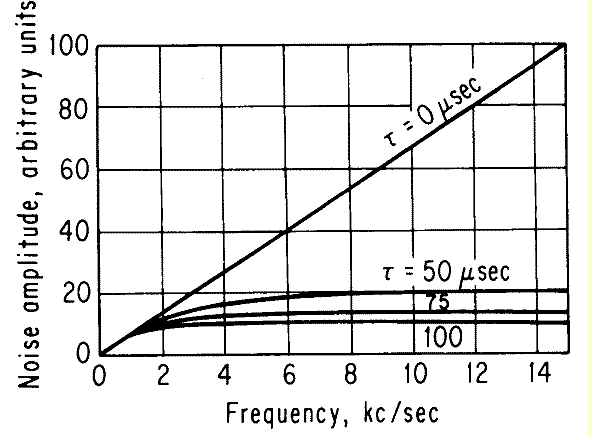
n the early days of FM, even in the 1960s and early 1970s, people were bothered by the "tinny" sound of FM. They would turn the Bass all the way up and the Treble all the way down. The low frequencies CAN sound better on AM, because the preemphasis causes more noise from the lower S/N ratio on lower audio frequencies on FM. For example, the pickup bass guitar notes and bass guitar break in the ubiquitous "Brown Eyed Girl" sounded better on AM than FM. Strong nearby signals with high Q transmitting antennas sounded as good, some say better than FM before NRSC roll off standards, on AM on wide band radios like the Sony SRF-A100, especially with ANY AM Stereo system. CKLW, which could broadcast 15+ kHz in AM Stereo, sounded better within the 25 mV/m contour than FM.
 
Last edited:
... The low frequencies CAN sound better on AM, because the (FM) preemphasis causes more noise from the lower S/N ratio on lower audio frequencies on FM. ...

For clarification/possible discussion:

Actually the S/N ratio of low audio frequencies transmitted/received by FM broadcast systems using pre-/de-emphasis is lower than for higher audio frequencies — as shown in the graphic next below for FM systems using 50, 75, and 100 µs pre-/de-emphasis.


FM_Preemphasis_Noise_Imprvmnt.jpg


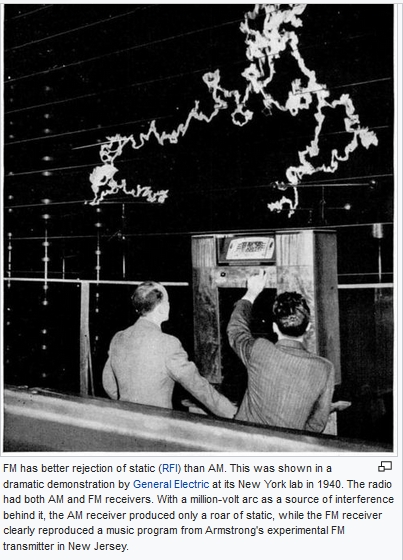
An additional improvement in S/N ratio and noise performance for FM vs AM broadcast results from the AM limiting characteristics of FM receivers. Below is a clip showing a demonstration of this conducted by G-E back in the early days of FM broadcasting.

A modern, analog FM stereo receiver may have a S/N ratio of 40 dB or greater in both its L&R audio output waveforms when the received FM signal drives that receiver into full AM limiting. That may occur for received field intensities on the order of 50 µV/m and greater.

OTOH, the S/N ratio at the audio output of an AM broadcast receiver tuned to an arriving carrier field intensity of 50 µV/m would be very poor in comparison; perhaps even unlistenable.


GE_Dem_AM_vs_FM_Reception.jpg
 
Last edited:
If the AM signal was transmitted at 100mHz, the difference between AM and FM wouldn't be so great.
The biggest problem with AM is the operating frequency.
Remember, analog TV used AM for the video and, at the higher frequencies, AM performed pretty well.
Still ... FM is a definite improvement over AM.
 
Listened to some FM earlier while waking up. Had to move my portable around to keep maybe half the stations from being distorted.

FM is awesome. But not perfect, by any stretch. I don't think any particular method of broadcast over the air can be perfect. They all seem to have their glitches.
 
I do not know what the bandwidth was for the original analog C-band satellite TV channels,
but they used FM video and those channels were w-i-i-i-de by terrestrial TV standards.
 
Status
This thread has been closed due to inactivity. You can create a new thread to discuss this topic.


Back
Top Bottom