• Get involved.
    We want your input!
    Apply for Membership and join the conversations about everything related to broadcasting.

    After we receive your registration, a moderator will review it. After your registration is approved, you will be permitted to post.
    If you use a disposable or false email address, your registration will be rejected.

    After your membership is approved, please take a minute to tell us a little bit about yourself.
    https://www.radiodiscussions.com/forums/introduce-yourself.1088/

    Thanks in advance and have fun!
    RadioDiscussions Administrators

Local Layoffs at Audacy (and a Resignation), the 2025 Edition

Something needs to be pointed out for the benefit of the naive: the HR department in virtually all corporations IS NOT YOUR FRIEND! They do not exist to protect you from your corporate bosses. They exist to protect the corporation from the employees.

I agree. I mentioned them sarcastically. People assume HR is their friend because they administer the benefits. But truthfully employees have no representation, and with government shutting itself down, the NLRB will also no longer be available. Employees are legally paid volunteers. That's what "at-will" means. The company has no other obligations. Don't depend on them for anything.
 
Incorrect. There are thousands of talented people in radio who started out part-time, rose to full-time (if that's the route they pursued) and perhaps went back to part-time for any number of reasons. Plenty of talented people are not working in the business because of cost-cutting, consolidation, automation, and good ol' boys' club politics and not nearly as many jobs as there used to be.
A great deal of that is due to the near-seventy-percent reduction in radio revenue in the last 25 years (inflation adjusted). Some has to do with the huge increase in FM stations due to Docket 80-90. Some has to do with new media nearly wiping out the use of radio by those under 30. And some has to do with the replacement of home radios with Alexa devices and their equivalents where one can select content verbally with out a need for a radio.
Conversely, there are plenty of "morning show talent" who suck, or who are egotistical jerky prima-donnas and make life difficult for their co-workers and/or management, yet they make 6-figure morning show money. I've known some who fight against the union just so they don't have to pay higher dues, yet it would elevate and support their co-workers. These are not fundamentally nice or good people, let alone whether they're talented or not.
I have worked with three morning show talents who, at some point, were #1 in Los Angeles. I did not enjoy working with any of them, but they were well liked by the audience and my job was "damage control". I did not have time to worry about whether they were nice to the rest of the staff.
They eventually fall or leave the industry at a certain point, anyway. Plenty of big-ticket talent, on the other hand, know the value of collective bargaining, do their jobs just as well to kill it every day on the air, and take their elevated salaries, and are true union supporters and team players. For protections for EVERYONE.
In other words, sometimes it is beneficial and sometimes it is not. A good case for an open shop.
There are also plenty of talented actors languishing in local improv or low-paying theatre for the love of the art and use of their own gifts, whatever they may be, who don't get elevated to George Clooney or Jennifer Aniston or SNL status; doesn't mean the unknowns aren't talented. There are categorically more rank-and-file hardworking union members than celebrities in any field. You don't like it? Don't work in it. You sound like an a-hole. You don't get to generalize "talent" based on union membership, salaries, or people's needs or gifts or why they do what they do, with the amount of time or daypart in which they choose to do it while they still have a job opportunity. You are not the arbiter of such things. Don't become a PD or a casting director.
Some of us have been PDs or consultants or managers and might disagree. This is not a universal perspective..
 
If the only thing the union can do is get workers more money, then that's not a good use of the union. Because, as I said, in radio, there's only so much money. If the union workers eat up all of the staff budget, they're just taking jobs away from everyone else. That's what we've seen at NPR stations where the union has come in. They get their members raises, and in the next budget, the staff gets cut. What's the point?
Every few posts, we both agree on something. This is such a case.
 
It's also worth noting that as sports/talk radio devolved into guy talk and gambling talk and snarky "hot takes," many onetime listeners have moved over to intelligent and up-to-the-minute podcasts from skilled reporters, leading columnists and sports media figures.
That's how "sports talk" began: Imus on WFAN. "Sports talk" has always been guy talk. Whatever guys talk about at a sports bar... uh, well, almost everything... is valid sports radio content.
 
Was listening to a re-broadcast of a program based in Canada and the host [Alan Cross] was doing a "60 facts in 60 minutes" and apparently there have been 11,000,000+ podcasts released yearly. Not sure if that's "new" podcasts or including episodes of all podcasts but even so you'd have to have about 100,000 sets of ears to listen to them all or there are a lot of podcasts going out to nowhere. It's like the old question "If a tree falls in a forest......". The analogy would be "If a podcast broadcasts and no one listening to it was there actually a podcast broadcast?"
 
While not in a union currently, I have dealt with them and tried to get one started after they appointed a supervisor [government agency, by the way] who instituted B.S. rules. Like everything, some unions are great, other are crap. One place I worked required you be in a union [grocery related industry] and pay dues from the get-go even though you weren't "officially" part of the union for 90 days. The only thing the union president did was negotiate a membership to the golf club that the owners of the business had a membership in, negotiate a parking space close to the office building so he didn't have to walk 1/4 of a mile from the parking lot, when a worker was "terminated" advised them not to fight it and he'd get them a job at some other union shop. In case of the supervisor appointed: required 6 weeks notice if you wanted a day off but if she didn't feel like coming in, didn't. Required 24 hours notice if you were going to be sick - how many of you have gone to bed feeling fine and woke up the next day sick as a dog? - and if you didn't, you be written up? Where she flat out said that men shouldn't be allowed to be in the department I was in and since I was the only guy there......Where, they were so sick of her crap at a prior government agency that they closed down the dept. she was in and farmed it out to another local government agency so they wouldn't have to deal with her.. When I was trying to get other workers to join a union [after broken promises of pay raises, etc] they did not want to pay union dues and when countered with you'll probably getting wage increases that will more then cover your dues. Of course they found a way to "get rid of the troublemaker"-me-. Eventually the state government cam in and mandated that local governments have one centralized system to deal with multiple cities, they had to join with a city that had a union in place and were required to join it. They immediately got a 30% raise and the supervisors got a 50% raise going from one of the lowest paid departments in the county to being one of the higher paid ones.
As far as radio goes, guy that trained me was required to do his 4 hour on air shift and since he was production supervisor, another 8 hours making/carting commercials. 12 hour days, required to come in Saturdays and just do production work, had Sundays off. No union, and he wasn't paid for his OT, they changed the "job classification" saying it was something different so they didn't have to pay him OT or so they said. He didn't buck the system because he loved radio so much and was afraid of being canned. Now if any place needed a union, that station did.
 
There are far more available DJs than skilled managers. When there is more supply than demand, the employer has an advantage.
I remember in broadcasting school back in the dark ages - hey, Marconi was a teacher there - that one of the figures/facts that was thrown out at us that there were like 100 DJ jobs available per year and 5,000 DJs applying for them. Nowadays it's probably like 25 per year and 15,000 applying for them. Another reason that station owners paid dirt cheap wages [at SOME stations] because there were like a dozen other guys standing behind you ready to take your job if you dared ask for a raise.
 
I was an audio/visual nerd in high school. Rebuilt the PA system in our gym twice. Fixed ANY projector/other AV stuff that broke down. Figured when I graduated from high school, I was finished with the place. [Insert laughter here.] For the next several years, until the then current crop of teachers had retired, I was called upon constantly to come up and help fix some type of equipment, from early Sony VHS recorders that were the size of a Mini-Cooper as well as Betamax machines, etc. Even had teachers call and ask me to come to their houses and hook up their new-fangled VCRs because they couldn't figure out how to. Offered to build and design stadium PA system when they rebuilt the stadium about 15 years ago, they went with someone else and as soon as I saw it I told them get ready from complaints from surrounding houses to sections of the stadium that couldn't hear a thing. And to top it off, people TWO miles away at the far end of town could hear EVERYTHING said over it yet sections of the stand [as mentioned] couldn't hear crap.
Once I got into radio and told them I was an AV nerd and fixed all sorts of electronics in high school, was told to stay out of the Chief Engineer's way and if something broke, it's HIS job to fix it. I guess they were scared of the FCC and that "1st phone" certificate that entitled them to fix all the "good" stuff.
 
That's how "sports talk" began: Imus on WFAN. "Sports talk" has always been guy talk. Whatever guys talk about at a sports bar... uh, well, almost everything... is valid sports radio content.

As Imus said about his show covering other topics: "Nobody at 6 AM wants to hear from Joey in Brooklyn."
 
Was listening to a re-broadcast of a program based in Canada and the host [Alan Cross] was doing a "60 facts in 60 minutes" and apparently there have been 11,000,000+ podcasts released yearly. Not sure if that's "new" podcasts or including episodes of all podcasts but even so you'd have to have about 100,000 sets of ears to listen to them all or there are a lot of podcasts going out to nowhere. It's like the old question "If a tree falls in a forest......". The analogy would be "If a podcast broadcasts and no one listening to it was there actually a podcast broadcast?"
What you heard was the truth, as pertains to content creators (and these days, all audio and visual entertainment is basically internet content). There is nearly infinite competition, all for one or two screens (usually your smartphone screen, followed by a laptop or smart TV). Visibility, to a content creator, is imperative to survive. But visibility is nearly impossible for most content creators. The ones who succeed the most are usually either very lucky, or they got in on the game early on when there was less competition for visibility.

I think this applies to Radio as well as other forms of content. Right now most Radio still is geographically oriented. You have maybe 30 stations in your market to choose from, on your radio device, and many listeners have shifted to the stream -- but the orientation is still local geographically. When everything 'radio' is internet only, you suddenly have more like 30 million audio channels to choose from. Big difference when it comes to the individual station attempting to get enough visibility to actually make money.
 
I think this applies to Radio as well as other forms of content. Right now most Radio still is geographically oriented. You have maybe 30 stations in your market to choose from, on your radio device, and many listeners have shifted to the stream -- but the orientation is still local geographically. When everything 'radio' is internet only, you suddenly have more like 30 million audio channels to choose from. Big difference when it comes to the individual station attempting to get enough visibility to actually make money.
It also doesn't help that live remotes have mostly gone the way of the dodo.
 
Huh? Did you see my post about the KIIS Wango Tango? Some stations do remotes every week.

The ONLY way radio can remain relevant is if it's in front of people every day. They have to SEE you in order to know you're there.

There's a BIG difference between Wango Tango and three hits an hour from Bob Dickman Chrysler-Plymouth.

Sales remotes were DEADLY for anyone just trying to listen to the radio station. It's why Bill Drake specifically prohibited them at a time when some competitors (including KFWB, KRLA and even KMPC) were still doing them in L.A.
 
There's a BIG difference between Wango Tango and three hits an hour from Bob Dickman Chrysler-Plymouth.

Sales remotes were DEADLY for anyone just trying to listen to the radio station. It's why Bill Drake specifically prohibited them at a time when some competitors (including KFWB, KRLA and even KMPC) were still doing them in L.A.
Remotes were just a tool for the sales department. They could rope a jock into coming out for 2 or 3 hours. Many times the client tried to weasel out of paying the "Talent Fee Appearance". Remotes were listener tune outs for sure.

I recall stations that used to broadcast live from the California State Fair. Inevitably, some yahoo would wander up and yell "Play Freebird" during a live break...šŸ˜‘
 
There's a BIG difference between Wango Tango and three hits an hour from Bob Dickman Chrysler-Plymouth.

I agree. If all you're doing is selling cars, it's probably a waste. People hate commercials, so a long commercial isn't good.

On the other hand, setting up the remote truck outside of a big concert or sports event is putting your station in front of a lot of eyeballs.

Typically it will be the currents-based stations that can do this kind of thing.

 
I agree. If all you're doing is selling cars, it's probably a waste. People hate commercials, so a long commercial isn't good.

On the other hand, setting up the remote truck outside of a big concert or sports event is putting your station in front of a lot of eyeballs.

Typically it will be the currents-based stations that can do this kind of thing.


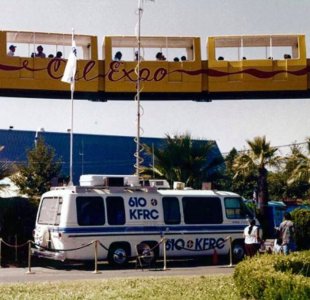
Classic example of remotes done right was KFRC in the 1980s, with a mobile studio.

469552935_1096153185496017_1529189031919816054_n.jpg

NO sales remotes---but they were live from the California State Fair and other major events and would go live all day from Bay Area bridge toll plazas---with all tolls that day paid by KFRC. Tremendous promotion.

And, it was a fully functional air studio, so the on-air sound was the same as if they were in their studios on Bush Street.

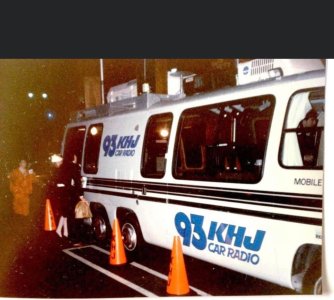
Here's video of the studio's last day with KFRC in November, 1983 before RKO sent it down to KHJ:


....and KHJ...desperate in those days....used it for sales remotes.

469523788_1096153045496031_4417033809515124482_n.jpg

Live from donut shop parking lots and the like.

It was back in SF at KFRC in 18 months.


Back
Top Bottom