• Get involved.
    We want your input!
    Apply for Membership and join the conversations about everything related to broadcasting.

    After we receive your registration, a moderator will review it. After your registration is approved, you will be permitted to post.
    If you use a disposable or false email address, your registration will be rejected.

    After your membership is approved, please take a minute to tell us a little bit about yourself.
    https://www.radiodiscussions.com/forums/introduce-yourself.1088/

    Thanks in advance and have fun!
    RadioDiscussions Administrators

Miami/Fort Lauderdale LPFM caught with 1000 watt ERP!

OK, but you still need to be able to read the meters and control the transmitter. And, I'm sure this transmitter was not type certified for LPFM.

As Frank has just debunked that "statement of fact", I would be interested to know what your basis was for saying "I'm sure ...".
 
In case if anyone wants to understand the likely motivation for WZPP-LP, et al to operate at such "criminal" power levels, now it can be told:

I listened to this aircheck all the way through (if this was a single stopset, it was long enough to have been from an Audacy or iHeart station!). The second spot actually self-identifies as a commercial by saying "in five minutes you will hear another commercial for ..."

They seem to think "acknowledging the support" makes the rest of it okay. I personally hope that they are fined commensurate to the revenue they took in ... and then have their license revoked.

This is one case where there better not be a consent decree as the resolution, IMHO.
 
Two Miami area LPFM stations WGVK-LP and WPSI-LP have filed to go silent. Both have the same address as well as the last name (Kost) is the same on both applications.
WVGK-LP went off the air on May 1, 2025, due to loss of tower site. Signed by Sofia Kost.
WPSI-LP went off the air May 5, 2025 due to technical reasons with equipment. Signed by Joshua Kost.
Same FCC attorney Dan Alpert.
 
I'm curious if the WZPP feed was both on air and online or online only. At any rate these guys must have a couple of folks doing sales at the least.
 
Two Miami area LPFM stations WGVK-LP and WPSI-LP have filed to go silent. Both have the same address as well as the last name (Kost) is the same on both applications.
WVGK-LP went off the air on May 1, 2025, due to loss of tower site. Signed by Sofia Kost.
WPSI-LP went off the air May 5, 2025 due to technical reasons with equipment. Signed by Joshua Kost.
Same FCC attorney Dan Alpert.
That's the Nestor Kost family... the Cesar Guel clones of South Florida. Just like the Hector Guevara are the Cesar Guel clones of Houston. They are well known in this shop.
 
I'm curious if the WZPP feed was both on air and online or online only. At any rate these guys must have a couple of folks doing sales at the least.
Extremely unlikely, especially given how the segues went in and out of the stopset. These are not the only ones who are running full fledged commercial businesses with LPFMs. I have heard my share of them.
 
How blatant. If I were the FCC I'd want to rip the license off the wall. This is not a questionable word or two in an underwriting announcement. This is intentional violation of the rules. The question is if the FCC has the teeth to bite them good. Such an organization will just go rogue as a pirate if you take the LPFM license, so there has to be follow-up with even a bigger bite.
 
This has been going on for years with at least a couple of LPFMs in the market. They are all controlled by one person even though they are in the name of various relatives and are basically "straw men" applications. The FCC just seems to turn a blind eye.
 
Last edited:
We have many LPFM stations in the Los Angeles area that are very successful. KWSV-LP Simi, KBUU-LP Malibu and KQBH-LP Los Angeles. One of the items that help it is to make sure that you have a Broadcast Engineer that knows the FCC rules and follows them. We do have many in the LA area that just a waste of time.
 
We have many LPFM stations in the Los Angeles area that are very successful. KWSV-LP Simi, KBUU-LP Malibu and KQBH-LP Los Angeles. One of the items that help it is to make sure that you have a Broadcast Engineer that knows the FCC rules and follows them. We do have many in the LA area that just a waste of time.

I am a particular fan of Hans Laetz, who operates the Malibu station. He is not only very community focused, he's a damned good engineer in the first place.
 
The way it looks, over the past several years, about 1/3rd of LPFMs fail. Many say there are a good number of LPFMs that have been off the air by up to well over a year but never filed for a STA.
 
The way it looks, over the past several years, about 1/3rd of LPFMs fail. Many say there are a good number of LPFMs that have been off the air by up to well over a year but never filed for a STA.

Here is the way I see it (my friend @Michi is of course welcome to correct me if I am off anywhere in my observations):

For every Hans Laetz there are at least two or three LPFM operators who don't have a clue. They start out with a desire to be on the air and give the community programming that they can't get elsewhere, but few of them completely understand that licensed stations, regardless of size, have regulations to follow. As we have seen, even the ones who aren't flagrantly violating the non-commercial status of their license are not always clear about where the non-"crossable" lines are about announcements for local business supporters.

And I also believe that -- again, excluding the deliberate violators -- most LPFMs don't even have regular technical inspections of their facilities to ensure compliance. Unfortunately for them, "we didn't know we were operating at too high a power" is not an argument the FCC readily accepts.

Given just those two points, I conclude that the observation you made about silent LPFMs who have not filed STA requests is true. If they have trouble with the underlying regulations and also don't have a regular contact with someone who can keep them on the air legally, they certainly don't know that they have to tell the FCC if they go off the air for more than 30 days. The ones that have already exceeded a year will probably not even be noticed by the Media Bureau unless someone tells them, and those licenses won't be cancelled until they expire and no one sends in the renewal paperwork.

Add into that the operating expenses, even with a volunteer staff, and it is no surprise that the "glamour" of being on the radio dims considerably. So a lot of them fail ... sadly, because they probably shouldn't have gone on the air in the first place.

 
I am a particular fan of Hans Laetz, who operates the Malibu station. He is not only very community focused, he's a damned good engineer in the first place.
and KWSV is operated by the people who had KVOH SW so they arent newbies to radio and have a clue
 
I took an interest in seeing LPFM happen and I am not happy with the end result. The only thing to do is navigate the rules as they are.

I honestly don't know what it is that makes people think because they are on the board the radio station should run to their personal likes. I've seen boards implode over programming, attempts to take over boards with their people by bullying other board members until they resign. Their programming ideas are all bad to horrible. A couple of examples: the guy that put every track off every classic rock album in rotation because people bought albums; the guy that was going to be all local in Texas. He gets a fellow across the pond to do his liners (British accent) and then does absolutely nothing local. He gets into 3 towns but offers no detail other than the name of the business (C & R Solutions). I have no idea what that is nor what town they're in. His mass appeal format is heavy rock. I'd say many fail because of bad programming.

Certainly bad programming means little if any support so once the money runs out, the lights go out at the LPFM.

It seems the value of a frequency is not lost on them. One station was on 6 months, went dark because they couldn't afford the tower rent. They never got back on the air but they did renew their license when it was time.

Too many think they can hire someone to sell underwriting for just commission. One station that did this later learned the guy went out and traded thousands of dollars in merchandise, a couple of services and had a couple of spots where he had comped meals and drinks all in exchange for ads he said were running on the LPFM. When one of the restaurants contacted the station about 6 months later, the truth came out.

I know of a few stations that bought the cheapest FCC approved transmitter only to have the transmitters burn up after a couple of years. They didn't have the money for repairs, much less a new transmitter.

On the other hand I have heard a good number of quality LPFMs. They were serious about serving their respective community. They smartly ran a mass appeal very local format on weekdays via computer and at night and on weekends had a few specialty shows. Underwriting was consistent. They had sense enough to set back savings for emergencies and they extended a hand to stations in need of help. Amazingly, they were not radio pros. They just listened to advice.
 
I have been dealing with a LPFM in LA that was in a time share and their transmitter did not turn off when they should have. It took a lot for them to actually go to the site and turn it off. They kept telling us it was not on. Sure was!
They did not have any remote control of the transmitter.
If you look at the web site LPFM Database.com it will show the stations that are authorized to be silent as well as those that are reportedly silent. We have one in LA that has been silent since the start of covid as one that is off for weeks at a time and goes on for a few hours and then off again.
 
What is the success/failure rate of LPFM stations? Are there any examples of an LPFM that stays above water while playing by the rules?
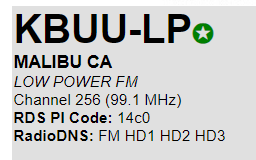
One way of telling which stations may be on the "better" side (no guarantees because of things not yet caught) is to look in FCCdata and on FCC.today for the green star that indicates that they are recognized under REC's PACE program:
1749155667074.png

That green star indicates that in the last 4 rolling years of on-air licensed operation:
  • The station has fully participated in the full EAS National Periodic Tests (2021 & 2023) (we have that data from a FOIA request), (Participation)
  • The station has been on the air at least 75% of the time (assuming they report their silence), (Availability)
  • The station has not received any enforcement notices (NOV, forfeiture, consent decree), and (Compliance)
  • The same nonprofit organization has been the licensee during that entire 4 year evaluation period. (Experience)
There are currently 504 LPFM stations that have met PACE. A considerable number of them (1,378) do not meet PACE because they did not fully participate (forms 1, 2 and 3) in all of the National Periodic Tests that were held in the last 4 years.

More info about PACE at PACE: REC's program for recognizing well-established LPFM stations | REC Networks

Look up an LPFM station's PACE status at PACE LPFM Station Check | REC Networks

Remember, none of the 2023 window LPFMs qualified for PACE since they have had 4 years of licensed operaitons.
 
Should excessive power really be a big deal as long as nobody's being interfered with? I understand if someone's signal is getting stepped on. But what if it's an empty channel, or a channel with no local stations? LPFMS are so limited in range and pretty costly to get on/fix, and less people have radios these days so it's less fair than 20 years ago IMO.
 
Should excessive power really be a big deal as long as nobody's being interfered with? I understand if someone's signal is getting stepped on. But what if it's an empty channel, or a channel with no local stations? LPFMS are so limited in range and pretty costly to get on/fix, and less people have radios these days so it's less fair than 20 years ago IMO.
While a channel may seem "empty" to you at your location, try putting higher power on it: the signal will extend much farther out and probably touch the outer signal areas of other stations.


Back
Top Bottom