• Get involved.
    We want your input!
    Apply for Membership and join the conversations about everything related to broadcasting.

    After we receive your registration, a moderator will review it. After your registration is approved, you will be permitted to post.
    If you use a disposable or false email address, your registration will be rejected.

    After your membership is approved, please take a minute to tell us a little bit about yourself.
    https://www.radiodiscussions.com/forums/introduce-yourself.1088/

    Thanks in advance and have fun!
    RadioDiscussions Administrators

Lpfm-col?

I am not sure under which category I should be posting this question, but...
how is it that so many of these new LPFM's have coverage areas that miss their cities of license?
At 60db for example,
WAYG-LP gets into one little corner of Miami and
WLJM-LP almost but not quite touches Miami Beach.
 
I am not sure under which category I should be posting this question, but...
how is it that so many of these new LPFM's have coverage areas that miss their cities of license?
At 60db for example,
WAYG-LP gets into one little corner of Miami and
WLJM-LP almost but not quite touches Miami Beach.

A lot of these little radio stations rely on a fanatical fan base that is motivated to DX them no matter what the cost. I notice Calvary Chapel's little station capitalizes on the famous call letters of a defunct WAY-FM outlet that used to be in Sarasota. NONE, and in NONE of the WAY-FM audience is going to be fooled or want to listen to Calvary Chapel's format. But members of Calvary Chapel are fanatics about their radio network. I helped a fair number of them in Plano, TX, DX the Calvary Chapel station all the way in Decatur, TX. The depth of their devotion to the format is amazing. I even helped one family get the station up near Sherman, TX. This was years ago before their power increase. They were very weak, deep fringe at the time. It took a good tuner with an outdoor antenna. 60 dB contours are meaningless to people who are fanatical about a station or format.
 
Thanks to both of you, but my question was really more about the legality of how a station can have a COL that it does serve.

Some stations could obviously move to the east without interfering with any other stations, plus there are some really better areas to the east.
I would rather have a station in downtown Miami than western Dade county even if some of the area is over water (WAYG),
and I would much rather cover the touristry area of Miami Beach (plus my supportive parishoners)
than the working class areas in North Miami (WLJM is not going to get new parishoners from out there).
 
Last edited:
I am not sure under which category I should be posting this question, but...
how is it that so many of these new LPFM's have coverage areas that miss their cities of license?
At 60db for example,
WAYG-LP gets into one little corner of Miami and
WLJM-LP almost but not quite touches Miami Beach.

As far as I know, LPFM stations are not required to cover their entire city of license due to their low power.
 
...LPFM stations are not required to cover their entire city of license due to their low power.
But the Miami Beach example I refered to doesn't touch any part of the city at all?
 
Try 200. There are a couple of hundred members of CC Plano. It is almost scary how fanatical they were.

The Dallas metro is 7 million persons; the top station cumes 1.75 million people.

You just made my point.
 
But the Miami Beach example I refered to doesn't touch any part of the city at all?

LPFM stations are licensed to serve a neighborhood, so the COL is in a sense irrelevant.
 
You entered those last posts before I could get back,
I was going to mention WJEW as an example for my previous post.
Their COL is Miami while they are actually in Homestead with a number of cities between them.
How far can they stretch it...the next county, the next state, the next time zone?
 
Last edited:


The Dallas metro is 7 million persons; the top station cumes 1.75 million people.

You just made my point.

And - my point about all these little Spanish language church LPFMs showing up all over Houston. The term is BROADcasting. Not NARROWcasting. But when you have an interest in a particular format, I guess it doesn't matter if it reaches only a tiny audience and ties up a frequency that is supposed to be used in the public interest, when there are only 100 frequencies available on the FM band.
 
You are right Bruce. You don't get to pick the formats of the stations and the FCC doesn't either. It doesn't matter. Knowing, through earlier posts of yours, would you have the same opinion if the format was one of your choosing? Say, NGEN style or oldies? I ask, not to pick a fight but to determine if you dislike LPFM or those who are utilizing LPFM with formats that do not interest you.
 
You are right Bruce. You don't get to pick the formats of the stations and the FCC doesn't either. It doesn't matter. Knowing, through earlier posts of yours, would you have the same opinion if the format was one of your choosing? Say, NGEN style or oldies? I ask, not to pick a fight but to determine if you dislike LPFM or those who are utilizing LPFM with formats that do not interest you.

I just see warring religious factions fighting to get as many translators as possible before their opponent does. I have no idea what the schism is among Spanish religious broadcasters, but it must be a doozy. As for LPFM's I like as opposed to those I don't - there is one I listen to. But the technical quality is TERRIBLE. So bad it is almost unlistenable. I suspect the same thing with a lot of the LPFMs that play other formats. At least translators re-broadcast something with good quality audio. I just don't see the whole business model for LPFM / translators really acting in the public interest. And I am seeing the FM band rapidly being re-made in the image of the AM band. How long before there are so many little factions on the dial that your radio will flip to a different station every block? That's not going to help anybody. Just as the AM band is basically unlistenable at night due to station glut.
 
A while back I'd worked with some people who wanted to put on an LPFM. Their tower location would have ensured that the main service lobe would cover the COL's downtown. In fact, iIrc, it would have covered the entire community of license.

Then, someone interpreted an updated LPFM ruling (and apparently did so accurately) as the main signal having only had to cover -- a choice! -- either 50% of the COL's land mass or 50% of its population.
Well, fair enough. The main signal did both the old and the new relaxed rules. I'm speculating here, but it seemed to me that 'big radio', wanting a more prestigious COL than their former mailbox was, got that old rule relaxed somewhat. Especially with commercial Class A stations. Also, iIrc, the main signal did not have to cover 'the downtown' to legally claim the improved digs as the official COL.

Anyway, I idly got in touch with an FCC-licensed consulting engineer about the COL rules for an LPFM. He literally shrugged it off as unimportant. From what I gathered, the COL mention and the honesty of the approach had everything to do with the location of the group who applied -- not the COL.

Corrections welcome!

 
A COL can be rather elusive. There's a station assigned to Blowout, Texas. It's on the maps but does not exist. The best I can figure is it is an entrance to a ranch along a dirt road. There's likely a cemetery on the ranch.

I've seen a few LPFMs assigned to towns they don't reach. Actually the post office in the town they don't reach delivers mail there which is why they chose that as the COL.

The defunct WFNG, actually between two towns, was assigned 'Frogtown, Georgia' because at one point there had been a scattering of dwellings there. Google maps takes you to a different Frogtown but this one is halfway between Dahlonega and Cleveland, Georgia. There is a Frogtown Road to help you locate the spot.
 
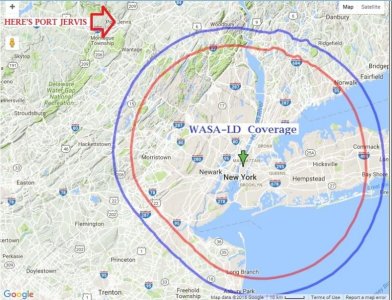
As I understand it, LPFM's and translators (and television LD's) do not have to maintain a studio in or completely cover a "city of license", so there is no city of license for such stations. What is referred to as a COL is simply a name for the sake of the filing, and could even be an owner's mailing address post office. Sometimes such a station will move an won't bother with the effort and fees involved in changing their "city of license". Locally for me, in NYC is WASA-LD with transmitter at Times Square in the heart of New York City, but it still identifies as Port Jervis (NY)... a small community hidden deep in a valley 100 miles away from NYC where WASA's analog station once was, before the move to New York. The WASA signal comes nowhere near Port Jervis, and their programming has nothing to due with Port Jervis. While the identification "Port Jervis" is colloquially referred to as a "city of license", WASA does not have a city of license.
 

Attachments

  • WASA coverage.jpg
    WASA coverage.jpg
    98.9 KB · Views: 5
Last edited:
Status
This thread has been closed due to inactivity. You can create a new thread to discuss this topic.


Back
Top Bottom