It's probably 2,949 feet above average local terrain, but 10,000 feet above sea level.where did you get those numbers? I checked two sources and they are 890 watts at 2,949 feet. 10,000???!!!

-
Get involved.
We want your input!
Apply for Membership and join the conversations about everything related to broadcasting.
After we receive your registration, a moderator will review it. After your registration is approved, you will be permitted to post.
If you use a disposable or false email address, your registration will be rejected.
After your membership is approved, please take a minute to tell us a little bit about yourself.
https://www.radiodiscussions.com/forums/introduce-yourself.1088/
Thanks in advance and have fun!
RadioDiscussions Administrators
You are using an out of date browser. It may not display this or other websites correctly.
You should upgrade or use an alternative browser.
You should upgrade or use an alternative browser.
Market with the strongest FM signals overall
- Thread starter CentralFL
- Start date
That's the height above average terrain used for FCC license calculation. Elevation above sea level is 2885 meters, or 9,465 feet:where did you get those numbers? I checked two sources and they are 890 watts at 2,949 feet. 10,000???!!!
Two things about this:
1. It's probably way more than 2885 meters above 395, judging from the coverage map.
2. I wouldn't want to have to maintain that site in the winter.
Dave B.

Anecdotally, from my years of traveling. Mostly work related. I'd have to give it to Los Amgeles. As has been said, Mount Wilson has to be tough to beat. Especially for any monster signals that might be grandfathered in. KRTH is one signal that comes to mind that's always been listenable in more than 20-years worth of rental car radios.Does anyone have an opinion on which market has the overall furthest reaching FMs? I'm thinking somewhere with a lot of Class C's and flat topography. Off hand, Houston, Tampa, Orlando and New Orleans come to mind. Orlando and Tampa have some lower powered stations, but still have plenty of 100 kw stations on tall towers. Thanks
If we want tp factor in frequent tropo events, I'd say New Orleans has to be in the conversation. Where my family and I vacation near Pensacola, about 150 miles east on the Gulf Coast, the full-signal New Otleans FMs are listenable more often than nor. Even during most winters.
How far south can 95.1 and 96.9 go before interference with Jacksonville? I'd have to say WLUB 105.7 out of Augusta, GA is a monster signalTX and FL definitely have an advantage over other states, especially with so many large markets close to each other.
Once you get into the Carolinas there is more space between the markets. Charleston has 9 100kw equivalent stations but there are 43 FM signals in the market including translators.
The powerful FMs from Charleston (95.1, 96.9, 101.7, 102.5) can compete with any market anywhere, especially the first 3. You can get a good signal 80-90 miles out for all of them.
The Mount Wilson stations in Los Angeles seem to have a fairly wide reach despite being class B FMs. Ditto with many of the Bay Area and Central Valley stations. Just look at KSKS in Fresno; the [potential] reach of the signal is insane, at 68,000 watts!
There are a few spots to get KSKS in the eastern Sierra. Such as on state route 120/Mono Lake Basin Rd between US-395 and Panum Crater. It's reliable reception every time as long as the weather is clear (knife-edge?). But I've only been there in summer and fall. Only 60 miles, but with 10,500 ft peaks in the way
Correspondingly, I've also received it in the Santa Clarita Valley, 190 miles to the south.
- shopping center on NE corner of The Old Road and Magic Mountain Parkway.
-Westridge, Valencia Blvd/Heritage View Lane
-IMT Apartments, Stevenson Ranch
-the old NIKE Los Pinetos missile base by Sylmar.
Again, reliable reception during clear weather, in spite of co-channel KDB Santa Barbara and KZFX Ridgecrest.
RabbitEars.InfoThat's a really good map. I can't get that website to work other than the nice link that you posted. Do you have to register to get that much detail out of it?
Longley-Rice Maps for FM are a "hidden" feature (no link from main site)
Edit: I see RF101 already mentioned it
I nominate the Eshom Point signals from Fresno/Visalia CA.
-94.9 KBOS, from Atwater/Merced south to Delano/McFarland when KXTT Maricopa/Bakersfield takes over. Then KBOS again from the 5 & 99 freeway split (exactly) south past Gorman until around route 138.
-97.1 KSEQ, reliable from Chowchilla south to Lebec on the Grapevine, 176 miles. KABX limits the it to the north, KNX from the south.
-91.5 KSJV, at one point its translator 97.1 K246BO Paso Robles received it directly.
Also to mention Mt. Wilson signals... after 2021's KNP Complex fire burned the IHeart station's transmitters, they never replaced HD Radio.
Along highway 43 south of Hanford to around Allensworth, 94.7 KTWV from LA is reliable. 95.5 KLOS also comes in for that stretch. ~150 miles, with big terrain/elevation changes.
KLOS is reliable in the hilly areas of east Bakersfield (Oswell to Morning Drive)
Attachment is the L-R map for KSEQ, but all the Eshom signals look similar.
-94.9 KBOS, from Atwater/Merced south to Delano/McFarland when KXTT Maricopa/Bakersfield takes over. Then KBOS again from the 5 & 99 freeway split (exactly) south past Gorman until around route 138.
-97.1 KSEQ, reliable from Chowchilla south to Lebec on the Grapevine, 176 miles. KABX limits the it to the north, KNX from the south.
-91.5 KSJV, at one point its translator 97.1 K246BO Paso Robles received it directly.
Also to mention Mt. Wilson signals... after 2021's KNP Complex fire burned the IHeart station's transmitters, they never replaced HD Radio.
Along highway 43 south of Hanford to around Allensworth, 94.7 KTWV from LA is reliable. 95.5 KLOS also comes in for that stretch. ~150 miles, with big terrain/elevation changes.
KLOS is reliable in the hilly areas of east Bakersfield (Oswell to Morning Drive)
Attachment is the L-R map for KSEQ, but all the Eshom signals look similar.
Attachments
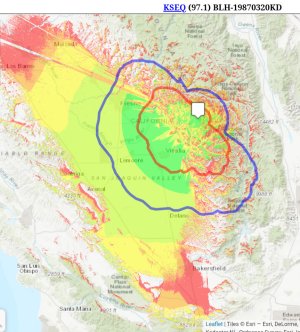
Little bitty Montgomery, AL (#155) has 4 100kw FM's. 5 if you count a massive 105.7 licensed to Troy.

they are at 2863 meter around 10 thousand feet with 2 bayswhere did you get those numbers? I checked two sources and they are 890 watts at 2,949 feet. 10,000???!!!
I know the feeling, i do maintain that site but not that station.That's the height above average terrain used for FCC license calculation. Elevation above sea level is 2885 meters, or 9,465 feet:
Two things about this:
1. It's probably way more than 2885 meters above 395, judging from the coverage map.
2. I wouldn't want to have to maintain that site in the winter.
Dave B.

Poor Mountain in Roanoke, VA has some monster signals. I remember getting WVTF, WSLQ, WSLC (former WPVR), and WXLK over 100 miles away in Amelia County as a kid (about 40 miles from Richmond) year round. They all have city-grade coverage in Lynchburg, nearly 50 miles away!
Not only that but I remember reading that some of those signals were more than 100,000 watts.Poor Mountain in Roanoke, VA has some monster signals. I remember getting WVTF, WSLQ, WSLC (former WPVR), and WXLK over 100 miles away in Amelia County as a kid (about 40 miles from Richmond) year round. They all have city-grade coverage in Lynchburg, nearly 50 miles away!

It's a small market, but in Grand Rapids, MI there are two superpower FMs:
WBCT 93.7 320kw
WSRW 105.7 265kw
I would think it's significantly more expensive to operate at those power levels, but I guess the station operators feel it's worth it? The benefit is not likely as great as the olden days when there were far fewer FM stations. The contours don't appear to be as large as one might expect.
WBCT 93.7 320kw
WSRW 105.7 265kw
I would think it's significantly more expensive to operate at those power levels, but I guess the station operators feel it's worth it? The benefit is not likely as great as the olden days when there were far fewer FM stations. The contours don't appear to be as large as one might expect.
The antennas for these stations are not as high up as those located on, say, a mountaintop. Even though they are grandfathered, they only receive the same protection as a standard Class B. Plus, even with the higher power, the laws of physics dictate how far those signals will get out. Once you get out past the horizon, things tend to deteriorate pretty quickly. But in-market, they are big signals.It's a small market, but in Grand Rapids, MI there are two superpower FMs:
WBCT 93.7 320kw
WSRW 105.7 265kw
I would think it's significantly more expensive to operate at those power levels, but I guess the station operators feel it's worth it? The benefit is not likely as great as the olden days when there were far fewer FM stations. The contours don't appear to be as large as one might expect.
WTVF is a TV station in Nashville, TN.I've picked up WTVF in Emerald Isle, North Carolina--out on the coast--multiple times, and it was very listenable from over 300 miles away.
It's a small market, but in Grand Rapids, MI there are two superpower FMs:
WBCT 93.7 320kw
WSRW 105.7 265kw
I would think it's significantly more expensive to operate at those power levels, but I guess the station operators feel it's worth it? The benefit is not likely as great as the olden days when there were far fewer FM stations. The contours don't appear to be as large as one might expect.
Also in the same market, 104.1 WVGR is grandfathered at 96kW.
WBCT and WSRW (especially the former) have listeners in Kalamazoo and Lansing.
But WVTF is the NPR station in Roanoke, Virginia--that's what I received despite a slip of the keyboard, not the Nashville CBS affiliate.WTVF is a TV station in Nashville, TN.

WMIT 106.9, licensed to Black Mountain, NC, has its tower on a peak near Mount Mitchell. That's where the call letters come from. It has to be over 6700 feet. With a 36,000-watt signal it sounds like a local station in Concord, about 6000 feet lower, over 100 miles away. They bought a translator in Rock Hill south of Charlotte but considering Rock Hill has a station at 107.1, they might need it.
Don't know how far east it might reach if not for WMGU in the Fayetteville market. I've picked up both at home but usually WMIT has the better signal.
The format is mostly Contemporary Christian with some preaching. Billy Graham's people own it.
A few years ago, on a flight from Saint Louis to Charlotte NC I was about 100 miles from Charlotte, just past Asheville, and flying right over the Mount Mitchell / NC Black Mountains, right above the transmitter for WMIT, but field testing in the plane, I was surprised, who or checking 106.9 I didnt hear WMIT at all, but instead heard WMGU loud and clear from Fayetteville with a strong signal, even while only 20,000 feet above the WMIT site AND looking right at the tower! Surely they don't send signal straight up, but signal goes straight out to/beyond the horizon...eh....but after a few more miles closer to the Morganton area, WMIT came in once again.
I've also heard WMIT and WSSL south of Augusta GA (over 100 miles) and WSPA 98.9 from Spartanburg SC down to Douglas GA about 200 miles.
Now that's amazing.A few years ago, on a flight from Saint Louis to Charlotte NC I was about 100 miles from Charlotte, just past Asheville, and flying right over the Mount Mitchell / NC Black Mountains, right above the transmitter for WMIT, but field testing in the plane, I was surprised, who or checking 106.9 I didnt hear WMIT at all, but instead heard WMGU loud and clear from Fayetteville with a strong signal, even while only 20,000 feet above the WMIT site AND looking right at the tower! Surely they don't send signal straight up, but signal goes straight out to/beyond the horizon...eh....but after a few more miles closer to the Morganton area, WMIT came in once again.
What was WSPA, of course. It's called WYRD now.I've also heard WMIT and WSSL south of Augusta GA (over 100 miles) and WSPA 98.9 from Spartanburg SC down to Douglas GA about 200 miles.
A little over 20 years ago, I was at Smoky Mountains National Park, and I was able to hear most of the 100,000 watt Charlotte stations in the area around Klingman's Dome. I also got WSPA-FM 98.9 there. Can't remember if I got anything else from Greenville/Spartanburg there. After going a little further through the park and going down in elevation, the Charlotte FM's were gone quickly.
You can get a lot on airplanes, too, though you're not supposed to listen to the radio there. And, yes, being that far over the tower means you often won't get the stations you're directly over. The signals go outward from the towers. You can also sometimes experience that when you're at the base of an FM tower, though you generally won't get distant stations covering them.
You can get a lot on airplanes, too, though you're not supposed to listen to the radio there. And, yes, being that far over the tower means you often won't get the stations you're directly over. The signals go outward from the towers. You can also sometimes experience that when you're at the base of an FM tower, though you generally won't get distant stations covering them.
- Status
- This thread has been closed due to inactivity. You can create a new thread to discuss this topic.