
-
Get involved.
We want your input!
Apply for Membership and join the conversations about everything related to broadcasting.
After we receive your registration, a moderator will review it. After your registration is approved, you will be permitted to post.
If you use a disposable or false email address, your registration will be rejected.
After your membership is approved, please take a minute to tell us a little bit about yourself.
https://www.radiodiscussions.com/forums/introduce-yourself.1088/
Thanks in advance and have fun!
RadioDiscussions Administrators
You are using an out of date browser. It may not display this or other websites correctly.
You should upgrade or use an alternative browser.
You should upgrade or use an alternative browser.
Buffalo May '26 ratings
- Thread starter ckg279
- Start date
Unless you have a complete listing of ALL stations (WGRF, WECK, WEDG, etc.), ratings paint an incomplete picture. Like Buddy says it’s all about the results for his clients - not the ratings at this point.

But for sales purposes, radio is sold based on the size of your station's audience. Your rates are based on your own station's audience size and not some other station's audience. So Nielsen does give a metric by which to sell based on the size of your own audience.Unless you have a complete listing of ALL stations (WGRF, WECK, WEDG, etc.), ratings paint an incomplete picture. Like Buddy says it’s all about the results for his clients - not the ratings at this point.
That said, I think Nielsen is making a mistake "delisting" non subscribers. We will see whether the new Eastlan releases in markets like Houston get traction at ad agencies. If they do, that will be a major problem for Nielsen.
I respectfully disagree. Our rates have nothing to do with audience size. It’s yield management, based on inventory. Nothing to do with ratings. Our clients will pay the freight to target the audience that will respond to their message.But for sales purposes, radio is sold based on the size of your station's audience. Your rates are based on your own station's audience size and not some other station's audience. So Nielsen does give a metric by which to sell based on the size of your own audience.
That said, I think Nielsen is making a mistake "delisting" non subscribers. We will see whether the new Eastlan releases in markets like Houston get traction at ad agencies. If they do, that will be a major problem for Nielsen.
This ratings crap with Nielsen is far beyond pathetic. There is no way to get an accurate representation of the market with all these stations missing. There is no point if you’re looking at it from a total market perspective. If you just want to use your ratings to sell your reporting station, that’s different.
Another piece of software that is going to give Nielsen a run is DTS by Xperi. We got the professional version today. Its samples about 22,000 cars in metro Buffalo that have DTS. It’s real time. You can see next day how many cars had your station on. They also have a heat map to show the geography of the cars.
This is actual information, not diaries, about real time car listening. It also does a ranking. There are 111 stations in Buffalo the appear on Buffalo cars. The car sample size is 22,000.
Go to Xperi DTS and check it out
But you are still limited by the need to have an audience that will respond and buy from your clients. I have always said that the best ratings service for small market stations is the cash register. That argument can overcome format and listener age objections with ease.I respectfully disagree. Our rates have nothing to do with audience size. It’s yield management, based on inventory. Nothing to do with ratings. Our clients will pay the freight to target the audience that will respond to their message.
I have long objected to the Nielsen philosophy. Around 2002 I was on of the couple of radio group representatives to the joint Nielsen / Arbitron / Radio /TV committee that evaluated combining the new PPM for all electronic media. Nielsen dropped out, as they wanted certain restrictions on reporting even then.This ratings crap with Nielsen is far beyond pathetic. There is no way to get an accurate representation of the market with all these stations missing. There is no point if you’re looking at it from a total market perspective. If you just want to use your ratings to sell your reporting station, that’s different.
For the moment, DTS is in newer cars. That means that people who have used cars are pretty much excluded and that, in turn, eliminates a huge portion of the Hispanic and Black audience as well as people of any race or culture who have lower incomes.Another piece of software that is going to give Nielsen a run is DTS by Xperi. We got the professional version today. Its samples about 22,000 cars in metro Buffalo that have DTS. It’s real time. You can see next day how many cars had your station on. They also have a heat map to show the geography of the cars.
As I said, it is a very defective sample. A defective sample, even if large, is not representative. Just 26 million cars around the world have DTS... while there are over 250 million vehicles with radios just in the USA. Would you trust a survey that can only measure around 5% of your local population... and then only in their cars?This is actual information, not diaries, about real time car listening. It also does a ranking. There are 111 stations in Buffalo the appear on Buffalo cars. The car sample size is 22,000.
Go to Xperi DTS and check it out
I just checked it out - very impressive.I respectfully disagree. Our rates have nothing to do with audience size. It’s yield management, based on inventory. Nothing to do with ratings. Our clients will pay the freight to target the audience that will respond to their message.
This ratings crap with Nielsen is far beyond pathetic. There is no way to get an accurate representation of the market with all these stations missing. There is no point if you’re looking at it from a total market perspective. If you just want to use your ratings to sell your reporting station, that’s different.
Another piece of software that is going to give Nielsen a run is DTS by Xperi. We got the professional version today. Its samples about 22,000 cars in metro Buffalo that have DTS. It’s real time. You can see next day how many cars had your station on. They also have a heat map to show the geography of the cars.
This is actual information, not diaries, about real time car listening. It also does a ranking. There are 111 stations in Buffalo the appear on Buffalo cars. The car sample size is 22,000.
Go to Xperi DTS and check it out
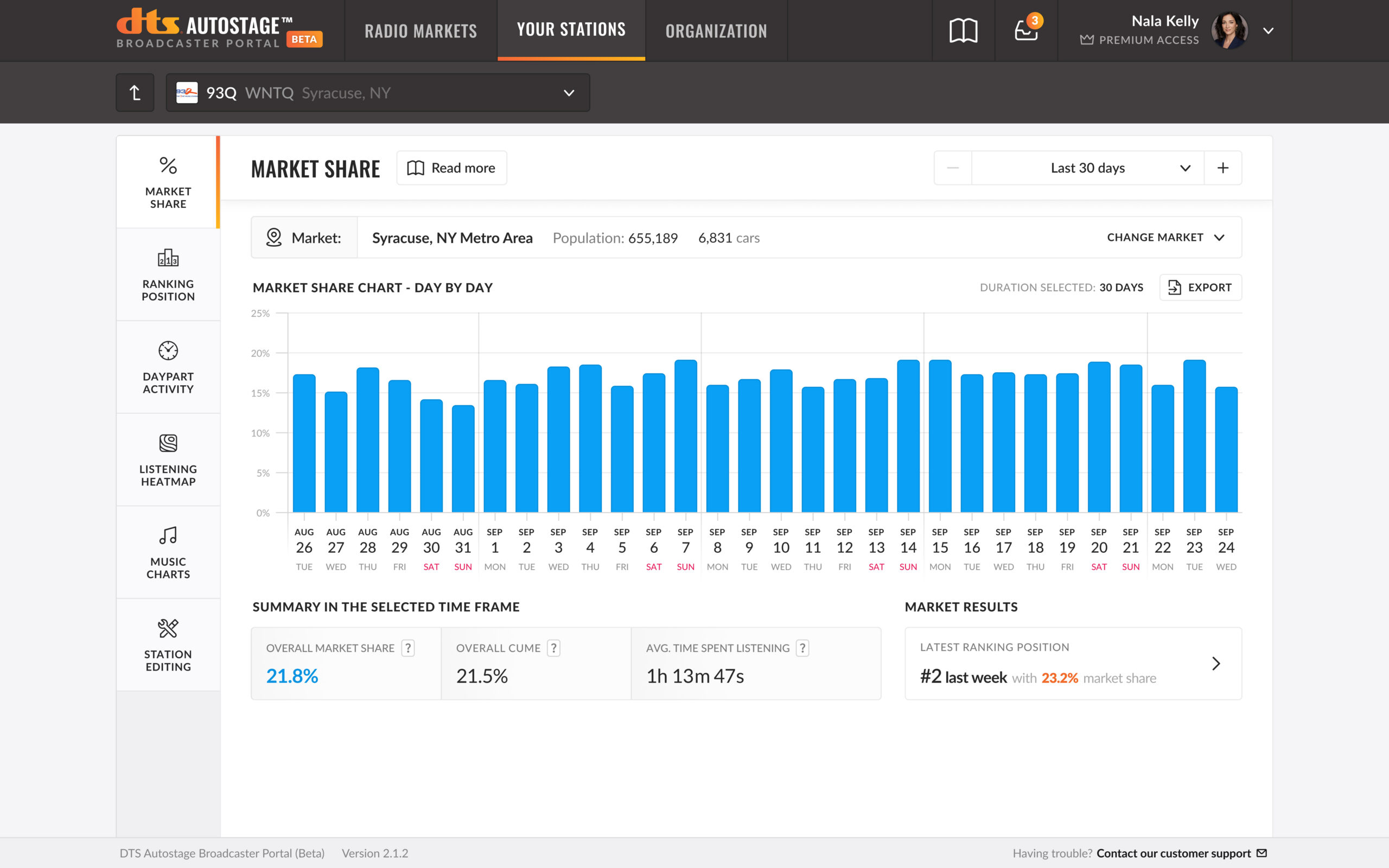
Xperi Launches DTS Autostage Portal Premium Tier - Radio World
Xperi, the parent of the DTS AutoStage technology, has announced a new premium tier of features for its broadcaster portal, features include station rankings by daypart and top 100 song charts
 www.radioworld.com
But you are still limited by the need to have an audience that will respond and buy from your clients. I have always said that the best ratings service for small market stations is the cash register. That argument can overcome format and listener age objections with ease.
I have long objected to the Nielsen philosophy. Around 2002 I was on of the couple of radio group representatives to the joint Nielsen / Arbitron / Radio /TV committee that evaluated combining the new PPM for all electronic media. Nielsen dropped out, as they wanted certain restrictions on reporting even then.
For the moment, DTS is in newer cars. That means that people who have used cars are pretty much excluded and that, in turn, eliminates a huge portion of the Hispanic and Black audience as well as people of any race or culture who have lower incomes.
As I said, it is a very defective sample. A defective sample, even if large, is not representative. Just 26 million cars around the world have DTS... while there are over 250 million vehicles with radios just in the USA. Would you trust a survey that can only measure around 5% of your local population... and then only in their cars?
I would trust it more than Nielsen. 22,000 cars are monitored in Buffalo. About 2500 diaries that never get returned go out in Buffalo
If DTS AutoStage released at least some ratings to the general public, Nielsen would be in big trouble. Even a rudimentary 12+ similar to Nielsen's public posting, however flawed, would give them a lot more visibility, especially if they included all stations, including non-subscribers. The greater sample size and granularity would attract subscribers if the results were anywhere near comparable.I just checked it out - very impressive.
Xperi Launches DTS Autostage Portal Premium Tier - Radio World
Xperi, the parent of the DTS AutoStage technology, has announced a new premium tier of features for its broadcaster portal, features include station rankings by daypart and top 100 song charts
Still, it's results that matter more than numbers. Neilsen's system here relies on recall. Both systems tell you who has a station on, not necessarily who's listening. Results are the product of people listening to content, not just hearing it in the background.