
I meant streaming, particularly in the U.S.
Already there---began December 13 on Apple TV, Vudu, Amazon Prime, Xfinity, Google Play, and YouTube. $19.89 a pop.

I meant streaming, particularly in the U.S.
That's partly what I said in my previous post, but thanks for mentioning the priceAlready there---began December 13 on Apple TV, Vudu, Amazon Prime, Xfinity, Google Play, and YouTube. $19.89 a pop.
My understanding is Eras was released on a Pay-Per-View basis on AZ Prime, though not yet free viewing for subscribers. You want to watch Taylor 10 times, you pay 10 times. Each time you have 48 hours to watch the movie front-to-back (with pauses, if necessary). But once you've seen it to the end, or the 48 hours expires, it's another toll charge (so to speak).I meant streaming, particularly in the U.S. Just as with popular movies originally in theaters, I wouldn't wait until all countries are released theatrically before offering streaming in the States. Now that she's caught the wave, you ride that wave from the theatrical peak to subscription streaming before the buzz potentially diminishes. There are a lot of Swifties out there who would want to watch the concert movie over and over, including personal watch parties. That may not be the case a year from now.
In many (not all) cases, it's a situation where they're trying to entice people to appreciate the programming their streaming service offers, hoping that once the free or reduced price offer ends, they'll continue to subscribe at full price. In other cases they lure people in on a low cost or "bundle" deal that lasts for a certain period, with the caveat that they need to provide their credit card or banking information in order to sign up. Once the lower priced offer is over, they continue to bill, often unannounced, at full price.A lot of streaming services are offered as part of a “bundle”, in a way, or better yet as a free bonus/add on - I get Max with no commercials free from AT&T (I believe it’s a grandfathered deal from when they were with Warner) with my cell phone plan, and I get Paramount+ with ads for free with my Walmart+ subscription (which I got for a year on Black Friday for $49). I believe T-Mobile offers a Netflix deal as well. Before the TMo integration, Sprint customers got a certain level of Hulu for free with their plan.
I do have to wonder if the streamers are making much from these deals or if it benefits the company offering it for free more. Someone is likely taking a loss/cut to include them. I’m sure Walmart’s Paramount+ inclusion is to try to compete with Amazon Prime offering video.
Sounds about the same as the theater price. Tickets were higher than a typical movie.I never looked to see what a ticket cost when it was in theaters. Does anyone know if the streaming price of $19.89 is higher than a non-IMAX theater ticket for it was?

 variety.com
Shoring up the contract with the nation's largest cable operator is important for Paramount Global's long-term financial health. It also comes as Paramount Global has been the subject of M&A rumors for several weeks with suitors including Skydance Media and Warner Bros. Discovery circling the owner of Paramount Pictures, Paramount+ , CBS, MTV, Nickelodeon, VH1, Comedy Central, BET Networks and other channels. Comcast itself is also seen as a possible contender if Paramount Global chair Shari Redstone decides that the time is right for a transformative deal for the media assets her father, Sumner Redstone, assembled in the 1980s and '90s.
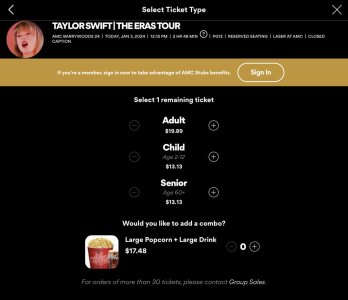
Adult tickets are $19.89, seniors and kids are $13.13 at AMC theaters:I never looked to see what a ticket cost when it was in theaters. Does anyone know if the streaming price of $19.89 is higher than a non-IMAX theater ticket for it was?
 www.wsj.com
Netflix announced they lost 17% of viewing last year:One in four people who cancel a premium streaming service typically resubscribes to that service within four months, and one in three does so within seven months. Half do so within two years.

 www.nexttv.com
Wait, you're paying $0.99 per month for something you can get for free?I don't check the "deals" for streaming services (I have max free w/AT&T Fiber), I found out about the $0.99/mo Hulu deal doing ongoing research for OTA DTV news (subscribed right away), a low cost (very) ad supported streaming service is something I would probably subscribe to on an ongoing basis.
Netflix announced they lost 17% of viewing last year:
Netflix Viewing Declined By 17% in 2023
Based on Netflix's own data, viewers spent over 7 billion hours less last year watching the platform than they did in 2022
Looks like a TSL (TSV?) problem. Subscriber numbers are up, viewing hours down.
17% decrease in viewership over the period of a year is a pretty big deal, one would think.Looks like a TSL (TSV?) problem. Subscriber numbers are up, viewing hours down.
17% decrease in viewership over the period of a year is a pretty big deal, one would think.
Sure, they're still getting that subscription money. But I'm sure the almost 20% loss in time spent viewing affects ad revenues.
And if that almost one out of 5 Netflixers eventually decide it's not worth the money, there's that.
But, then again. a lot of people keep subscriptions even for services they aren't using all the time. If the price is low enough, there's always that "but I want to keep it because there may be that one program (or movie) I want to watch" thing going on.
looks like it's safe to say, the Streaming bubble has finally busted, it's a matter of time before we start seeing bundling of all streaming services on a few internet providers similar to how channels were bundled on basic cable/satellite companies because it's clear streaming is becoming more and more like the same cycle people escape from when they left Cable/Satellite, i bet the streaming channels that stream for free are the one benefiting from this, also wouldn't be surprise to find out internet piracy of content might be on the rise again too.
Four is plenty. I wish there were room for four major parties.No. Again, too many players rushed into a space Amazon, Netflix and Hulu were already dominant in and spent too much money to be instantly competitive in terms of content and subscriber numbers.
There's room for four major streaming platforms. There's not room for eight.
One fundamental problem is that when people started really "cutting the cord" en masse, it was because cable had become cost prohibitive, especially considering the fact that they could view 1,000 + TV and music channels through their cable provider, when they maybe only watched 10 of them at most on a regular basis. One big difference back then is that one could often see many of the NBA, NFL or MLB games they wanted to watch at ESPN.com or another site for free. It was also simple to go to the Travel Channel, Discovery or HGTV and watch a whole hosts of back episodes of your favorite shows, for free, and so folks with a laptop, maybe 1 or 2 (relatively low cost back then) streaming subscriptions to Netflix or similar and an OTA antenna could really save a lot of $$ relatively easily. Now all those back episodes and free sports streaming are locked down and only available via a paid streaming service. More and more content is only available via streaming and the cost of those streaming subscriptions is rising - to the point where, for many who aren't terribly unhappy with the offerings from their cable company, it may be worth it financially to just stay with them.looks like it's safe to say, the Streaming bubble has finally busted, it's a matter of time before we start seeing bundling of all streaming services on a few internet providers similar to how channels were bundled on basic cable/satellite companies because it's clear streaming is becoming more and more like the same cycle people escape from when they left Cable/Satellite, i bet the streaming channels that stream for free are the one benefiting from this, also wouldn't be surprise to find out internet piracy of content might be on the rise again too.


