• Get involved.
    We want your input!
    Apply for Membership and join the conversations about everything related to broadcasting.

    After we receive your registration, a moderator will review it. After your registration is approved, you will be permitted to post.
    If you use a disposable or false email address, your registration will be rejected.

    After your membership is approved, please take a minute to tell us a little bit about yourself.
    https://www.radiodiscussions.com/forums/introduce-yourself.1088/

    Thanks in advance and have fun!
    RadioDiscussions Administrators

Mickey Luckoff & KGO

KFOG was owned by General Electric when it flipped to rock in 1982. Talk about big corporate radio. At the time, GE was one of the biggest corporations in the world.
When there was wailing and gnashing of teeth over the impending end of KFOG, with the blame being laid on "corporate radio", I made that point to Peter Hartlaub of the San Francisco Chronicle. He promptly got very defensive, especially after I sarcastically referred to KFOG as being "owned by a little mom 'n' pop known as General Electric". Hartlaub didn't understand radio all that well anyway, although he thought he did.

The thing they did that was smart was they hired someone who knew the market, and understood the rock music community. They stayed away from corporate rock and did the local thing. There was a great local music community in SF that Tom Donohue was tied in with. But when he died, and Metromedia flipped KSAN to country, there was a big hole that KFOG filled. They did local broadcasts of the annual BAMMY awards. That really endeared them with the locals. It was just a well run radio station. Susquehanna bought the station in 1989, and they were another great company.
KFOG had its ups and downs and, by the 2000s, it had gotten a bit stale. The things they did well included image and early forays into creating an online community (the "Fogheads"). But I think it hit its peak in the 1990s. Still, I missed it when it was gone.
 
When there was wailing and gnashing of teeth over the impending end of KFOG, with the blame being laid on "corporate radio", I made that point to Peter Hartlaub of the San Francisco Chronicle. He promptly got very defensive, especially after I sarcastically referred to KFOG as being "owned by a little mom 'n' pop known as General Electric". Hartlaub didn't understand radio all that well anyway, although he thought he did.

GE was one of the first big corporations to get out of radio. They could see the writing on the wall, and their original motivation for owning radio stations (consumer electronics) was changing. When they bought NBC a few years later, they immediately sold all of the stations and the radio network. That was the canary in the coal mine that the golden era of radio was over.
 
People talk about big corporate radio as though it didn't exist before 1996. But ABC Radio was big corporate radio in its time. Amazingly they did a fairly good job with FM in all of their markets except San Francisco. From what I've read here, I gather the blame should all go to Mickey. He didn't see it coming. He and Sklar had their heads firmly in the past and couldn't imagine any use for FM.
There were lots of broadcasters who just could not see FM happening.

Storz, without the vision of Todd, never looked seriously at FM and they sold the stations about a decade after his death.

Storer, one of the largest independent operators, sold off some FMs and did not develop others rapidly. In the mid-70's they were busy upgrading KTNQ in LA on AM instead of moving into FM.

Taft eventually developed its FMs, but was slow.

Metromedia, under Kluge, was an early adopter of the post-simulcast-prohibition opportunities with his Metromedia. Think "Buzard".

Golden West / Gene Autry did not develop FM rapidly. Doubleday, even under Gary Stevens, was focused on AMs; when Stevens went out on its own, he quickly looked at FM for growth.

Bonneville adopted its own Beautiful Music formats, so it was "big" in FM but did nothing further for years..

Those are just a few examples. But FM took many by surprise when one or two operators "opened up the band" and "brought down" established AM stations, sometimes very fast. I saw one top 20 market go from 12 FM shares to over 50 in less than 6 months.
ABC inherited a great combo from Star in DC and managed to do a great job with the combo, making WMAL-FM into a powerhouse Q107. It was a consistent ratings winner for years.
But that was a late arrival on the list of early successful FM stations. In DC, the station that broke the band open was WPGC, which had an AM daytimer Top 40 but upgraded the FM and immediately knocked off WEAM and other contemporary AMs. That was right about when we landed on the moon... a very early "big" FM. But it already found good Beautiful Music stations on FM, and even the first real FM "oldies" station, WMOD.

 
Remind me of when KFOG flipped from easy-listening to what ultimately became AAA. Was that before or after KSFX became KGO-FM?

After. The KGO flip was May 3, 1982, the KFOG change was September 16, 1982.

KFOG just had a fresher idea about album rock than the ABC guys did. People responded to it but not to KSFX.


KFOG always seemed something of an artifice to me, but people did respond to it.

It was a period where programmers in the trades were referring the AOR as "the new MOR". That they were, in terms of 18-49 adults, what stations like KSFO were in their day.

At one time, the San Francisco market was distinctive, and the radio dial reflected that. What worked there might not work elsewhere, and vice versa. I think that distinctiveness has mostly gone away. There's no (commercial) radio station these days that makes me think, "only in San Francisco".

San Francisco had several of those. KSFO, certainly. KSAN. KSFX during the disco/dance years.
 
After. The KGO flip was May 3, 1982, the KFOG change was September 16, 1982.

KFOG just had a fresher idea about album rock than the ABC guys did. People responded to it but not to KSFX.

I grew up in the Bay Area around that time. 1982 was a crazy year for rock radio in the market. At the beginning of the year, it was KSFX and KMEL, with KSJO and KOME in the South Bay. Then, around March, KCBS-FM became KRQR. KSFX bailed out a few months later, switching to talk as KGO-FM. Then in August, KMPX was sold, and they flipped from big band music to AOR as The Quake (KQAK), stealing Alex Bennett from KMEL in the process. A month later, it was KFOG's turn, as they dumped the elevator music for their own quirky take on the format (imagine 60s psychedelic rockers like the Grateful Dead mixed with contemporary new wave-ish music like Prince, Thompson Twins and Eurythmics). So, six AOR stations suddenly in the market.

And those stations did hang around for a few years, if not longer. KQAK did switch to "Rock of the 80s" in Spring 1983, and lasted until around 1985. KMEL went CHR around that time.
 
I grew up in the Bay Area around that time. 1982 was a crazy year for rock radio in the market. At the beginning of the year, it was KSFX and KMEL, with KSJO and KOME in the South Bay. Then, around March, KCBS-FM became KRQR. KSFX bailed out a few months later, switching to talk as KGO-FM. Then in August, KMPX was sold, and they flipped from big band music to AOR as The Quake (KQAK), stealing Alex Bennett from KMEL in the process. A month later, it was KFOG's turn, as they dumped the elevator music for their own quirky take on the format (imagine 60s psychedelic rockers like the Grateful Dead mixed with contemporary new wave-ish music like Prince, Thompson Twins and Eurythmics). So, six AOR stations suddenly in the market.

And those stations did hang around for a few years, if not longer. KQAK did switch to "Rock of the 80s" in Spring 1983, and lasted until around 1985. KMEL went CHR around that time.

Yep. KMEL's CHR switch was August 25, 1984. And that was a big surrender. Century was a company that made most of its money in album rock.

Thinking about that, though---the three big AOR chains---ABC, Metromedia and Century---all found themselves out of the format in SF in a four-year period.

For anyone interested in the background and development of AOR, R&R's 1978 special edition is a great read:

 
Yep. KMEL's CHR switch was August 25, 1984. And that was a big surrender. Century was a company that made most of its money in album rock.

Thinking about that, though---the three big AOR chains---ABC, Metromedia and Century---all found themselves out of the format in SF in a four-year period.
Earlier in 1984, Century sold KSHE in St. Louis and its Los Angeles station to Emmis. That sale may have had an effect on Century's outlook for KMEL. The general manager of KSHE, Sheldon (Shelley) Grafman, also was involved in the management of the other Century album-rock stations at various times. He was also the brother of Howard Grafman, one of the founders of Century.
 
Interesting enough, on my Facebook feed this morning, a newspaper article from May 1980 about ABC's Chicago FM station popped up in the "Midwest Radio Memories" group. The ABC station was then WDAI, which had switched to disco from AOR less than a year and a half before, was shifting to an "adult rock" format and changing its calls to WRCK, "W-Rock". Dave Kent was doing overnights on WDAI, but would transfer to KSFX (mislabeled in the story as KSSX) in San Francisco. Dave Kent, of course, was better known as KFOG mainstay Dave Morey. "Curiously," the article stated of KSFX, "that station, too, is phasing out its disco sound".

Yet more evidence that ABC had issues figuring out what to do with its FMs.
 
I mentioned Tom Donohue in post #14, and was reminded recently that in addition to his radio career, he was also the owner of a small record label called Autumn Records. Tom signed a San Francisco band called the Beau Brummels. They had a couple of hits in 1965: Laugh, Laugh and Just a Little. The album was produced by Tom's friend and fellow DJ Sly Stone. Also on the label roster was a band called The Great Society with a singer named Grace Slick. Their album contained a song called Somebody To Love that Grace took to RCA when she joined the Jefferson Airplane. There was a time when DJs did more than just play the music. They also made the music.
 
There were lots of broadcasters who just could not see FM happening.

Storz, without the vision of Todd, never looked seriously at FM and they sold the stations about a decade after his death.

Bonneville adopted its own Beautiful Music formats, so it was "big" in FM but did nothing further for years..
Bonneville's original reason for buying wide coverage major market FM stations was to use the 67 KHz SCA to send LDSchurch programming and real time news to their faithful. They distributed SCA receivers to each temple and anyone else who wanted one.
 
Bonneville's original reason for buying wide coverage major market FM stations was to use the 67 KHz SCA to send LDSchurch programming and real time news to their faithful. They distributed SCA receivers to each temple and anyone else who wanted one.
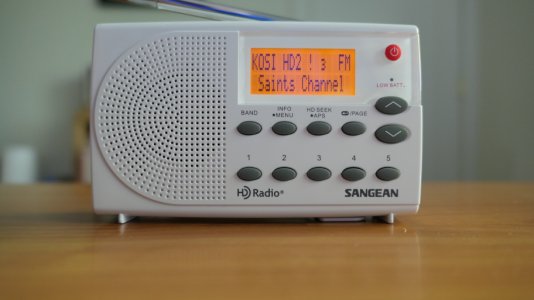
At least in some markets, they're now using HD subchannels for that purpose. I don't recall that Bonneville has been doing that in San Francisco, but they do in Denver:

P1030312-resized.jpg

(Alt-text: Photo of a Sangean HD radio tuned to KOSI, Denver, with the display showing the station's call letters and that its HD2 channel is "The Saints Channel")
 
Interesting enough, on my Facebook feed this morning, a newspaper article from May 1980 about ABC's Chicago FM station popped up in the "Midwest Radio Memories" group. The ABC station was then WDAI, which had switched to disco from AOR less than a year and a half before, was shifting to an "adult rock" format and changing its calls to WRCK, "W-Rock". Dave Kent was doing overnights on WDAI, but would transfer to KSFX (mislabeled in the story as KSSX) in San Francisco. Dave Kent, of course, was better known as KFOG mainstay Dave Morey. "Curiously," the article stated of KSFX, "that station, too, is phasing out its disco sound".

Yet more evidence that ABC had issues figuring out what to do with its FMs.

And that format lasted less than a year, replaced with CHR using the WLS-FM calls again (as I recall, they simulcast Larry Lujack in mornings with AM 89) ... then, without warning one night in early 1986, changed the calls to WYTZ but without any change in format. And they still didn't really know what they were doing, because they changed the direction of "Z-95" several times trying to navigate competitors such as WBBM-FM (B96) and WKQX (Q101). Then back to talk as WLS-FM, and then in fairly quick succession "94.7 Kicks Country" (WKXK), "CD 94.7" (WXCD), all-80s "The Zone" (WZZN), which then went Alternative and then Active Rock.

By then, they were becoming part of Citadel, aired Scott Shannon's True Oldies Channel as WLS-FM (what? again?) and gradually became a rock-oriented Classic Hits station.

At least, that's the way Jeffrey T. Mason told me it went.

You were saying, Mark? :unsure:
 
Metromedia, under Kluge, was an early adopter of the post-simulcast-prohibition opportunities with his Metromedia. Think "Buzard".
Or, if memory serves me correctly... in Los Angeles where I was was growing up: "Little bit of Heaven, 94.7, KMET" ? Maybe I was just a kid and didn't remember it well...
 
I recall a convention of the FM Broadcasters Association where Gabbert was on a panel and mentioned how so many groups ignored FM (like Storz), spun off FMs (Like Storer) or failed to see the future of them in areas where AM had better coverage. A lot of FMs were bought by shrewd broadcasters from old-line companies that felt that "if FM had gotten nowhere in its first 30 years, it would never happen, ever."
Storer also lost a massive amount of money in that timeframe owning Northeast Airlines, so of course the FMs were expendable. Purportedly KGBS AM/FM were also on the block at this time.

George once said of the airline, "we were losing more money in a year than I'd ever thought of making in a year".
 
Or, if memory serves me correctly... in Los Angeles where I was was growing up: "Little bit of Heaven, 94.7, KMET" ? Maybe I was just a kid and didn't remember it well...

Metromedia swapped KLAC-FM (102.7) in 1966 for KRHM (94.7)---and re-named 94.7 KMET. It launched May 2, 1966.

Their first format, though, wasn't rock, but automated MOR, with all-female disc jockeys.

When Tom Donahue had his falling out with both KMPX in San Francisco and KPPC in Pasadena, he approached Metromedia about programming both KSAN and KMET. That began in late May 1968 at KSAN and June at KMET.

By the way, the "little bit of heaven" thing came from a 1975 one-off jingle that Shadoe Stevens, then program director, had the Pointer Sisters cut while they were at the station. It became so popular that people instantly associate it with the station, regardless of era. Ironic, given that the format rarely used jingles and album rock listeners were (supposedly) jingle-averse:

 
Metromedia, under Kluge, was an early adopter of the post-simulcast-prohibition opportunities with his Metromedia. Think "Buzard".
WMMS is an interesting story; it was the lone Metromedia FM in which the progressive rock didn't take off and was replaced for a time in 1969–70 with Hit Parade. They went back to the rock format in 1970 with a few WIXY jocks, then got Billy Bass and Martin Perlich after they quit Nationwide's WNCR and recruited Denny Sanders from Boston. The Buzzard was created two years into the station's Malrite era.
 
Status
This thread has been closed due to inactivity. You can create a new thread to discuss this topic.


Back
Top Bottom