Richard Wagoner has an interesting story in his SoCal radio waves column about a book that fictionalizes a contest the station ran in the early 80's. Sounds like a fun read.

-
Get involved.
We want your input!
Apply for Membership and join the conversations about everything related to broadcasting.
After we receive your registration, a moderator will review it. After your registration is approved, you will be permitted to post.
If you use a disposable or false email address, your registration will be rejected.
After your membership is approved, please take a minute to tell us a little bit about yourself.
https://www.radiodiscussions.com/forums/introduce-yourself.1088/
Thanks in advance and have fun!
RadioDiscussions Administrators
You are using an out of date browser. It may not display this or other websites correctly.
You should upgrade or use an alternative browser.
You should upgrade or use an alternative browser.
Mighty 690 Novel
- Thread starter xkxrx
- Start date

Mighty 690 (XETRA), one heck of a top 40 station. All I remember is all the big hits they played repeatedly. Back in 1980, it seems "Whip It" and "Don't Bring Me Down (1979)" were played a ton. But other good songs were played, such as "Another One Bites the Dust", "Woman in Love", "Magic" and "Upside Down", among many others. Clutter Free, the Mighty 690!, Great Southern California radio memories
Yeah, the Mighty 690 is out of TJ, Mexico, but the signal reached easily into the L.A. metro (and likely beyond)Your in The wrong area. Try to post in the San Diego board

Going back to Gordon McLendon's "Extra News over Los Angeles", XETRA has targeted LA and not San Diego.Your in The wrong area. Try to post in the San Diego board

Summer '82, they were running a tight list of good hits....yet this fun gem, too:
They clearly marketed to and sold both the LA and SD markets.Yeah, the Mighty 690 is out of TJ, Mexico, but the signal reached easily into the L.A. metro (and likely beyond)
In the early 80s I loved the Mighty 690 and so did a lot of my friends. It just sounded so much different (fresher, even more up-beat than KIIS-FM) and what seemed like a more aggressive (read: fun!) playlist. Tight rotations though! In 82-83 I lived at Lake Tahoe and at night the Mighty 690 blew in like a local. I liked it because it was like taking a bit of my hometown (LA) with me when I moved.
At some point around '81 or so, they had a contest were there was a hidden bag with a large sum of money somewhere and they gave out clues all summer narrowing down where to find it. Eventually there were a bunch of listeners running around Balboa Park in San Diego one afternoon where it was eventually found. Made for entertaining radio at the time.
I actually considered this one for the recent under-appreciated thread as well.

Your in The wrong area. Try to post in the San Diego board
Nope. As others have said, The Mighty 690 targeted L.A. as well as San Diego. Actually, more so, because of the bigger pool of ad dollars. This was true in its "Xtra News" days, during its run as a Beautiful Music station and as The Mighty 690 in the 80s.
The Mighty 690's best L.A. book was a 2.4 in the fall of 1981. That was before KIIS-FM really figured it out, but among stations playing contemporary hit music, it was:
KRTH: 3.1
KRLA (which was at the peak of its "HitRadio 11" format before essentially going Gold): 2.8
KIQQ: 2.5
XTRA: 2.4
KFI: 2.2
KIIS-FM: 2.1
So---0.7 behind KRTH (at that time, RKO called it AC, but Radio and Records listed them as a CHR), 0.3 behind KRLA, a tenth behind KIQQ and beating KFI and KIIS-FM. They absolutely are part of the discussion of L.A. radio.
Richard Wagoner has an interesting story in his SoCal radio waves column about a book that fictionalizes a contest the station ran in the early 80's. Sounds like a fun read.
As for the book....well, I have questions. Or maybe they're with the review.
It says "a novel" right there on the cover, but Wagoner goes with:
A quick check of R&R shows the launch was September 19, 1980---so the author was closer than Wagoner.And yet … it’s not true.
I suspected as much when reading some seemingly odd details. The mention of competing popular FM stations “KRUZ and KLAA.” — KRUZ is licensed to Santa Barbara, not Los Angeles, and KLAA is a Los Angeles AM station on 830 AM that didn’t exist in 1981. A line about the company “that had just launched The Mighty 690” in 1981 — the station launched in 1978.
So I asked Cherin about it, and he fessed up immediately. The book was inspired by actual events, but those events “are what my mind remembers, listening to the station as an eleven-year-old kid,” he explained. He calls it a fictionalized version of events.
The contest did run, of course. The clues were indeed given over the air. But the “treasure” was not a metal box filled with cash buried somewhere inside Dodger Stadium as he writes in the book and “what my young mind remembered,” he says, but a piece of paper found behind the rear license plate of a car in the Redondo Beach Pier parking lot. Said piece of paper brought to the station, of course, in exchange for a check.
What about the characters described in the book? “Based upon people I knew in my life,” Cherin says. Not part of the contest at all.
But why? Why not just tell the story as it happened? Part of it has to do with wanting to tell the story of the memory that he held so dear. And in some ways, I suppose he couldn’t give actual details. I can imagine it being close to impossible to find the contestants involved. But a stronger part was a desire to tell a story of the power of radio. At that he succeeds.
That was a very special time and place for me and many others,” Cherin explained. “One that doesn’t exist any more. Radio, back then, was special. It appealed to everyone … it was our social network, especially for those of us coming of age.” I can relate to that.
But the digging? “For whatever reason, I have vivid memories of the contest culminating with finalists digging in Dodger Stadium. Probably what my imagination created in my mind,” he admits, adding that as an adult he realizes it is absurd to think that the Dodgers would let anyone dig up their field … especially in the middle of baseball season.
In spite of the reality that the details are not necessarily real, Cherin does an amazing job of putting the reader in the middle of the contest, in such a way that you feel you actually know everyone involved in the story. And he does indeed capture the excitement of “a” contest, even if it isn’t “the” contest. It’s engaging even if it’s not accurate.
In the end, I think it’s definitely a worthwhile read. Just remember it’s fiction and don’t use it as a historical reference.
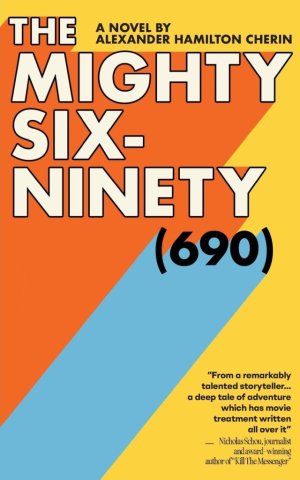
I mean, honest to God, the only way the cover could have made it clearer that it was a novel was to change the title to "Novel"---and then define "novel" in parentheses.
But it sold for LA coverage. Rates are roughly proportional to population and indexed to ratings. LA has always been a market with about 3 to 4 times the rates of SD stations.They clearly marketed to and sold both the LA and SD markets.
This is why the LA stations, five or six of which are normally in the top ten in the Riverside-San Bernardino market, don't sell "out there". In fact, most don't even subscribe to the book in the Inland Empire.

I was a Mighty 690 listener in the 80s.. I lived in the west San Fernando Valley.. quite a bit distant from Sandy Eggo.Your in The wrong area. Try to post in the San Diego board
They sold San Diego too. It has been way too many years and I couldn't possibly name the advertisers, but I clearly remember San Diego only entities advertised. I remember clearly because it added to the allure added uniqueness of the station. This was not just an LA station or an SD station but a total blowtorch for all of SoCal.But it sold for LA coverage. Rates are roughly proportional to population and indexed to ratings. LA has always been a market with about 3 to 4 times the rates of SD stations.
This is why the LA stations, five or six of which are normally in the top ten in the Riverside-San Bernardino market, don't sell "out there". In fact, most don't even subscribe to the book in the Inland Empire.
David, I know this is hard for you to do, but sometimes you have to trust the people who actually listened to the station.
Last edited:
They sold San Diego too. It has been way too many years and I couldn't possibly name the advertisers, but I clearly remember San Diego only entities advertised. I remember clearly because it added to the allure added uniqueness of the station. This was not just an LA station or an SD station but a total blowtorch for all of SoCal.
David, I know this is hard for you to do, but sometimes you have to trust the people who actually listened to the station.
Wow, it took all of five minutes to check the first unscoped aircheck of the Mighty 690 that came up when I searched this morning. It it we have ads for:
- Kearny Mesa Yamaha
- Red Coat Inn (A club on University Ave in SD)
- Honda/Kawasaki of Mission Viejo
- Creepshow Movie ("Now Showing at Selected Theaters and Drive-Ins in San Diego")
- FoodBasket (a San Diego division of Lucky Stores)
- Honda/Kawasaki of Lemon Grove
- Musicland ("All LA and San Diego Locations")
- Athlete's Foot of Fashion Valley and Mission Valley
In fact, in the entire hour I don't think I heard even one LA specific spot. I scanned fast, maybe there was one I missed. But point sufficiently made. Hear for yourself:
Last edited:
I just want the return of the Fabulous 690 - L.A. radio peaked then 🤣
Nope. As others have said, The Mighty 690 targeted L.A. as well as San Diego. Actually, more so, because of the bigger pool of ad dollars. This was true in its "Xtra News" days, during its run as a Beautiful Music station and as The Mighty 690 in the 80s.
When did the Mighty 690 or better said, XETRA begin broadcasting top 40 music? I was a listener from sometime in 1980 through early 1984.
September 19, 1980.When did the Mighty 690 or better said, XETRA begin broadcasting top 40 music? I was a listener from sometime in 1980 through early 1984.
"The World at your Fingertips...It's over 8000 miles from Los Angeles to Bombay...but the World is only 1/14 of a second from Los Angeles via Xetra News!"Going back to Gordon McLendon's "Extra News over Los Angeles", XETRA has targeted LA and not San Diego.
If I remember correctly XeTRA 690 was one of those top 40 stations that would deliberately play records much faster than 45 RPM to create more advertising minutes per hour. For me the music was not listenable on that station.September 19, 1980.
Speeding up records was not intended to add commercial minutes, as there was no limit to that in Mexico. And increasing speed by a couple of percent only gave about 2" per minute, or a minute and a half in the whole music time per hour.If I remember correctly XeTRA 690 was one of those top 40 stations that would deliberately play records much faster than 45 RPM to create more advertising minutes per hour. For me the music was not listenable on that station.
AMs sped up songs so they would sound "brighter" than on competitors (or, in the 70's, when compared with FM).
I sped up songs on several AMs I was GM at in the 70's and the purpose then was to sound "crisper" than other AMs that played the same music. Even at the end of the 70's, in that market, San Juan, FM had only about 10% of listening. But when an FM came on at the beginning of 1979 with a new mass appeal format and earned a 33 share just 90 days into its new format, music on AM was pretty much destined to come to an end.
For me, it sounded a lot more than a couple of percent on XeTRA !Speeding up records was not intended to add commercial minutes, as there was no limit to that in Mexico. And increasing speed by a couple of percent only gave about 2" per minute, or a minute and a half in the whole music time per hour.
AMs sped up songs so they would sound "brighter" than on competitors (or, in the 70's, when compared with FM).
I sped up songs on several AMs I was GM at in the 70's and the purpose then was to sound "crisper" than other AMs that played the same music. Even at the end of the 70's, in that market, San Juan, FM had only about 10% of listening. But when an FM came on at the beginning of 1979 with a new mass appeal format and earned a 33 share just 90 days into its new format, music on AM was pretty much destined to come to an end.
- Status
- This thread has been closed due to inactivity. You can create a new thread to discuss this topic.