
I'd frame it more like a solution in search of a problem. For some reason Kirk believes people would stop using smartphones for entertainment, news, and music, if only there were more radio signals on the dial. That's I believe why he's been on this jag about cramming more translators onto the FM band.Fiddling with broadcast modes, whether that's messing with FM as in the OP's hare-brained idea or rolling out a new digital radio standard, seems a bit like a case of shutting the stable door with the horse five miles down the road.

-
Get involved.
We want your input!
Apply for Membership and join the conversations about everything related to broadcasting.
After we receive your registration, a moderator will review it. After your registration is approved, you will be permitted to post.
If you use a disposable or false email address, your registration will be rejected.
After your membership is approved, please take a minute to tell us a little bit about yourself.
https://www.radiodiscussions.com/forums/introduce-yourself.1088/
Thanks in advance and have fun!
RadioDiscussions Administrators
You are using an out of date browser. It may not display this or other websites correctly.
You should upgrade or use an alternative browser.
You should upgrade or use an alternative browser.
Modifying FM for FM Translators
- Thread starter kfbkfb
- Start date

Canada has a long range plan to use Internet/broadband only for distribution of CBC content.
Kirk Bayne
You bet, a lot less loud...At one time some stations were attempting to transmit an FM broadcast version of Dolby noise reduction. This apparently, required reduced bandwidth to + or - 50 kHz ,it worked well on home Hi Fi receivers with built in DNR. But in car radios it just wasn't loud enough and was abandoned.In FM "loudness" is measured in bandwidth. It is, of course, frequency modulation. If you take an existing station and (ignoring stereo and any SCA) modulates 100%, it uses + and - 75 kHz. Of course, 100% modulation is an arbitrary measure, as it could just as well be + / - 100 kHz or + / - 50 kHz. But in the comparison of the US standard of +/- 75 kHz, a station doing +/- 15 kHz is going to be significantly less loud than the other stations.
The loudness comparison is measured in db's and I'm not going to try to explain logarithms any more than I am going to try to compare a 7.1 and a 7.9 earthquake to someone who thinks that they are only about 12% different.
As I understand it DAB uses frequencies up in the UHF band. Signals up there in the attic behave much more like light waves than VHF/FM. In areas where FM is marginal but reasonable on a average receiver, folks in the same locations may not get any reception on a DAB receiver at all (assuming same transmitter locations).Nobody has yet turned off FM radio in favor of digital radio. Norway is closest to having done so - all of its major networks are digital-only now, but there are still some FM stations on the air, mostly specialist and smaller local stations. Switzerland is in the process of a switchover, but I don't know how far through they are with it. The UK is the country with the longest-standing DAB network, and FM is still in heavy use (it's still about 33% of listening).
I don't think there'd be a market for yet another digital radio standard - there's already HD Radio and DAB, which offer different things to suit different markets - HD Radio suiting the more fragmented US market better, while DAB supports more regulated radio markets in the likes of Europe. France started to try out its own DMB standard years ago, but is now rolling out DAB (specifically, DAB+ which uses more modern audio encoding) in line with the rest of Europe.
As you say, the time is nearing where IP will be the default - mobile coverage is getting better and better, it's already the main way I listen to radio in my car, and at home I use a smart speaker rather than a DAB radio. Fiddling with broadcast modes, whether that's messing with FM as in the OP's hare-brained idea or rolling out a new digital radio standard, seems a bit like a case of shutting the stable door with the horse five miles down the road.

I know two chaps in England who help me with my radio history website; on is in a hilly smaller town northeast of Liverpool and the other is outside of Cambridge in a rural remote suburb.As I understand it DAB uses frequencies up in the UHF band. Signals up there in the attic behave much more like light waves than VHF/FM. In areas where FM is marginal but reasonable on a average receiver, folks in the same locations may not get any reception on a DAB receiver at all (assuming same transmitter locations).
The first one is in a first floor flat, and can't get any of the regional DAB signals. The other says that he has to wiggle a radio around to get reception. Both have to resort to streaming instead.
And both say, "as long as the politicians get a good signal to hear the BBC news in London or in their home district, they don't care at all about the fact that DAB is very deficient in rural areas, in hilly zones and even when obstructed by other buildings."
DAB is in VHF Band III, roughly 170-240MHz. It's the same spectrum as TV channels 7 through 13 in North America. Different countries use different subsets of this band for their own transmissions depending on other users of this spectrum, but a DAB radio purchased anywhere can cover this entire spectrum. Each transmission is a "multiplex" which can carry a number of stations - anything from a handful up to about 30 using the latest DAB+ encoding and relatively low bitrates.As I understand it DAB uses frequencies up in the UHF band. Signals up there in the attic behave much more like light waves than VHF/FM. In areas where FM is marginal but reasonable on a average receiver, folks in the same locations may not get any reception on a DAB receiver at all (assuming same transmitter locations).
The listener gets their radio out and presses a single button (usually marked "auto tune" or similar) which will scan through all the spectrum and record the channels available on each multiplex it can receive, which then appear in an alphabetical list. Radios that move around, in cars, tend to have a second receiver which constantly scans in the background, adding and deleting stations as they come and go as the listener passes between local areas.
I don't know how old this anecdote is. In recent years there's been a big push to improve coverage, especially on the local multiplexes. There has been a program of power increases and new transmitters. I've driven a lot of miles up and down the country listening to various DAB stations and never noticed a major problem. I find it better - one of the big improvements is the SFN, with all transmitters on the same frequency there is no more multipath and other negative effects when driving through hilly areas. Areas where FM is unlistenable as the signals bounce around the mountains have rock-solid audio on BBC DAB. I find it difficult to believe that anyone near Liverpool or Cambridge is struggling to receive the BBC, and with first hand experience of using the system in areas from central London to remote Scottish islands I can say it doesn't disappear behind buildings.I know two chaps in England who help me with my radio history website; on is in a hilly smaller town northeast of Liverpool and the other is outside of Cambridge in a rural remote suburb.
The first one is in a first floor flat, and can't get any of the regional DAB signals. The other says that he has to wiggle a radio around to get reception. Both have to resort to streaming instead.
And both say, "as long as the politicians get a good signal to hear the BBC news in London or in their home district, they don't care at all about the fact that DAB is very deficient in rural areas, in hilly zones and even when obstructed by other buildings."
The choice is a huge improvement. Where I am in Manchester, I get a relatively small selection of about 15-16 FM stations (with lots of repetition, e.g. 3-4 different translators of "Greatest Hits Radio" and lots of repeated BBC network stations), whereas on DAB I can receive over 100 with an almost endless choice of formats including various music genres and stations for under-served ethnic communities. FM is full, DAB is not, there is just so much more flexibility for new entrants to come into the market and launch a radio station.
The most recent innovation is small-scale DAB, a new layer of coverage using low-cost open-source technology to give the smallest local stations access to the DAB platform - these are launching in various countries at present, including the UK and the Netherlands. Manchester has one as part of a pilot, and is about to get a permanent one with better coverage than the pilot.
I get that you don't like DAB for (political?) reasons - but the idea that it's an unusable mess that is depriving listeners of radio is wide of the mark. If it was so poor, it wouldn't have grown to become the biggest contributor to radio listening hours in the UK over the past decade. Nobody has had their FM broadcasting license taken from them by the government, nobody has been forced to buy a new DAB radio, the FM system is still there as it always was, and yet the market has freely chosen to migrate to DAB.
Last edited:
Actually, I think the CBC (and BBC) have the right idea - ubiquitous wireless broadband with good coverage even in the most rural of areas - AM, FM (& HD), DAB, ATSC (1.0 & 3.0), DVB-T(& 2), IMDB et al. will all be swept away and replaced with streaming audio and audio/video.
One unique advantage of streaming systems is that the audio and video codecs can be upgraded at the transmitting end and will require only an updated app download to use - the existing systems don't allow upgrading codecs, FM radio parameters are carved in stone as are the parameters for ATSC 1.0 DTV, for example.
Perhaps AI could be used to create more efficient (i. e. lower data rate) HDTV video codecs, in the case of a very rural area having a low maximum data rate broadband signal, people in that area could still have multiple HDTV programs available to them.
Kirk Bayne
One unique advantage of streaming systems is that the audio and video codecs can be upgraded at the transmitting end and will require only an updated app download to use - the existing systems don't allow upgrading codecs, FM radio parameters are carved in stone as are the parameters for ATSC 1.0 DTV, for example.
Perhaps AI could be used to create more efficient (i. e. lower data rate) HDTV video codecs, in the case of a very rural area having a low maximum data rate broadband signal, people in that area could still have multiple HDTV programs available to them.
Kirk Bayne
What a classic piece of video! Thanks for unearthing it. It's amazing that the receivers used to cost £700. I saw one in a supermarket the other day for £19.99.
The roads were so quiet in 1995, too...
The roads were so quiet in 1995, too...
Last year.I don't know how old this anecdote is.
I have no like or dislike. But before a total transition is done anywhere, there has to be adequate coverage everywhere.I get that you don't like DAB for (political?) reasons - but the idea that it's an unusable mess that is depriving listeners of radio is wide of the mark.
DAB has only worked "successfully" where the government has enormous control over broadcasting and where it has the dominant audio services itself. That explains why England, Scandinavia, and Switzerland are well advanced and why it totally failed in Canada.
Again, the broadcast industry in the UK is significantly dominated by the government, and has only had broad commercial radio for the last 50 years. In places like Canada that tried DAB but failed, commercial radio dates back nearly a century and the CBS, while significant, has far less influence than the Beeb in England.If it was so poor, it wouldn't have grown to become the biggest contributor to radio listening hours in the UK over the past decade.
And that is in part because commercial radio was always marginalized on both AM and FM with lesser power and (on AM) poor high-band frequencies.Nobody has had their FM broadcasting license taken from them by the government, nobody has been forced to buy a new DAB radio, the FM system is still there as it always was, and yet the market has freely chosen to migrate to DAB.
The biggest problem in the UK for FM allocation is the BBC's "sub bands". Each of their four national FM networks requires 2.2MHz of spectrum for its own exclusive use (in recent years, they have squeezed a few LPFMs into these areas of the dial, but never more than 40 watts or so). For instance, BBC Radio 2 is 88.1 through 90.2 MHz and nobody else can use it, for the most part. In Scotland, Wales and Northern Ireland even more spectrum is required to accommodate the various national and language services in those countries e.g. BBC Radio Scotland and Radio nan Gàidheal.Last year.
I have no like or dislike. But before a total transition is done anywhere, there has to be adequate coverage everywhere.
DAB has only worked "successfully" where the government has enormous control over broadcasting and where it has the dominant audio services itself. That explains why England, Scandinavia, and Switzerland are well advanced and why it totally failed in Canada.
Again, the broadcast industry in the UK is significantly dominated by the government, and has only had broad commercial radio for the last 50 years. In places like Canada that tried DAB but failed, commercial radio dates back nearly a century and the CBS, while significant, has far less influence than the Beeb in England.
And that is in part because commercial radio was always marginalized on both AM and FM with lesser power and (on AM) poor high-band frequencies.
DAB solves this by giving the BBC their own multiplex which they can use as they please for their own stuff, and then giving separate multiplexes to commercial radio on national, local (and now small-scale) levels. The effect has been to increase choice for the listener, who may previously have had the BBC and a couple of commercial stations on FM and now has a huge choice of commercial radio stations. Far from increasing the government stranglehold on radio, DAB has leveled the playing field and given new entrants the opportunity to run stations. It may have been kicked off at government level, but it's an exercise in improving listener choice.
I don't recognize the reception issues your correspondents talk about. Perhaps they are using poor quality equipment or are living in buildings with steel frames or thick old stone walls. I've lived in various different places, urban and rural, and traveled in even more. The places where I've found zero DAB signal (mostly very remote Scottish glens) also have zero FM signal. The only home I've had DAB trouble in was an 18th century cottage with thick stone walls, and all radio reception (FM and DAB) required the radio on a windowsill. Because it uses an SFN, it's more robust - it was designed from day one for mobile reception, whereas the FM network was planned out on the basis of the listener tuning in on a hi-fi with a roof antenna.
As a counter-example, though, Ireland has even greater government control over radio than the UK - the government there tells you what format you're allowed to run on your license (they advertise, for instance, a Rock license for Dublin and that station isn't allowed to flip away from Rock) and in that market, DAB never took off and has now been officially switched off. The only DAB signals left in Ireland are pirates.
The only DAB signals left in Ireland are pirates.
That's a lot of complicated equipment for a pirate radio station operator to acquire and maintain, why don't they just use FM for pirate radio signals?
Kirk Bayne
DAB is surprisingly open source. Opendigitalradio.org – Open techniques for Digital Radio BroadcastingThat's a lot of complicated equipment for a pirate radio station operator to acquire and maintain, why don't they just use FM for pirate radio signals?
Kirk Bayne
Given it can be setup as a Single Frequency Network, you can distribute small transmitters across a metro area without worrying about if one transmitter with interfere with the other, it just makes a stronger signal overall.
Large chunks of cars sold in Ireland have a DAB tuner as the same models are sold in other countires that have active DAB. So why not use the tech that is in all those cars?
You can see a couple of the pirate DAB multiplexes on this site, that picks up DAB signals from receivers around the world and shows the services and configurations.
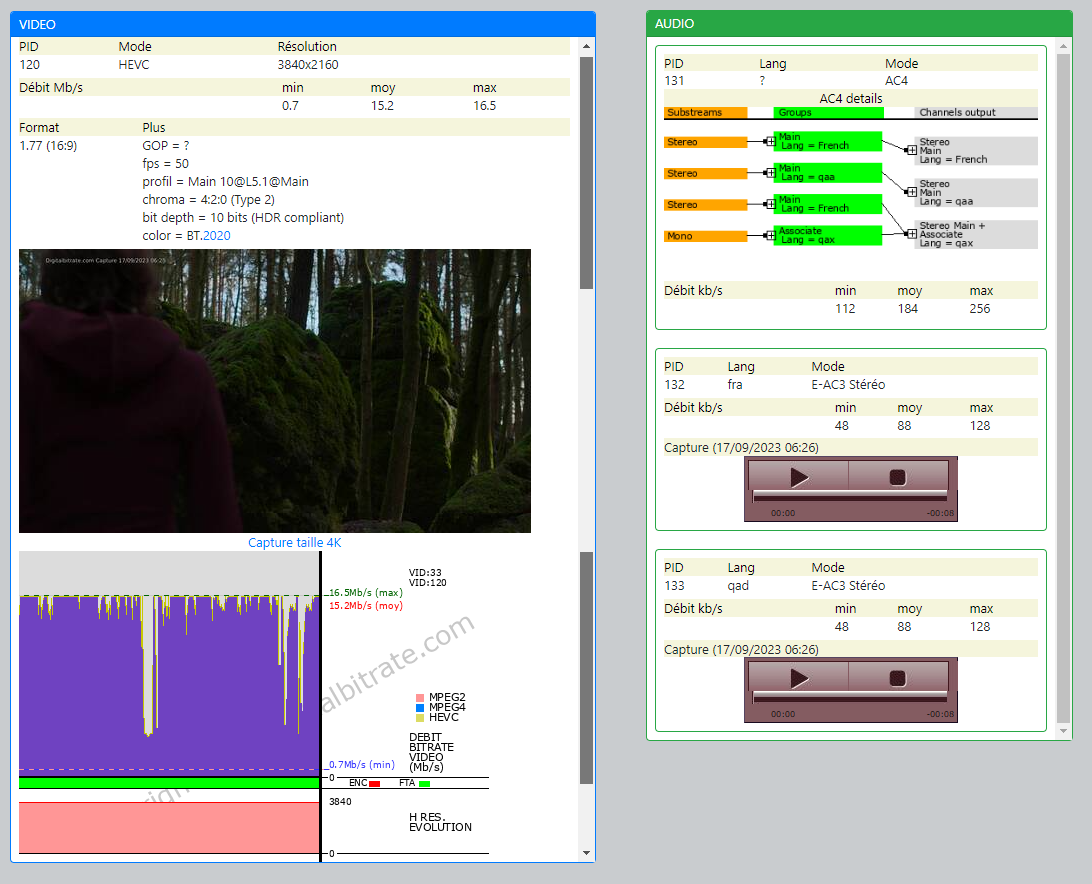
 www.digitalbitrate.com
Pirates have always been common in Ireland, and in many cases tolerated although this level of tolerance seems to be decreasing as the country modernizes and integrates with wider markets. There are a number of fairly high-powered AM stations with very obvious transmitter sites (including large towers) and no licenses.
DAB Ireland Dundalk mux list
Bitrate measurements of TV channels and Radio DAB+ DTT FIBER Satellite Cable OTT.
Pirates have always been common in Ireland, and in many cases tolerated although this level of tolerance seems to be decreasing as the country modernizes and integrates with wider markets. There are a number of fairly high-powered AM stations with very obvious transmitter sites (including large towers) and no licenses.
What sort of content (music, controversial talk) do the pirate radio stations broadcast?
aside:
I found out about the (1964 - 1968) Radio Caroline situation about 15 year ago, I thought it was hysterical that such a thing was done, about 10 years ago, there was an FM pirate station here in the KC area (IIRC, 107.9), but that's the only one I've heard about.
Kirk Bayne
aside:
I found out about the (1964 - 1968) Radio Caroline situation about 15 year ago, I thought it was hysterical that such a thing was done, about 10 years ago, there was an FM pirate station here in the KC area (IIRC, 107.9), but that's the only one I've heard about.
Kirk Bayne
What sort of content (music, controversial talk) do the pirate radio stations broadcast?
Mostly Music.
Funny thing is, regional-large market DAB in theory would work well here in the States. Think about it for a second; sell that transmitter site, or do away with that expensive tower lease and the need to light/monitor a tower. For Class B and C stations, lose that expensive power bill, maintenance costs, and capital expense of having to replace expensive transmission equipment. All you need to send the common DAB site is audio. Cost of transmission and maintenance is spread across all the streams, and much less variable than being responsible for your own site. Everyone in the market has equal coverage.
But it will never happen, because of the old way of competitive 'it's my signal-thinking'.
But it will never happen, because of the old way of competitive 'it's my signal-thinking'.
Those Stick values are how a majority of these companies built themselves into the powerhouses they are today.Funny thing is, regional-large market DAB in theory would work well here in the States. Think about it for a second; sell that transmitter site, or do away with that expensive tower lease and the need to light/monitor a tower. For Class B and C stations, lose that expensive power bill, maintenance costs, and capital expense of having to replace expensive transmission equipment. All you need to send the common DAB site is audio. Cost of transmission and maintenance is spread across all the streams, and much less variable than being responsible for your own site. Everyone in the market has equal coverage.
But it will never happen, because of the old way of competitive 'it's my signal-thinking'.
Ironically, It think it would be much cheaper for iHeart or the like to have national feeds of "The Breeze", "Alt.", Kiss, BIN, that are multiplexed in each market.
- Status
- This thread has been closed due to inactivity. You can create a new thread to discuss this topic.