
• Get involved.
    We want your input!
    Apply for Membership and join the conversations about everything related to broadcasting.

    After we receive your registration, a moderator will review it. After your registration is approved, you will be permitted to post.
    If you use a disposable or false email address, your registration will be rejected.

    After your membership is approved, please take a minute to tell us a little bit about yourself.
    https://www.radiodiscussions.com/forums/introduce-yourself.1088/

    Thanks in advance and have fun!
    RadioDiscussions Administrators

Mt. Rushmore of L.A. Stations

There are a few You Tube videos where we can hear The Wave after it first debuted.

The best collection is on Archive-dot-org:

It's also in chronlogical order, so you can hear the progression and evolution of the format.


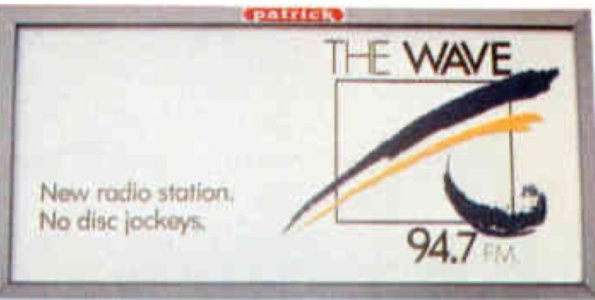
KTWV proudly declared it had no DJs.

These billboards were up all over L.A. and Orange County for the first year:
Screenshot 2025-09-15 at 7.33.51 AM.jpeg


Radio & Records called the format "NAC." NAC stood either for "New Adult Contemporary" or "New Age/Contemporary".

A good perspective from the first year of The Wave:


The format description NAC was eventually dropped, replaced by Smooth Jazz.

A cast of actors did scripted mini-plays to mark the beginning of each hour.

Those vignettes were very much love 'em or hate 'em. You can hear two examples on the first aircheck on the archive-dot-org page I linked to above...the first one at 1:00 into the aircheck, the next at :59:00. They didn't all have kids, but for some reason, these did. Maybe they were dayparted for when they thought their audience would be with their kids (after school through bedtime, mornings before school, etc).

Sting and Peter Gabriel were as likely to be heard as Anita Baker and Sade.

Also Paul Simon, Rickie Lee Jones, Dire Straits, Steely Dan...
 
XETRA was LA's first all news station, dating back to 1961 as "Extra News over Los Angeles".
I would love to hear an hours-long aircheck of that from 1961 ... if such a time capsule exists.

Before the PPM, KTWV, WQCD, KWJZ, WNUA, KKSF, and other smooth jazz stations were often in the top 5 in Arbitron ratings (sometimes even #1). When the PPM was introduced, the ratings dropped like a rock, and smooth jazz faded quickly from FM airwaves.
Is there any chance the sound of PPM watermarking significantly contributed to driving away the smooth jazz audiences at a semi-conscious level? Recall the many threads on Radio Discussions where participants swore up and down that they could hear that watermarking, even excruciatingly so with Voltair enhancement. Of all the formats that appeal to audiences with discerning ears, classical, traditional jazz, and smooth jazz are tops. Simply consider how carefully stations have always processed them, often to audiophile standards. This has me curious if watermarking may have been the explanation for the "inexplicable" drops the industry saw in smooth jazz listening coincident to the turning on of their PPM encoders on a market by market basis. While one could say that similar drops in classical and traditional jazz listening would have occurred were this so, there's the small wrinkle that commercial (read: aggressively watermarked, or even watermarked at all) classical and traditional jazz stations are as rare as hens' teeth. Could the classical and traditional jazz stations' having been spared the [aggressive] watermarking axe have helped lead industry people away from realizing the real cause of the smooth jazz format's sudden post-PPM ratings implosions -- at least above and beyond the pre-2009 drops David Eduardo noted?

I miss 'The World Music Hour', and 'Musical Starstreams', which aired on the NAC version of The Wave.
Miss it no more. https://starstreams.com/

These billboards were up all over L.A. and Orange County for the first year:

View attachment 10317
They also used to sponsor (paint) the garbage cans on the sands of certain southern California beaches. I believe they are immortalized in a handful of films and television shows filmed at those locations around that time.
 
Last edited:
Is there any chance the sound of PPM watermarking significantly contributed to driving away the smooth jazz audiences at a semi-conscious level?

No. The problem was that it wasn't being picked up.

there's the small wrinkle that commercial (read: aggressively watermarked, or even watermarked at all) classical and traditional jazz stations are as rare as hens' teeth.

The signal is the same for commercial and non-commercial stations.
 
My choices are the following:

KFI AM 680
KISS-FM 102.7 (Rick Dees, Casey Kasem's American Top 40, Ryan Seacrest, AT40, Shadoe Stevens)
KSPN (Legacy with the RAMS)
KFWB (Legacy station)
 
XETRA was LA's first all news station, dating back to 1961 as "Extra News over Los Angeles". And that was thanks to Gordon McLendon taking a vacation in free-for-all Havana, Cuba, and hearing Goar Mestre's all news "Radio Reloj" which had been on the air since the late 1940's!

LA had a lot of Spanish programming before KWKW, including every morning on KPOP (later KGBS and then KTNQ) and several of the brokered stations. Richard Eaton also did mostly Spanish on KALI earlier than KWKW did under Howard Kalmenson.
"It's over 7000 miles from Los Angeles to Bombay...but the World is only 1/14 of a second to Los Angeles via Extra News!"
 
I would love to hear an hours-long aircheck of that from 1961 ... if such a time capsule exists.


Is there any chance the sound of PPM watermarking significantly contributed to driving away the smooth jazz audiences at a semi-conscious level? Recall the many threads on Radio Discussions where participants swore up and down that they could hear that watermarking, even excruciatingly so with Voltair enhancement. Of all the formats that appeal to audiences with discerning ears, classical, traditional jazz, and smooth jazz are tops. Simply consider how carefully stations have always processed them, often to audiophile standards. This has me curious if watermarking may have been the explanation for the "inexplicable" drops the industry saw in smooth jazz listening coincident to the turning on of their PPM encoders on a market by market basis. While one could say that similar drops in classical and traditional jazz listening would have occurred were this so, there's the small wrinkle that commercial (read: aggressively watermarked, or even watermarked at all) classical and traditional jazz stations are as rare as hens' teeth. Could the classical and traditional jazz stations' having been spared the [aggressive] watermarking axe have helped lead industry people away from realizing the real cause of the smooth jazz format's sudden post-PPM ratings implosions -- at least above and beyond the pre-2009 drops David Eduardo noted?


Miss it no more. https://starstreams.com/


They also used to sponsor (paint) the garbage cans on the sands of certain southern California beaches. I believe they are immortalized in a handful of films and television shows filmed at those locations around that time.
If masterofradio.com doesn't have an aircheck of it available for trade, then it probably doesn't exist, sadly. There's a lot of XETRA Mighty 690 CHR 1982-84, and of course 91X available. But no Xtra News.

 
Is there any chance the sound of PPM watermarking significantly contributed to driving away the smooth jazz audiences at a semi-conscious level?
No.

While most stations showed considerable cume growth from those secondary or tertiary listeners who just did not write down less listened to stations in the diary, Smooth Jazz was one of the formats that had no secondary listening to speak of. Either you were a dedicated listener or not a listener at all.

Stations with no secondary listeners lost share, as other stations had "more new listeners" that the diary had not picked up.

And the biggest reason for loss of share in the PPM was that diary smooth jazz listeners tended to write in that they listened "all day" with just a start and end of daily listening entered. In fact, those people interrupted their listening dozens of times in the day with anything from coffee and bathroom breaks to meetings at work or picking up the kids at home. The huge smooth jazz TSL collapsed, and the shares with it.
Recall the many threads on Radio Discussions where participants swore up and down that they could hear that watermarking, even excruciatingly so with Voltair enhancement. Of all the formats that appeal to audiences with discerning ears, classical, traditional jazz, and smooth jazz are tops. Simply consider how carefully stations have always processed them, often to audiophile standards. This has me curious if watermarking may have been the explanation for the "inexplicable" drops the industry saw in smooth jazz listening coincident to the turning on of their PPM encoders on a market by market basis.
That is unlikely, as what affected the ratings was 1) fine detail of listening that showed few long-hours listening spans and 2) the lack of secondary listeners.
While one could say that similar drops in classical and traditional jazz listening would have occurred were this so, there's the small wrinkle that commercial (read: aggressively watermarked, or even watermarked at all) classical and traditional jazz stations are as rare as hens' teeth. Could the classical and traditional jazz stations' having been spared the [aggressive] watermarking axe have helped lead industry people away from realizing the real cause of the smooth jazz format's sudden post-PPM ratings implosions -- at least above and beyond the pre-2009 drops David Eduardo noted?
The format had been in decline for a number of years... well before the PPM arrived.

You have asked this question in various forms before. I was involved with the development of the PPM in Philadelphia and Houston from 2002 to 2008, and was party to "how the hotdog is made" even when the PPM was being developed up on the third floor of the Arbitron building as far back as about 1996. All these questions have been answered long ago: insertion of the PPM encoding at normal levels does not drive listeners away. In particular, the smooth jazz songs are "easy" to encode as they have, generally, full instrumental backing and plenty of places to insert a code.
 
Last edited:
I promise you, in sixteen minutes, you'll have had enough (February 2, 1964):

"It's Midnight in Liverpool, and 4 O 'clock in the afternoon in Los Angeles"....huh?

The news story about The Beatles, and the negative effect on teenage girls was amusing.

A long banned Carleton cigarette ad was classic!

Was the news room and studio in Mexico? The rules were strict back then, in that radio programming must originate from Mexico. That would explain the lack of street reporters, or maybe they just didn't have the budget.
 
"It's Midnight in Liverpool, and 4 O 'clock in the afternoon in Los Angeles"....huh?

The news story about The Beatles, and the negative effect on teenage girls was amusing.

A long banned Carleton cigarette ad was classic!

Was the news room and studio in Mexico? The rules were strict back then, in that radio programming must originate from Mexico. That would explain the lack of street reporters, or maybe they just didn't have the budget.
The rules then applied to sending programming across the border.

Some stations broadcasting to the U.S. taped and ran the tapes later in the day or the next day after they had been taken across the border. But for news, it had to be done there as far as I can determine.
 
The rules then applied to sending programming across the border.

Some stations broadcasting to the U.S. taped and ran the tapes later in the day or the next day after they had been taken across the border. But for news, it had to be done there as far as I can determine.
If memory serves and it is a bit hazy from back then, but I used to listen to Extra News. They seemed to run 4- 15 minute segments an hour. The first two differed in that they simply had different lead stories. These two 15 minute segments were recorded live on the air and then played back at the bottom of the hour. And then at the top of the hour this process was started over.
Of course I'm the first to admit that I don't know what I'm talking about...this is simply they way it sounded to me.
 
"It's Midnight in Liverpool, and 4 O 'clock in the afternoon in Los Angeles"....huh?

The news story about The Beatles, and the negative effect on teenage girls was amusing.

A long banned Carleton cigarette ad was classic!

Was the news room and studio in Mexico? The rules were strict back then, in that radio programming must originate from Mexico. That would explain the lack of street reporters, or maybe they just didn't have the budget.
It was an anchor and a teletype machine at the transmitter in Mexico. No street reports, just rip and read, shuffled a bit every 15 minutes or so. Deadly.
 
McClendon also did the same format on an AM/FM simulcast at WNUS, Chicago---now WGRB and WGCI. McClendon told Broadcasting Magazine that the wire copy could not be re-written because that would require writers, and that anyone who suggested mobile news reports would be fired for suggesting that he spend more money:


By 1966, two years before they abandoned format because KFWB and KNX had gone all-news (Chicago flipped to beautiful music that same year), they had beefed up staffing, telling Broadcasting Magazine they had 20 on-air newsmen, with everyone living in San Diego except the guys who were in the two mobile news units in L.A.

Because of the FCC rule about transmitting across the border, they must have filed their reports by phone.

 
OK. Now let's do a NATIONAL Mount Rushmore of Radio stations. Me thinks the majority of people might be picking stations out of New York, LA, Chicago. Might be a few for Atlanta, Miami, Dallas, Cleveland..........


Back
Top Bottom