• Get involved.
    We want your input!
    Apply for Membership and join the conversations about everything related to broadcasting.

    After we receive your registration, a moderator will review it. After your registration is approved, you will be permitted to post.
    If you use a disposable or false email address, your registration will be rejected.

    After your membership is approved, please take a minute to tell us a little bit about yourself.
    https://www.radiodiscussions.com/forums/introduce-yourself.1088/

    Thanks in advance and have fun!
    RadioDiscussions Administrators

National Advertisers and 55+ radio audiences

Well they should start, because that's who's listening to the radio -- the people who grew up with it and developed their fondness of the radio medium before the internet changed everything.
Plenty of people under 55 continue to use radio. But, in a sense, this does not matter as radio is sold based on the number of listeners.
And they should learn how to sell it because in a few years there will be no one left *at all* under the age of 55 who grew up with radio as an essential part of their lives. Radio is becoming a medium for an increasingly aging audience, that's just how it is.
Well, roughly 80% of persons over 18 use radio weekly. If radio figures out how to stay viable as a one-to-many option in a one-to-one world, it can last for longer than most of us will be around.
 
Really? Here are some median ages:

AAA: 51, with 41% over the age of 55.

AC: 45 with 30% over the age of 55.

Adult hits: 47 with 30% over the age of 55

Adult Standards: 61 with 80% over the age of 55

All News: 59 with 62% over the age of 55.

Get the picture? How about a few more?

All talk: 62 with 66% over the age of 55.

Classic hits: 52 with 46% over the age of 55

Classic Rock: 51 with 38% over the age of 55

Classical: 62 with 64% over the age of 55

News/Talk: 62 with 61% over the age of 55.

Oldies: 58 with 56% over the age of 55

Public: 53 with 50% over 55.

Soft adult: 52 with 45% over the age of 55

Thats a whole lot of programming for 55+. I'm really tired of all these old people crabbing about how there's no radio for them.
On the flip side of the coin, looks like a lot of formats are aging out.
 
On the flip side of the coin, looks like a lot of formats are aging out.
But a funny thing happens... formats age demographically exactly one year with every calendar year that passes. In other words, this is a slow process. Stations can either adjust playlists or change format as time goes by.

This is not something that happens rapidly; that sort of situation in radio is rare, such as the "instant death" of disco in 1980 where suddenly there were no real new hits in the genre and stations dropped the music very rapidly.
 
As the average age of the listener increases - and many in the youngest demographics are not using radio at all - I am guessing that we will see more formats that appeal to older audiences.
 
Anecdotal example:

My folks are in their early 70s.

They both love new country music, both are content listening to classic rock, and my dad also likes 90s and some 00s rock. In fact, he listens to the local Active Rock station on occasion in his truck. My mom partakes in the Adult Contemporary station on occasion.

Never once has either complained that the local radio dial lacks options for people "their age." (Coincidentally, their market has a 60s / 70s Oldies station on a major FM signal, but that is probably option #3 at best.)

CTListener hit the nail on the head, in my opinion.

By the way, when I was in high school, the median song age on classic rock radio was about 25 (median release year was 1970-ish). Recall many early classic rock stations even ran a liner proclaiming "it doesn't have to be old to be a classic!" Today, the median song age for classic rock is probably in the neighborhood of 40 years (median release year is probably 1985-ish).

 
The Led Zeppelin and Pink Floyd tracks from the early 70's are well over 50 years old. Someone who was 18 at Woodstock might as well be dead to advertisers. The Zeppelin, Floyd stuff is basically that same era.

Classic Rock stations used to be AOR formats. They did play new music, so it wasn't all nostalgia. That hasn't been the case for over 30 years...
 
Anecdotal example:

My folks are in their early 70s.

They both love new country music, both are content listening to classic rock, and my dad also likes 90s and some 00s rock. In fact, he listens to the local Active Rock station on occasion in his truck. My mom partakes in the Adult Contemporary station on occasion.

Never once has either complained that the local radio dial lacks options for people "their age." (Coincidentally, their market has a 60s / 70s Oldies station on a major FM signal, but that is probably option #3 at best.)

CTListener hit the nail on the head, in my opinion.

By the way, when I was in high school, the median song age on classic rock radio was about 25 (median release year was 1970-ish). Recall many early classic rock stations even ran a liner proclaiming "it doesn't have to be old to be a classic!" Today, the median song age for classic rock is probably in the neighborhood of 40 years (median release year is probably 1985-ish).
Perhaps the complaints to which people are referring is about the decline of '50s and '60s oldies. I made a post about remaining oldies stations, and, as far as I can tell, only Milwaukee has a '50s/'60s oldies station on a full market FM signal (at least among top 100 markets).
 
You can argue the specifics of advertiser wants and needs and how they buy all you want, and you can also say the 55+ audience isn’t financially worth chasing, but the reality is that the medium itself is aging out. I saw a claim in this thread that “80% of adults over 18 use radio every week” which is likely accurate, but the real question is how many under 35 listen every week? That is the future, and that number is not pretty. Many of those young people NEVER listen to radio - why would they? Short attention spans and an entire life of music and information being on demand right in the palm of their hand. Those people are not sitting through 6 minute stop sets and letting someone else pick the next song. I understand the reasons that advertisers don’t want 55+, but within about 20 years, and declining every year, is pretty much all radio will have left. The figures Big A showed evidence that trend clearly
 
The Led Zeppelin and Pink Floyd tracks from the early 70's are well over 50 years old. Someone who was 18 at Woodstock might as well be dead to advertisers. The Zeppelin, Floyd stuff is basically that same era.
Rock music is an exception because white guys with bad haircuts and guitars haven't changed much since then.
 
I contend looking at the past is in error on predicting the future. You say the 25 year old is not using radio. I agree. Will said 25 year old utilize radio at age 40? I say they very well could be. My listening choices and overall musical tastes have evolved over time leading me places that my 25 year old self would never go. Will that be over the air? Perhaps not but it will be the on air product via a different listening device.
 
I contend looking at the past is in error on predicting the future. You say the 25 year old is not using radio. I agree. Will said 25 year old utilize radio at age 40? I say they very well could be. My listening choices and overall musical tastes have evolved over time leading me places that my 25 year old self would never go. Will that be over the air? Perhaps not but it will be the on air product via a different listening device.
But did the 25 year olds of 2000 eventually use the cassette tape? Did the 25 year olds of 1990 eventually use 45s?
 
Again?

David's been saying this for 20+ years, and the article managed to miss it entirely:


... older people do have brand preferences based on experience of perhaps 30 years or so of trying "the next best thing". It does take more ad money to convince them to change.


That's it. The juice (in terms of business from 55+) isn't worth the squeeze (more ad dollars to prompt fewer sales from people who, depending on how "over 55" they are, may not be conquests for long).
 
Really? Here are some median ages:

AAA: 51, with 41% over the age of 55.

AC: 45 with 30% over the age of 55.

Adult hits: 47 with 30% over the age of 55

Adult Standards: 61 with 80% over the age of 55

All News: 59 with 62% over the age of 55.

Get the picture? How about a few more?

All talk: 62 with 66% over the age of 55.

Classic hits: 52 with 46% over the age of 55

Classic Rock: 51 with 38% over the age of 55

Classical: 62 with 64% over the age of 55

News/Talk: 62 with 61% over the age of 55.

Oldies: 58 with 56% over the age of 55

Public: 53 with 50% over 55.

Soft adult: 52 with 45% over the age of 55

Thats a whole lot of programming for 55+. I'm really tired of all these old people crabbing about how there's no radio for them.

Exactly. Nobody's saying 55+ can't listen.

And I've said this before, too. What they really want is someone to finance the operation of a station they like. NONE of them are saying "I want to hear more advertising trying to sell ME things."
 
What they really want is someone to finance the operation of a station they like. NONE of them are saying "I want to hear more advertising trying to sell ME things."

In fact, they're at the head of the line complaining about the long stop sets. They complain about it more than the under 35s.

Then they complain when the music shifts or when the 70-year old DJ or talk show host gets forced out by management.

Nobody is complaining about the lack of under-35 year old talk show hosts.

55+ is like everybody else: We want what we want, and we want it for free.
 
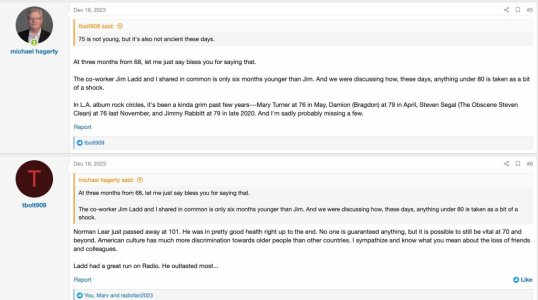
Anyone over 65 is really doing a disservice to society by being alive.

Well, good morning to you, too, youngster.

They are using up oxygen that other people need.

That's not how oxygen works.

Some are bedridden and haven't been able to change the station on their bedside Radio in 20 years...😑

And some...aren't.

In fact, in the 65 to 74 age group, only 24.3% have any kind of disability---not necessarily serious enough to make them bedridden.

Bump that up to 75 and over (to give your batshit insolence a fair shot) and still more than half---54.1%---are without a disability.


Also....this you?


Screenshot 2025-06-10 at 8.21.35 AM.jpeg
 
Last edited:
Ok! I'm turning 62 a week from tomorrow. What that means in terms of "typical music" is that I went to high school between 1977 and 1981 so under what I've read, the music that most people remember the best is the music that they were listening to during their teenage years.

Let's see. That means that someone who is 55 years old now graduated from high school 7 years after I did, or in 1988. The music that person is most likely to remember the best is music that came out between 1984 and 1988 while he/she was in high school.

Putting this in radio terms, stations focused on 1980s music (either as an 80s station, a classic hits station, or an adult hits station) should be doing well. I saw recently where KRTH was going to drop the 1970s songs from its playlist but nothing was said about dropping the 1980s entries. Put another way, those people who are 55 today are still being well-served by radio as The BigA noted above. It really isn't until you get to the 65-years and older (and for nutcases like me who most prefer the music of the late 1960s and early 1970s) that you see radio turning away because of ad agencies no longer showing interest.


Back
Top Bottom