
Can you tweak the equalizer settings.The "shark fin" is definitely part of the problem. But even flamethrower WHKO K99.1 sounds crappy.

-
Get involved.
We want your input!
Apply for Membership and join the conversations about everything related to broadcasting.
After we receive your registration, a moderator will review it. After your registration is approved, you will be permitted to post.
If you use a disposable or false email address, your registration will be rejected.
After your membership is approved, please take a minute to tell us a little bit about yourself.
https://www.radiodiscussions.com/forums/introduce-yourself.1088/
Thanks in advance and have fun!
RadioDiscussions Administrators
You are using an out of date browser. It may not display this or other websites correctly.
You should upgrade or use an alternative browser.
You should upgrade or use an alternative browser.
New Car Radios....a sorry state.
- Thread starter BruceB
- Start date

You can't "tweak" the excessive audio processing of some stations. That is not EQ, it is a combination of AGC, limiting and compression as well as dynamic adjustment of frequency band content. Add in a dose of PPM injection and you have the classic "set it up to 11" from Spinal Tap.Can you tweak the equalizer settings.
(It is amazing how that 1984 movie showed how sound would progress up to how it is 40 years later. Square waves, anyone?)
Maybe I have been busy learning all the high tech. Good project for tomorrow.Can you tweak the equalizer settings.
I dont want to change to much because the USB flash drive sounds really good.
Would be interesting but good luck getting to it. Not like the old get under the dash days.Is it possible to add an antenna amplifier to the shark fin antenna, or not?
Move the seat all the way back, lay on the floor and get to it! Those days are over and I'm too old for that anyway😄
other sources sound good. My guess is Honda includes a AM/FM chip set to be in compliance with US regulations.
I've been a "hi fi buff" since the 60s. It's just a poor radio. Honda just doesn't think people listen to the radio so they don't care. The Nissan and the Mazda were the same. Cheap radio.
What's funny is I joined a Honda forum which is all over the world and they are raking me over the coals for griping about the radio. They are saying "who listens to the radio?
If everything through the unit sounds good but the AM and FM reception are both distorted and of low fidelity, and this is happening simultaneously across multiple automakers suddenly, I would sincerely suggest to you that it is being done intentionally to discourage radio use and maximize revenue on behalf of the paid alternatives built into those head units (SiriusXM and whatever other services CarPlay and Android Auto serve as gateways for). There are actually no regulations in U.S. law right now forcing automakers to include radios in cars, but congress has been trying to pass legislation for a while, and the odds of that passage happening were looking good just recently. If a sudden radical decrease in listenability is occurring across multiple car brands to only radio audio just as new legislation is looking set to stop automakers from physically excluding radios from their latest models, I would call that a giant red flag -- i.e., their plan B -- and suggest people hound regulators to look into it closely, and quickly.
P.S. You should also know that astroturfing social media discussions using offensive A.I. bots disguised as real people is now an epidemic. In the most unscrupulous cases, posting unfavorable opinions or complaints about some big industry's agenda can get you accosted by "people" who make you feel like you're in an old fashioned Chinese struggle session. Radio may be going out of fashion, but FM at least is nowhere close to being a dead laughingstock of obsolescence just yet. So I don't know which exact forum(s) you're posting those complaints on, or if they're popular enough for the opinions expressed there to influence lots of people's buying decisions. But if complaints about how the FM reception sounds in their new cars inexplicably summons mobs that "rake you over the coals" -- as if you had just ridiculously demanded their head units support the shortwave bands and 8-track tapes, I would look at that with some suspicion. Of course, if you were posting on a forum where everyone was under 25, then that kind of reaction would make sense. But why would everyone on a general automaker's forum be exclusively zoomers? (Pun not intended.
 )
)I don't know that it's a conspiracy so much as just a like-minded attitude that radio is just not that important to their customers anymore.As to the forums I suspect that's a younger person thing.If everything through the unit sounds good but the AM and FM reception are both distorted and of low fidelity, and this is happening simultaneously across multiple automakers suddenly, I would sincerely suggest to you that it is being done intentionally to discourage radio use and maximize revenue on behalf of the paid alternatives built into those head units (SiriusXM and whatever other services CarPlay and Android Auto serve as gateways for). There are actually no regulations in U.S. law right now forcing automakers to include radios in cars, but congress has been trying to pass legislation for a while, and the odds of that passage happening were looking good just recently. If a sudden radical decrease in listenability is occurring across multiple car brands to only radio audio just as new legislation is looking set to stop automakers from physically excluding radios from their latest models, I would call that a giant red flag -- i.e., their plan B -- and suggest people hound regulators to look into it closely, and quickly.
P.S. You should also know that astroturfing social media discussions using offensive A.I. bots disguised as real people is now an epidemic. In the most unscrupulous cases, posting unfavorable opinions or complaints about some big industry's agenda can get you accosted by "people" who make you feel like you're in an old fashioned Chinese struggle session. Radio may be going out of fashion, but FM at least is nowhere close to being a dead laughingstock of obsolescence just yet. So I don't know which exact forum(s) you're posting those complaints on, or if they're popular enough for the opinions expressed there to influence lots of people's buying decisions. But if complaints about how the FM reception sounds in their new cars inexplicably summons mobs that "rake you over the coals" -- as if you had just ridiculously demanded their head units support the shortwave bands and 8-track tapes, I would look at that with some suspicion. Of course, if you were posting on a forum where everyone was under 25, then that kind of reaction would make sense. But why would everyone on a general automaker's forum be exclusively zoomers? (Pun not intended.

Most already have one. The internal amp interacts with the SDR receiver.Is it possible to add an antenna amplifier to the shark fin antenna, or not?

It works for me in most cases except when my wife and/or daughter are with me.I'm a radio guy but I have to admit a 32gb flash memory drive loaded with pretty much my whole cd collection kinda makes music radio unneeded.
All new cars sold in the EU and UK have DAB, it's the law (even in countries with no DAB transmitters, it still applies). In the UK in particular, you wouldn't buy a new car without DAB as it now constitutes a majority of radio listening.I'm assuming the head unit has the pre and power amp which is fine because other sources sound good.
My guess is Honda includes a AM/FM chip set to be in compliance with US regulations.
On the forum, guys in Europe say their Hondas have DAB .
My Toyota has a shark fin and I'm really impressed with the signal reception - FM and DAB, both really sensitive, you can hear stations quite a way out of their coverage patch.
What I don't like is the listener experience on DAB for local stations when moving between areas. Drive into a new area in the FM era, and you just had to scan/tune to the right frequency. With DAB, you have to wait for the radio to find the local ensemble for the area you just drove into, and then scroll through 100+ stations to find the local station you want. You can't safely do it while driving, it takes too long to do it at lights, and I don't want to pull over to tune the radio, so I end up streaming through my phone instead.
The radio UI is crap, the streaming and Spotify UI is great.
When I started on this site all my car had was radio. So that's why I was so demanding. My next car, in 2007, had a cassette player. I could have had more variety that way. I have a CD player in a car I got a year ago.
I haven't figured out how to get any other source for music. Sirius/XM doesn't have anything ideal. I'd always be changing from channel to another.
I haven't figured out how to get any other source for music. Sirius/XM doesn't have anything ideal. I'd always be changing from channel to another.
A cassette player in 2007?When I started on this site all my car had was radio. So that's why I was so demanding. My next car, in 2007, had a cassette player. I could have had more variety that way. I have a CD player in a car I got a year ago.
I haven't figured out how to get any other source for music. Sirius/XM doesn't have anything ideal. I'd always be changing from channel to another.
And I still have it. What's so strange about that?A cassette player in 2007?
The car is nearing 30 years old but it still runs.
CD players should have been standard by mid 2000. The last cars I saw with cassette players were late 90s.And I still have it. What's so strange about that?
The car is nearing 30 years old but it still runs.
And I have one in the 20-year-old car I've had for a year.CD players should have been standard by mid 2000. The last cars I saw with cassette players were late 90s.
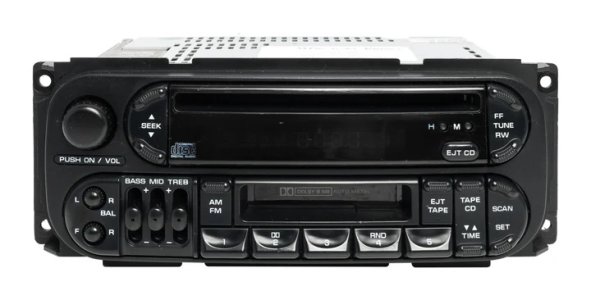
I had a 2002 Chrysler PT Cruiser and a 2005 Dodge Caravan, both of which had the Chrysler RAZ radio that had both cassette and CD and was used in various models until 2007. If I could get something like this now with Bluetooth and a USB port like most current car audio systems I'd have my dream car systemCD players should have been standard by mid 2000. The last cars I saw with cassette players were late 90s.
:
I'm guessing he means he bought the car in 2007. Doesn't seem to be a guy that buys new cars. That's my impression.A cassette player in 2007?
That's a terrible design flaw. Metadata should have been incorporated into the standard so that each station's signal, in any given area, told tuners which frequencies to find that same station on in each directly adjacent area. Then as soon as the current signal was lost, the tuner could rapidly look at those other, specific frequencies to see whether the station the owner was just listening to was truly present on any of them at a higher dB level, and switch immediately to it, keeping the disruption time to a bare minimum.What I don't like is the listener experience on DAB for local stations when moving between areas. Drive into a new area in the FM era, and you just had to scan/tune to the right frequency. With DAB, you have to wait for the radio to find the local ensemble for the area you just drove into, and then scroll through 100+ stations to find the local station you want. You can't safely do it while driving, it takes too long to do it at lights, and I don't want to pull over to tune the radio, so I end up streaming through my phone instead.
They made the same (and in some ways, a worse) mistake with ATSC over-the-air digital TV here in the U.S. Consumers are frequently told to "rescan their TVs" every time a new station appears, an exiting one changes its RF channel frequency, or an existing station adds or changes subchannels. The problem with this arrangement is that it takes several minutes to do, and many people, after having done it enough times, grew tired of it (the attrition effect) and simply don't bother anymore unless a major network station suddenly vanishes. Consequently, many new signals have trouble getting noticed. Worse, many televisions let you go back and mark off (exclude) channels you don't want to see after doing a full rescan. But they wipe all those user blocks away after doing a rescan. So if you live in a major urban area like I do, where there are hundreds of channels broadcasting in numerous foreign languages you don't understand, or worse, airing nothing but infomercials, it takes lots of work, after a rescan, to go through all of that and exclude everything you don't want appearing via your "channel up" and "channel down" buttons. And yet all that work gets tossed every time you find yourself needing to rescan the band. When the ATSC standard was designed, it should have specified that each time an ATSC-capable TV is powered off (e.g. overnight), it rescans the band without requiring the owner to do it manually. Then, when the television is next turned on, it shows the owner a list of differences (additions/deletions/changes), letting them choose the ones they want to keep. That would also function as a way of letting people know that new stations/channels have actually appeared on the dial.
Can't afford them.I'm guessing he means he bought the car in 2007. Doesn't seem to be a guy that buys new cars. That's my impression.
Don't like them either.
It does do that, but only if the same station is present on both multiplexes. It'll also follow a station across to FM if the DAB signal is lost but FM is still present. That part works pretty seamlessly (although the DAB/FM switching can cause music to skip as there's a different delay).That's a terrible design flaw. Metadata should have been incorporated into the standard so that each station's signal, in any given area, told tuners which frequencies to find that same station on in each directly adjacent area. Then as soon as the current signal was lost, the tuner could rapidly look at those other, specific frequencies to see whether the station the owner was just listening to was truly present on any of them at a higher dB level, and switch immediately to it, keeping the disruption time to a bare minimum.
The flaw is tuning between different stations - if you're leaving a city, arriving in a new city and want to listen to a local station in that city, you can't just spin the dial to the known frequency of that station as you could with FM. You have to go through the whole process of scrolling through a list of stations to find the one you're looking for, which you can't really do on the road. They aren't even presented in alphabetical order, they're in multiplex frequency order, and multiplex frequencies are obscure.
- Status
- This thread has been closed due to inactivity. You can create a new thread to discuss this topic.