
Was just a thought...

-
Get involved.
We want your input!
Apply for Membership and join the conversations about everything related to broadcasting.
After we receive your registration, a moderator will review it. After your registration is approved, you will be permitted to post.
If you use a disposable or false email address, your registration will be rejected.
After your membership is approved, please take a minute to tell us a little bit about yourself.
https://www.radiodiscussions.com/forums/introduce-yourself.1088/
Thanks in advance and have fun!
RadioDiscussions Administrators
You are using an out of date browser. It may not display this or other websites correctly.
You should upgrade or use an alternative browser.
You should upgrade or use an alternative browser.
New Life for REELRADIO
- Thread starter michael hagerty
- Start date

Yes, I considered it long ago. I even did a number of trips to other states to see if I could get out of CA (every magazine or book I buy now has 9.5% local CA sales tax, too) but the cost would be greater than the savings.Was just a thought...

So wonderful to see that Reelradio continues! I was a member almost 30 years ago as I wanted to support Uncle Ricky and enjoy airchecks I had never been able to hear live as they happened.
Since I just listened to a few airchecks free, is it no longer subscription based as in the past?
There's no welcome message or explanation of how it will work going forward from the North Carolina museum---in fact, I reached out to one of the prior board members to be sure that it was in fact ready for visitors (it's been lurking online, unpublicized, for a couple of months while they did a bit of fine-tuning).
I'm hoping Carl Davis will post something, along with a means of contact, soon. There are a lot of questions, including whether there are plans for new additions and/or comments in the future (until Richard's injury, the comments at REELRADIO were a vibrant part of the site).
I think fear of online airchecks being removed is why many download them. I have downloaded a number of unscoped airchecks that are on the Internet Archive and other similar sites as there is always the possibility that someday they will no longer be available due to copyright issues or a takedown request.
The Internet Archive makes downloads available unless specifically chosen otherwise by the poster. So does SoundCloud.
In the case of REELRADIO, the understanding was that the airchecks were on loan from the various contributors (which is why each had his or her own collection on the site), in the same way exhibits are on loan to museums. All of those contributors (including myself) got those airchecks through the hard but enjoyable work of networking and trading with other collectors.
We chose to loan them to Richard so other people might be able to hear and enjoy them.
Richard went to great lengths to make sure that what went on REELRADIO was not online any other place, and the terms of use specifically forbade copying:
Streamed Media on this site is not available for download or distribution, and the site is intended only for the private, non-commercial use of individual listeners who access the site. Access to the site requires your agreement to these conditions.
I don’t think the Mona Lisa will be disappearing from public view anytime soon…and there are countless places on the Internet and physical media to see that work. Besides, the image is public domain.
First, I've seen the Mona Lisa a few thousand times in my lifetime---but the original, at the Louvre, exactly once---and I can tell you that there's no comparison.
Beyond that, unless you're trying to see just how much you can miss the point by, you understood exactly what I was saying. Richard wanted people to come to REELRADIO to hear what were, until people copied and posted them elsewhere, unique airchecks only available there, was specific about the rules, an account was required to play the exhibits, and the terms of use, including a promise not to copy and distribute, were agreed to in setting up the account.
"I stole them to save them" isn't an excuse. Especially since they're still there despite all the things REELRADIO has gone through in 29 years.
Tragically, though, most of them can now be found in multiple places. Which is why the new owners have just surrendered on that count.
I have a contrarian view: I encourage downloading and saving by as many people as possible at WorldRadioHistory to insure that all the content is preserved at many places."I stole them to save them" isn't an excuse. Especially since they're still there despite all the things REELRADIO has gone through in 29 years.
Now that I am going to close the site, I hope many copies are still "out there".
I have a contrarian view: I encourage downloading and saving by as many people as possible at WorldRadioHistory to insure that all the content is preserved at many places.
Now that I am going to close the site, I hope many copies are still "out there".
And that's fine. Richard Irwin felt differently and I, signing up for his site 29 years ago, agreed not to copy. His site, his call.

I'm going to regret wading back in here, aren't I?
My academic training isn't in journalism or engineering, it's in history. And as a historian, I consider it a tragedy when a valuable historical resource disappears. That's true of the airchecks that make up Reelradio, and it's true of the materials that make up World Radio History.
I understand your arguments about Reelradio, Michael, and I wonder if there's a middle ground where someone who donated a collection and very specifically doesn't want it shared could ask the museum to remove those materials or restrict downloading.
Me? I have tens of thousands of airchecks of most of US radio and TV over the last 30 years, and at this point, if I dropped dead tomorrow, the tapes would probably end up in a dumpster and the hard drives would get recycled. I would prefer that not to happen, but I understand the reality that there's really no monetary value to any of it. I'm making arrangements with Tracy Carman and the Media Preservation Foundation to try to get as much to him now as possible.
But here's my other reality as a historian: individual lives are short and history is long. It's impossible to really control what happens to your stuff once you're gone, and anyway once you're gone you're gone. So I would much rather err on the side of having whatever I've built be more widely available than less available, in the event it's of value to someone in the future.
Which brings me to WRH. I would implore you, David, to at least not make any final decisions while you're laid up in a hospital bed. And I don't really understand fully why a bunch of loud but ultimately meaningless arguments on a tiny message board would sour you on "all of radio."
You've built something of immense value to so many people in and just outside the industry. Almost nobody else in the history of broadcast history has done what you've done.
Whenever you're gone (and I hope it's not soon!), do you want to be remembered for having created all of it - or for having destroyed it in a fleeting fit of pique because some anonymous people disagreed with you on a long-forgotten message board?
If you're tired of running the site, believe me, I get it. I am 32 years (!) into writing NERW and it has long since become more of a burden than fun. But in your case, I am certain that even if new additions to the site were to cease or slow down, there are resources out there like Tracy's foundation that would be delighted to keep the site alive in archival form.
You've housed archives of WRH with me, though we haven't updated that in a long time. I'd be happy to at least be a repository for the material so it doesn't get lost for good. History deserves better, and you deserve to be remembered better for building it.
My academic training isn't in journalism or engineering, it's in history. And as a historian, I consider it a tragedy when a valuable historical resource disappears. That's true of the airchecks that make up Reelradio, and it's true of the materials that make up World Radio History.
I understand your arguments about Reelradio, Michael, and I wonder if there's a middle ground where someone who donated a collection and very specifically doesn't want it shared could ask the museum to remove those materials or restrict downloading.
Me? I have tens of thousands of airchecks of most of US radio and TV over the last 30 years, and at this point, if I dropped dead tomorrow, the tapes would probably end up in a dumpster and the hard drives would get recycled. I would prefer that not to happen, but I understand the reality that there's really no monetary value to any of it. I'm making arrangements with Tracy Carman and the Media Preservation Foundation to try to get as much to him now as possible.
But here's my other reality as a historian: individual lives are short and history is long. It's impossible to really control what happens to your stuff once you're gone, and anyway once you're gone you're gone. So I would much rather err on the side of having whatever I've built be more widely available than less available, in the event it's of value to someone in the future.
Which brings me to WRH. I would implore you, David, to at least not make any final decisions while you're laid up in a hospital bed. And I don't really understand fully why a bunch of loud but ultimately meaningless arguments on a tiny message board would sour you on "all of radio."
You've built something of immense value to so many people in and just outside the industry. Almost nobody else in the history of broadcast history has done what you've done.
Whenever you're gone (and I hope it's not soon!), do you want to be remembered for having created all of it - or for having destroyed it in a fleeting fit of pique because some anonymous people disagreed with you on a long-forgotten message board?
If you're tired of running the site, believe me, I get it. I am 32 years (!) into writing NERW and it has long since become more of a burden than fun. But in your case, I am certain that even if new additions to the site were to cease or slow down, there are resources out there like Tracy's foundation that would be delighted to keep the site alive in archival form.
You've housed archives of WRH with me, though we haven't updated that in a long time. I'd be happy to at least be a repository for the material so it doesn't get lost for good. History deserves better, and you deserve to be remembered better for building it.
I've been through revolutions, bombings, beatings, crash landings and all kinds of other stuff. But when one does things with no "profit motive" I think they take insults and offenses harder. At least I do.Which brings me to WRH. I would implore you, David, to at least not make any final decisions while you're laid up in a hospital bed. And I don't really understand fully why a bunch of loud but ultimately meaningless arguments on a tiny message board would sour you on "all of radio."
My wife, after I just went and came from Urgent Care to get the shot they give for "minor with no impairment" TIA's, said, "no more radio". We started thinking of our often discussed move to Mendoza, Bariloche or Pinamar where we can have steaks with no additives and wine that is the world's best. We had discarded living in Argentina due to, mostly, the website.You've built something of immense value to so many people in and just outside the industry. Almost nobody else in the history of broadcast history has done what you've done.
Whenever you're gone (and I hope it's not soon!), do you want to be remembered for having created all of it - or for having destroyed it in a fleeting fit of pique because some anonymous people disagreed with you on a long-forgotten message board?
I've looked for possibilities, but when people see the server cost and the tech support and related items that are into the 5 digit range, it scares people.If you're tired of running the site, believe me, I get it. I am 32 years (!) into writing NERW and it has long since become more of a burden than fun. But in your case, I am certain that even if new additions to the site were to cease or slow down, there are resources out there like Tracy's foundation that would be delighted to keep the site alive in archival form.
Good idea. I have some small (6tb) hard drives and I'd be glad to copy the site onto one and send it. It won't fit on anything smaller, and an 8tb ssd is way to expensive. So you will get a big hard drive that doubles as a doorstop.You've housed archives of WRH with me, though we haven't updated that in a long time. I'd be happy to at least be a repository for the material so it doesn't get lost for good. History deserves better, and you deserve to be remembered better for building it.
I'm going to regret wading back in here, aren't I?
My academic training isn't in journalism or engineering, it's in history. And as a historian, I consider it a tragedy when a valuable historical resource disappears. That's true of the airchecks that make up Reelradio, and it's true of the materials that make up World Radio History.
I understand your arguments about Reelradio, Michael, and I wonder if there's a middle ground where someone who donated a collection and very specifically doesn't want it shared could ask the museum to remove those materials or restrict downloading.
Scott, they're not my arguments, they're what Richard Irwin wanted and was very specific about. I simply abided by his wishes and honored the agreement I made for access to his site.
Virtually everything on that site has already been copied, traded, sold (!) and posted on other sites. A restriction now would be closing the barn door---not after the horse is out but after the barn burns to the ground and has been replaced by a Starbucks drive-through.
I personally have no issue with downloading/copying and if Richard had been fine with it, I would have too. I applaud David for his attitude toward the wealth of material on WorldRadioHistory.com.
Me? I have tens of thousands of airchecks of most of US radio and TV over the last 30 years, and at this point, if I dropped dead tomorrow, the tapes would probably end up in a dumpster and the hard drives would get recycled. I would prefer that not to happen, but I understand the reality that there's really no monetary value to any of it. I'm making arrangements with Tracy Carman and the Media Preservation Foundation to try to get as much to him now as possible.
But here's my other reality as a historian: individual lives are short and history is long. It's impossible to really control what happens to your stuff once you're gone, and anyway once you're gone you're gone. So I would much rather err on the side of having whatever I've built be more widely available than less available, in the event it's of value to someone in the future.
This is why I continue to trade. And why I'm having conversations with those I trade with about the future of what we have.
My collection is unscoped California only up to the end of 2021 (the 100th anniversary of KNX and of KCBS as a licensed commercial station---then KQW) .
So the Bay Area Radio Museum is likely to get the airchecks relevant to them. I'd love to see if the California Historical Radio Society is interested in representing the state as a whole rather than just the Bay Area, and I may start some of those conversations at Radio Day By The Bay in July.
As for the "junk" dilemma, I decided when rebuilding my collection (I lost most of it in a divorce and move 12 years ago) that I would go digital.
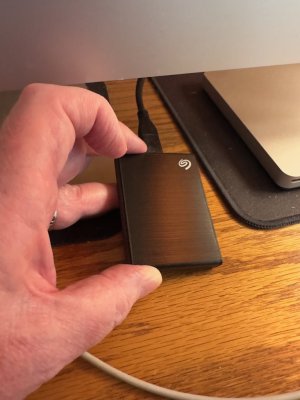
Everything is on a ridiculously tiny 1TB drive and a similar-sized backup. I'll have specific instructions about where it goes and it won't be a heavy lift, literally or figuratively, for whoever gets the assignment.
That will probably (God willing) be me. I'd like to do it, as Aaron Mintz did, in my lifetime---but with an entity that will make it easily accessible for people to hear and enjoy. I want a few more years to see what else should be in it and to make sure we've got the best copies.
Last edited:
I was just chatting with Greg Ogonowski (think of the other part of the Optimod creation) who told me about his early work with Richard Irwin. A lot of good gear, including Optimods were used in the original restoration of the airchecks when the site was first built. The biggest issue with airchecks, of course, is that they were often of very poor quality and had to be fixed in both levels and in the audio content. Greg and an associate put together all the gear, at rather significant expense, to make the site viable and listenable.
I asked Greg to join RadioDiscussions and perhaps expand on the early development of REELRADIO.
I asked Greg to join RadioDiscussions and perhaps expand on the early development of REELRADIO.
That would be very cool!I was just chatting with Greg Ogonowski (think of the other part of the Optimod creation) who told me about his early work with Richard Irwin. A lot of good gear, including Optimods were used in the original restoration of the airchecks when the site was first built. The biggest issue with airchecks, of course, is that they were often of very poor quality and had to be fixed in both levels and in the audio content. Greg and an associate put together all the gear, at rather significant expense, to make the site viable and listenable.
I asked Greg to join RadioDiscussions and perhaps expand on the early development of REELRADIO.

Man, it's hard to keep up.
Where those digital files go after I've gone is a question I haven't figured out yet. I don't think online is an option: the copyright Stasi is too ready to pounce on airchecks, even though the artists were already paid when the radio station played their tunes on the original broadcasts. Nor do I want things locked away in a room presided over by a prissy archivist who lives in fear that someone someday might bring an ink pen into the room.
In any event, some of my recordings are at the State Historical Society of Missouri, where they're actually pretty nice archivists, or at the St. Louis Media History project. But, to hear the tapes at the Historical Society, one would have to travel to Columbia, which doesn't have the best air service, and you'd have to be really dedicated to make the trip.
I also have all the copies of the St. Louis Journalism Review from 1973, when it started, up to about 2010 when the publication was turned over to Southern Illinois University and became somewhat more academic. I don't know what I'm going to do with those, either. I might ask newspapers.com about that. It seems that archiving printed publications is much easier than dealing with audio recordings.
I sincerely hope, David, that you reconsider. World Radio History is a valuable resource and I very much appreciate your efforts and your philosophy in maintaining access to be as open as possible. I'm sure it can be frustrating at times. I had to give up on my own, much smaller and earlier radio-history efforts a couple of decades ago, largely due to career demands.
The other thing I want to say along these lines, and it's a very personal thing, is that radio and radio people can be very frustrating, too. Drama seems to come with the territory. Yet somehow the interest and desire for involvement of some type with radio don't entirely go away. That's been true for me even after the horrible experiences I had in my radio career. Afterwards, I went for years without thinking about radio or, sometimes, even listening to it. But I always came back around, though at arm's length. If the drama gets to be too much at a particular moment, I avoid certain topics or just don't check the board for a while.
As I tend to do, I've accumulated these recordings, and I'm using drives similar to the ones you've pictured, but then what? I'm not good at answering that kind of question, and that's the larger challenge for me.
One reason I'm trying to digitize as much as I can is that I know that my dear spouse will pitch everything once I'm no longer around. He didn't grow up in the United States and the significance of these recordings is totally lost on him. Another factor is tape deterioration. This hasn't been a problem for me with ordinary audio cassettes but has become a problem with some of the airchecks I recorded onto Hi-Fi VCR tapes in the 1990s. I've had to do a lot of digital fixup work on some of those tapes. The main problem there has been dropouts of the Hi-Fi track with audio reverting very briefly to the standard VCR lo-fi audio track. I can usually get a reasonable result after editing but it takes work and time. With all the moves I've had over the years, it's amazing that most things have come through in good shape, so I am thankful for that.Other major collectors of advancing age (70+), trying to get ahead of that issue for their loved ones, are finding that it is very much a niche interest with very few people willing to spend cash to obtain a collection (even just to cover shipping), no matter how complete, well-recorded or well-preserved. There's a very real risk of that stuff just getting tossed.
Some have tried getting their collection out into the public by posting online, but that's tricky. YouTube routinely blocks airchecks on copyright grounds and deletes accounts after a given number of infractions. MixCloud used to allow unscoped airchecks, but a couple of years ago made that conditional on having a very pricey Premium account.
The last refuge appeared to be the Internet Archive, but recent DOS attacks and a couple of court losses in book copyright cases make that less than a sure thing.
Where those digital files go after I've gone is a question I haven't figured out yet. I don't think online is an option: the copyright Stasi is too ready to pounce on airchecks, even though the artists were already paid when the radio station played their tunes on the original broadcasts. Nor do I want things locked away in a room presided over by a prissy archivist who lives in fear that someone someday might bring an ink pen into the room.
In any event, some of my recordings are at the State Historical Society of Missouri, where they're actually pretty nice archivists, or at the St. Louis Media History project. But, to hear the tapes at the Historical Society, one would have to travel to Columbia, which doesn't have the best air service, and you'd have to be really dedicated to make the trip.
I also have all the copies of the St. Louis Journalism Review from 1973, when it started, up to about 2010 when the publication was turned over to Southern Illinois University and became somewhat more academic. I don't know what I'm going to do with those, either. I might ask newspapers.com about that. It seems that archiving printed publications is much easier than dealing with audio recordings.
I am having the same issue: it's uncertain how long I can continue to support WorldRadioHistory, and my attempts to find a future curator have met with zero results. So at some point, the site will disappear and 25 years of work will also be gone. And now, I feel it is just not worth it.
I sincerely hope, David, that you reconsider. World Radio History is a valuable resource and I very much appreciate your efforts and your philosophy in maintaining access to be as open as possible. I'm sure it can be frustrating at times. I had to give up on my own, much smaller and earlier radio-history efforts a couple of decades ago, largely due to career demands.
The other thing I want to say along these lines, and it's a very personal thing, is that radio and radio people can be very frustrating, too. Drama seems to come with the territory. Yet somehow the interest and desire for involvement of some type with radio don't entirely go away. That's been true for me even after the horrible experiences I had in my radio career. Afterwards, I went for years without thinking about radio or, sometimes, even listening to it. But I always came back around, though at arm's length. If the drama gets to be too much at a particular moment, I avoid certain topics or just don't check the board for a while.
Well stated, and better than I could do. And 32 years!Me? I have tens of thousands of airchecks of most of US radio and TV over the last 30 years, and at this point, if I dropped dead tomorrow, the tapes would probably end up in a dumpster and the hard drives would get recycled. I would prefer that not to happen, but I understand the reality that there's really no monetary value to any of it. I'm making arrangements with Tracy Carman and the Media Preservation Foundation to try to get as much to him now as possible.
But here's my other reality as a historian: individual lives are short and history is long. It's impossible to really control what happens to your stuff once you're gone, and anyway once you're gone you're gone. So I would much rather err on the side of having whatever I've built be more widely available than less available, in the event it's of value to someone in the future.
Which brings me to WRH. I would implore you, David, to at least not make any final decisions while you're laid up in a hospital bed. And I don't really understand fully why a bunch of loud but ultimately meaningless arguments on a tiny message board would sour you on "all of radio."
You've built something of immense value to so many people in and just outside the industry. Almost nobody else in the history of broadcast history has done what you've done.
Whenever you're gone (and I hope it's not soon!), do you want to be remembered for having created all of it - or for having destroyed it in a fleeting fit of pique because some anonymous people disagreed with you on a long-forgotten message board?
If you're tired of running the site, believe me, I get it. I am 32 years (!) into writing NERW and it has long since become more of a burden than fun. But in your case, I am certain that even if new additions to the site were to cease or slow down, there are resources out there like Tracy's foundation that would be delighted to keep the site alive in archival form.
You've housed archives of WRH with me, though we haven't updated that in a long time. I'd be happy to at least be a repository for the material so it doesn't get lost for good. History deserves better, and you deserve to be remembered better for building it.
The immediate challenge I'm running into is running out of disk space, because, for archival purposes, I try to save as much as I can in both lossy and lossless formats. But a lossless format achieves, at most, slightly less than 50% compression. So those files are still big. In addition, I would like to redo some of my earlier digitizations, because I've gotten better and quicker tools over time, and I've figured out how to do a reasonable job of cleanup in most cases. For example, I've got several cassettes worth of airchecks from Rice University's KTRU in the mid-1980s. I don't have them in lossless form and I'd like to take care of that. So I have some re-work to do. Moreover, I'm still adding current airchecks, both from Denver, and from various trips. I've also just started on 48 files that I recorded while in Europe this month.As for the "junk" dilemma, I decided when rebuilding my collection (I lost most of it in a divorce and move 12 years ago) that I would go digital.
Everything is on a ridiculously tiny 1TB drive and a similar-sized backup. I'll have specific instructions about where it goes and it won't be a heavy lift, literally or figuratively, for whoever gets the assignment.
That will probably (God willing) be me. I'd like to do it, as Aaron Mintz did, in my lifetime---but with an entity that will make it easily accessible for people to hear and enjoy. I want a few more years to see what else should be in it and to make sure we've got the best copies.
As I tend to do, I've accumulated these recordings, and I'm using drives similar to the ones you've pictured, but then what? I'm not good at answering that kind of question, and that's the larger challenge for me.

I don't know if I'd close it...maybe find a different owner? History is good to be preserved.I have a contrarian view: I encourage downloading and saving by as many people as possible at WorldRadioHistory to insure that all the content is preserved at many places.
Now that I am going to close the site, I hope many copies are still "out there".

Hope you don’t close it @davideduardo - it’s a great site! Also I hope you get well soon!
You hit on an interesting topic.The immediate challenge I'm running into is running out of disk space, because, for archival purposes, I try to save as much as I can in both lossy and lossless formats. But a lossless format achieves, at most, slightly less than 50% compression. So those files are still big. In addition, I would like to redo some of my earlier digitizations, because I've gotten better and quicker tools over time, and I've figured out how to do a reasonable job of cleanup in most cases. For example, I've got several cassettes worth of airchecks from Rice University's KTRU in the mid-1980s. I don't have them in lossless form and I'd like to take care of that. So I have some re-work to do. Moreover, I'm still adding current airchecks, both from Denver, and from various trips. I've also just started on 48 files that I recorded while in Europe this month.
I scan everything for WorldRadioHistory as an uncompressed bitmap (JPEG) at 300 dpi (which is adequate for even the most "high resolution" printed material) and save the originals. Then I whack the hell out of them to make compact PDFs that don't drive up my server service costs when 20,000 people a day download stuff.
I use Synology NAS enclosures. I have mirrored 5 x 22gb systems for the site itself, doing daily incrementals and weekly fulls, saving 8 weeks minimum. That approaches the capacity of those NAS systems, as I have one of each 5 as a "replace dead drive" option in case a drive is about to faild.
The others are 8 drives each, with 20tb hard drives. There I store the raw scans, also mirrored. I am going to have to add capacity (slowly put in larger drives if I keep doing the site) using 26 tb drives... if they hit a better price as that would be $8000 to replace them all now (or I get two more systems with 8 drives and do A-M on one and N-Z on the other pair.
That would be 42 hard drives with the expansion, all eating expensive CA electricity. Oh, and I mirror the daily backups with 4 internal hard drives, each doing incrementals for 4 weeks on 4-day intervals on each drive. To run this, I'm using a Ryzen Threadripper 7965 with 256gb of RAM at 6600. Storage for work is on a RAID 0 card with 4 x 4tb new generation SSDs, with 3 mirrored SSD boot drives and a mirrored 8 tb SSD for the work drive backups.
I still have about 100 recordable CDs with my earlier work which I need to put on the storage system.
Days that I do not have extensive consulting conference calls, I can work 8 hours easily, which my doctor says keeps my brain active. And that is a good excuse for spending all that money instead of watching episodes of Reacher over and over.
You are not reading the thread. I have been looking for someone to continue the site for a decade, but the costs of maintaining it and continuing to complete the collections are in excess of $50 thousand a year. Just the high-end scanners are worth over $60 thousand.I don't know if I'd close it...maybe find a different owner? History is good to be preserved.
Props to you for going lossless.The immediate challenge I'm running into is running out of disk space, because, for archival purposes, I try to save as much as I can in both lossy and lossless formats. But a lossless format achieves, at most, slightly less than 50% compression. So those files are still big. In addition, I would like to redo some of my earlier digitizations, because I've gotten better and quicker tools over time, and I've figured out how to do a reasonable job of cleanup in most cases. For example, I've got several cassettes worth of airchecks from Rice University's KTRU in the mid-1980s. I don't have them in lossless form and I'd like to take care of that. So I have some re-work to do. Moreover, I'm still adding current airchecks, both from Denver, and from various trips. I've also just started on 48 files that I recorded while in Europe this month.
I settled on mp3s at 44.1khz sample rate and 320kbps bitrate after reviewing the practical differences between that and lossless and then considering space and expense. Best I could do.
That is a very real concern. In the past year (ish), we have seen the deaths of two major collectors, Dave Klayman and Bill Earl.
Fortunately Dave and Bill had discussed with their survivors how they wanted their collections to be handled, and they specified sharing with other major collectors, to increase the circulation of the airchecks.
Aaron Mintz (still with us) had a legendary collection, but decided to give up the hobby a decade or so ago and donated his complete archive to Emerson College. That sounds good, but the college makes it available only for on-site listening for researchers, with no borrowing or duplication allowed. Which means the vast majority of it will never be heard again.
Other major collectors of advancing age (70+), trying to get ahead of that issue for their loved ones, are finding that it is very much a niche interest with very few people willing to spend cash to obtain a collection (even just to cover shipping), no matter how complete, well-recorded or well-preserved. There's a very real risk of that stuff just getting tossed.
Some have tried getting their collection out into the public by posting online, but that's tricky. YouTube routinely blocks airchecks on copyright grounds and deletes accounts after a given number of infractions. MixCloud used to allow unscoped airchecks, but a couple of years ago made that conditional on having a very pricey Premium account.
The last refuge appeared to be the Internet Archive, but recent DOS attacks and a couple of court losses in book copyright cases make that less than a sure thing.
That was Richard's opposition to downloads and copying: There's no reason to return to REELRADIO once you have it. It's why you can't just pick up a convincing copy of the Mona Lisa in the Louvre gift shop and hang it on the wall at home.
Richard viewed REELRADIO as a museum, one you had to visit. In a conversation with one of the (now former) board members, I mentioned that Richard would be happy that the North Carolina Broadcast History Museum and its President, Carl Davis, a friend of Richard's, would inherit REELRADIO, but that he'd be way less happy about the downloading.
My friend pointed out that the horses left the barn years ago---there's very little that's not already in circulation. Survival of what's there outweighs the copiers, traders and sellers.
Hopefully the North Carolina Broadcast History Museum will be rewarded for its saving REELRADIO by people who will visit and listen often on the site.
With regard to youtube.com, I believe the site has made available a lot more unscoped airchecks than it used to. Some of those airchecks originated from reelradio.com (those are usually the best-sounding ones) while others have come from other sources. The youtube.com account I have seen with the most unscoped fare is the one operated by "Real Radio Joe" though I have also heard rumors that some of his methods for obtaining some of the airchecks he posts may be unscrupulous at best.
Wherever you go, whether it be one of those cities in Argentina or a closer locale such as Monterrey, I hope you will post about the local and national media scene there. As a longtime enthusiast of international media (sparked by shortwave listening starting in the mid-1960s) I’m always interested in “how it’s done” in other places.My wife, after I just went and came from Urgent Care to get the shot they give for "minor with no impairment" TIA's, said, "no more radio". We started thinking of our often discussed move to Mendoza, Bariloche or Pinamar where we can have steaks with no additives and wine that is the world's best. We had discarded living in Argentina due to, mostly, the website.
Well, I've gone to the new site (thanks, Michael Hagerty, for providing the link) but I cannot seem to be able to get any of the exhibits to play. They all say "Google Drive" when I click on the MP3 link but I don't have that.
In the meantime, it looks like the old site is still up (though I didn't try to play any exhibits from there) and I can still view the comments from the past there.
With regard to other sites getting reelradio.com exhibits, most of the exhibits I've seen on other sites that originated from reelradio.com are exhibits that are either big city radio stations or that are more than 15 years old or both. I can still cite several (though I won't list them here for fear of giving someone ideas) airchecks, both scoped and unscoped, that I have as yet to see anywhere else.
In the meantime, it looks like the old site is still up (though I didn't try to play any exhibits from there) and I can still view the comments from the past there.
With regard to other sites getting reelradio.com exhibits, most of the exhibits I've seen on other sites that originated from reelradio.com are exhibits that are either big city radio stations or that are more than 15 years old or both. I can still cite several (though I won't list them here for fear of giving someone ideas) airchecks, both scoped and unscoped, that I have as yet to see anywhere else.