• Get involved.
    We want your input!
    Apply for Membership and join the conversations about everything related to broadcasting.

    After we receive your registration, a moderator will review it. After your registration is approved, you will be permitted to post.
    If you use a disposable or false email address, your registration will be rejected.

    After your membership is approved, please take a minute to tell us a little bit about yourself.
    https://www.radiodiscussions.com/forums/introduce-yourself.1088/

    Thanks in advance and have fun!
    RadioDiscussions Administrators

New Life for REELRADIO

In post 172, I mentioned there had been follow-up reporting to the 2019 NYTimes article. Here's a link to one:


In the context of this entire thread, I would recommend a book called "Arts Inc." by Bill Ivey. Bill was formerly the head of the National Endowment of the Arts. His book asks the question: Who is responsible for preserving our culture? That could be music, or it could be radio programming. Bill goes into a lot of detail explaining why corporations are absolutely the wrong people to be preserving culture. Unfortunately, Bill suggests that the government should do it. He said the US should name a cabinet level position called Minister of Culture. That person would be responsible for preserving our past. Of course, we already have the National Archivist and the Librarian of Congress, so there's already a lot of duplication. His book was written in 2008 (ironically around the time of the Universal fire).

Here's a link to Bill's book:

 
In post 172, I mentioned there had been follow-up reporting to the 2019 NYTimes article. Here's a link to one:


In the context of this entire thread, I would recommend a book called "Arts Inc." by Bill Ivey. Bill was formerly the head of the National Endowment of the Arts. His book asks the question: Who is responsible for preserving our culture? That could be music, or it could be radio programming. Bill goes into a lot of detail explaining why corporations are absolutely the wrong people to be preserving culture. Unfortunately, Bill suggests that the government should do it. He said the US should name a cabinet level position called Minister of Culture. That person would be responsible for preserving our past. Of course, we already have the National Archivist and the Librarian of Congress, so there's already a lot of duplication. His book was written in 2008 (ironically around the time of the Universal fire).

Here's a link to Bill's book:

There is a significant issue when you let either the government or large universities keep "history". Generally, under the excuse of "preventing deterioration" they let few people view or scan documents. When they allow scanning, they only do it themselves at exorbitant costs.

This system prevents the wide circulation of digital versions of "old stuff". It is not the best way of preserving history or making sure that history is accessible-
 
There is a significant issue when you let either the government or large universities keep "history". Generally, under the excuse of "preventing deterioration" they let few people view or scan documents. When they allow scanning, they only do it themselves at exorbitant costs.

This system prevents the wide circulation of digital versions of "old stuff". It is not the best way of preserving history or making sure that history is accessible-

That issue has also applied to corporations. When you have brittle documents that could tear easily, giving the general public direct access to those documents, even if they are totally blind (like yours truly), may not be the best of ideas. On the other hand, making copies of the original documents and then diseminating them widely would make a lot of sense if the historical documents you've gotten hold of are considered to be something that pretty much everybody else should know about.

The Internet has made it possible for wide document distribution without having to come up with the money for paper and the printers needed to create physical document copies. What has lagged behind, however, are copyright laws and other requirements intended to ensure that rights holders get paid when people see old documents, particularly old commercial documents. And those laws apply to all three of the sources of documents mentioned here--corporations, governments, and schools.

Which, of course, brings us back to old airchecks and the music on them. TheBigA is correct when he/she is discussing the laws surrounding these airchecks; at some point, however, the conflict between rights holders and rights users will come to a head to a point where the U.S. Congress may be forced to reassess the issues involved.
 
There is a significant issue when you let either the government or large universities keep "history".

As I said, the US government has several institutions that do exactly that: National Archives, Library of Congress, Smithsonian Institution, to name a few.

They have dealt with deterioration by doing document preservation, rather than allow scanning. The cost is really not the biggest issue, as we're discovering with this administration wanting to reinterpret history. That's a completely different problem that no one ever anticipated.
 
CBS News with an interesting, related piece: The Smithsonian racing against time to digitize audio on cassettes:
Mostly as a winter project, but I've been working on digitizing my old airchecks. Starting with ones that are somehow special to me, and going beyond that on a case by case basis. Some of them play reasonably well, others not so much. I didn't think cassettes were afflicted with sticky shed syndrome but some of these seem to be. Of course, having been stored in an unheated outbuilding for the last 20 years hasn't helped either. :rolleyes:
 
Mostly as a winter project, but I've been working on digitizing my old airchecks. Starting with ones that are somehow special to me, and going beyond that on a case by case basis. Some of them play reasonably well, others not so much. I didn't think cassettes were afflicted with sticky shed syndrome but some of these seem to be. Of course, having been stored in an unheated outbuilding for the last 20 years hasn't helped either. :rolleyes:

The only cassette I've had to deal with that had the sticky shed syndrome was made by Ampex, groan. Every other major manufacturer seemed to get it right.
 
That issue has also applied to corporations. When you have brittle documents that could tear easily, giving the general public direct access to those documents, even if they are totally blind (like yours truly), may not be the best of ideas. On the other hand, making copies of the original documents and then diseminating them widely would make a lot of sense if the historical documents you've gotten hold of are considered to be something that pretty much everybody else should know about.
It's not just about things "everybody" should be aware of. Where we see the greatest loss of valuable information is in specialized fields. Local libraries get little demand for, let's say, books about the later 30's and early 40's development of FM. They discard books on the subject as "nobody" reads them. People online talk about how FM "developed in the later 60's" and that becomes fact to many as there are no easy to find documents showing how FM went three decades prior to that!

Replace the area of interest and the specific invention or development and you see how free access to electronically distributional documents is essential.
The Internet has made it possible for wide document distribution without having to come up with the money for paper and the printers needed to create physical document copies. What has lagged behind, however, are copyright laws and other requirements intended to ensure that rights holders get paid when people see old documents, particularly old commercial documents. And those laws apply to all three of the sources of documents mentioned here--corporations, governments, and schools.
There is a contrarian opinion being pushed by the Internet Archive that documents, including books, magazines and even doctoral dissertations should be allowed digital distribution just like public libraries distribute physical publications. Their point is that so few of those publications are available in any other fashion, making them "dead" to the average person.

The Internet Archive wants controlled digital "lending" like libraries lend physical books, with limited return times and copy control. Trying to collect rights for all such publications would be complicated and shut out most people from the ability to research at all.
Which, of course, brings us back to old airchecks and the music on them. TheBigA is correct when he/she is discussing the laws surrounding these airchecks; at some point, however, the conflict between rights holders and rights users will come to a head to a point where the U.S. Congress may be forced to reassess the issues involved.
I doubt that Congress will devote ten seconds of time to aircheck collectors. Better would be legislation that allowed limited distribution of content where music or images are incidental to the purpose of reviewing such content and where they do not represent the primary reason for reviewing it.
 
Radio/Cassette recorders absolutely existed at that stage, but in looking at airchecks specifically, there's a pretty typical breakdown:

Pre-1950: The vast majority are transcription discs, with a handful of wire recordings.

1950s: Reel to reel tape is the primary source, though I've seen transcription disc airchecks up to 1955. Most of the tapes were recorded by the talent, station or network itself. As Hi-Fi becomes more of a thing in the mid-late 50s, high-quality reel machines show up in homes and become a source of a lot of airchecks of FM "fine arts" programming (jazz, classical, folk, spoken word).

1960s: Reel to reel tapes from talents, station and networks continue, as do high-quality reel recordings which capture the beginnings of FM Stereo Multiplex broadcasting and the emerging formats as the FCC ends 100% simulcasts. A flood of cheap reel-to-reel machines with condenser mics, best suited to dictation, start ending up in the hands of kids and teens, who too often put a microphone next to a speaker and hit "record".

1970s: The reels from the source and from audiophiles continue, and some of the kids with the bad recorders graduate to good recorders with line inputs, but just as many move to cheap cassette recorders.

1980s: Not as many airchecks from the source anymore---throughout the 70s, stations have defaulted to skimmers for talent evaluation. Home reel-to-reel machines are past their peak. The boom in all-in-one rack stereo systems, including cassette decks, keeps a source of decent-quality home airchecks alive, but a lot of people buy cheap boomboxes instead, and way too many $1.99 drugstore blank cassettes get used.

1990s and beyond: Cassettes of varying quality, a brief spurt of high-quality airchecks using videocassettes at their highest speed, and then the various forms of digital.

A follow-up to this.

I mentioned the price of reel-to-reel tape in another post, and a couple of people have asked why radio stations didn't archive more of their own stuff.

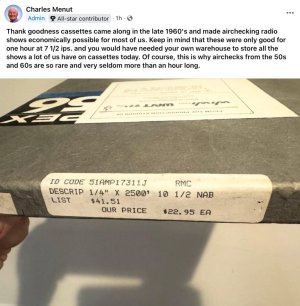
This morning, this showed up in a Facebook group I follow:


Screenshot 2025-07-09 at 6.31.55 AM.jpeg


That is Ampex 456 Studio Master tape---and the rock-bottom warehouse discount price was $22.95 a reel. Ampex offered 456 over most of the 70s and 80s and into the 90s, but let's just say that this is from 1985.

Adjusted for inflation, that's a $70 reel of tape at the discount price and $125 list.
 
That is Ampex 456 Studio Master tape---and the rock-bottom warehouse discount price was $22.95 a reel. Ampex offered 456 over most of the 70s and 80s and into the 90s, but let's just say that this is from 1985.

Adjusted for inflation, that's a $70 reel of tape at the discount price and $125 list.
And that audio tape is cheap compared to 2” Quad videotape from the 1960s and 70s. That’s why so many TV shows from that era have disappeared, as tapes were wiped and reused many times.
 
That's studio tape. You could buy Shamrock tape for $2 a reel too. It was crappy quality, oxide would fall off, and then record at 1-7/8ths.
There were a lot of choices for consumer grade reel to reel audio tape at fairly cheap prices in the 1960s. As a kid I would buy 7” reels and cut them up for the 3” reels on my little tape recorder. Did a lot of recording of TV and shortwave stuff…but those tapes have all disappeared into the mists of my youth.

Have managed to hang on to most of my audio cassette material from later years, however.
 
The really well-heeled in the 1960s could buy a large table radio with a built-in 126-track tape recorder -- it uses a 4-inch-wide reel of tape.
My initial thought was that is an insane number of tracks. But then recall the old eight track decks of the 1960s and 70s got everything on 1/4” tape. Extrapolate that to four inches and you would have 128 tracks, so perhaps not so crazy after all.
 
That is Ampex 456 Studio Master tape---and the rock-bottom warehouse discount price was $22.95 a reel. Ampex offered 456 over most of the 70s and 80s and into the 90s, but let's just say that this is from 1985.

Adjusted for inflation, that's a $70 reel of tape at the discount price and $125 list.
In what must surely count as a miracle, I still have a 1974 Olson Electronics catalog, published in September 1973, which included, among many other things, blank tape for sale, both in individual units and in bulk. Bulk sales usually were in lots of 12.

We'll get to the reel-to-reel tape for sale toward the end of this post, but let's first look at cassette prices.

One note of caution is that the catalog was published just before the Japanese tape manufacturers entered the market. So TDK, Maxell, etc. aren't represented. Their entry provided more price competition and, often, better quality. Chromium dioxide tape was new; only one brand of it was offered in the Olson catalog.

For comparison, I just looked at C-90 cassettes. C-120s weren't always available and, as I recall, had a shaky reputation. C-90 seemed to be the longest-running tapes that had at least some reliability.

The cheapest C-90 was an unbranded tape for $1.59, $1.29 if bought in bulk. In 2025 dollars, that's $10.37 and $8.41 respectively.
Olson's house brand was $2.50, $2.15 in bulk...$16.30 and $14.02 in today's prices.
There were three varieties of Scotch cassettes. The cheapest, "Highlander", went for $1.79, $1.70 in bulk. Today that would be $11.67 and $11.09.
Ampex also had three varieties. The "370 series" was the least expensive, at $2.25, $2.04 in bulk. Inflation-adjusted, that's $14.67 and $13.30.
Ampex was the only maker that had a chromium-dioxide offering. That went for $3.98 per tape, $3.50 in bulk. The 2025 equivalent would be $25.95 and $22.82.

Reel-to-reel tape was sold by physical length. For comparison, I looked at 7" reels (the most common) and 1800 feet of tape. Again, pricing in bulk was slightly lower. To keep this from sounding like a livestock report, I'll just give the unit price.

Olson's house brand: $1.79 ($11.67 in 2025 dollars)
"Shamrock" (those are Olson's quotes, not mine!): $2.59 ($16.89)
Scotch: $5.99 ($39.06)
Scotch "Highlander": $3.75 ($24.45)
Ampex: $4.40 ($28.69)
Ampex High Output: $5.49 ($35.80)

No wonder people felt the need to reuse tapes.

Edit: Since the catalog was actually published in 1973, perhaps I should have used a 1973-2025 inflation comparison rather than 1974-2025. Of course, those were the years when prices started going crazy, so they are something of a moving target. I still think you'll get the idea.
 
Last edited:
It's not just about things "everybody" should be aware of. Where we see the greatest loss of valuable information is in specialized fields. Local libraries get little demand for, let's say, books about the later 30's and early 40's development of FM. They discard books on the subject as "nobody" reads them. People online talk about how FM "developed in the later 60's" and that becomes fact to many as there are no easy to find documents showing how FM went three decades prior to that!

Replace the area of interest and the specific invention or development and you see how free access to electronically distributional documents is essential.

There is a contrarian opinion being pushed by the Internet Archive that documents, including books, magazines and even doctoral dissertations should be allowed digital distribution just like public libraries distribute physical publications. Their point is that so few of those publications are available in any other fashion, making them "dead" to the average person.

The Internet Archive wants controlled digital "lending" like libraries lend physical books, with limited return times and copy control. Trying to collect rights for all such publications would be complicated and shut out most people from the ability to research at all.
And I very much agree with the Internet archive's point of view; unfortunately, I neither have the money nor the politicians to make that point of view stick; neither does the Internet archive.

I doubt that Congress will devote ten seconds of time to aircheck collectors. Better would be legislation that allowed limited distribution of content where music or images are incidental to the purpose of reviewing such content and where they do not represent the primary reason for reviewing it.

I agree about the airchecks. However, I think the current copyright laws have much broader applications outside of the aircheck space that are just beginning to be felt now by wide swaths of the general population.
 
The really well-heeled in the 1960s could buy a large table radio with a built-in 126-track tape recorder -- it uses a 4-inch-wide reel of tape. Finding one in working condition today is bound to be a treasure trove of vintage radio recordings:


And the number of those that made it to the United States was.......?

From what I can find, there was no North American distribution. And nobody who did sell radios and recorders in the U.S. bothered with a knockoff.
 
For comparison, I just looked at C-90 cassettes. C-120s weren't always available and, as I recall, had a shaky reputation.

Correct. Thinner tape to fit on the same size spools. Made them more susceptible to stretching and breaking.

The cheapest C-90 was an unbranded tape for $1.59, $1.29 if bought in bulk. In 2025 dollars, that's $10.37 and $8.41 respectively.
Olson's house brand was $2.50, $2.15 in bulk...$16.30 and $14.02 in today's prices.
There were three varieties of Scotch cassettes. The cheapest, "Highlander", went for $1.79, $1.70 in bulk. Today that would be $11.67 and $11.09.
Ampex also had three varieties. The "370 series" was the least expensive, at $2.25, $2.04 in bulk. Inflation-adjusted, that's $14.67 and $13.30.
Ampex was the only maker that had a chromium-dioxide offering. That went for $3.98 per tape, $3.50 in bulk. The 2025 equivalent would be $25.95 and $22.82.

Reel-to-reel tape was sold by physical length. For comparison, I looked at 7" reels (the most common) and 1800 feet of tape. Again, pricing in bulk was slightly lower. To keep this from sounding like a livestock report, I'll just give the unit price.

Olson's house brand: $1.79 ($11.67 in 2025 dollars)
"Shamrock" (those are Olson's quotes, not mine!): $2.59 ($16.89)
Scotch: $5.99 ($39.06)
Scotch "Highlander": $3.75 ($24.45)
Ampex: $4.40 ($28.69)
Ampex High Output: $5.49 ($35.80)

No wonder people felt the need to reuse tapes.

Yeah, and as the bulk of home aircheckers stopped being adults with hi-fi sets and good reel-to-reel machines and morphed into teens using their allowances, birthday money and after-school jobs to buy tape, cheap stock and re-use became a lot more common.


Back
Top Bottom