• Get involved.
    We want your input!
    Apply for Membership and join the conversations about everything related to broadcasting.

    After we receive your registration, a moderator will review it. After your registration is approved, you will be permitted to post.
    If you use a disposable or false email address, your registration will be rejected.

    After your membership is approved, please take a minute to tell us a little bit about yourself.
    https://www.radiodiscussions.com/forums/introduce-yourself.1088/

    Thanks in advance and have fun!
    RadioDiscussions Administrators

New Life for REELRADIO

I remember a college teacher having that unit in his pick-up truck. Then again he taught Mass Com there too. He got it from Pacific Stereo or Cal Stereo back in the 70s, I went to the college in the early 80s.

That may have been the only Blaupunkt in a pickup truck. Which college?
 
So, today, listening to a January 1974 aircheck of Shadoe Stevens on KROQ, there's an ad for a stereo store in Burbank. And highlighted is the Blaupunkt Bamberg---an AM/FM/Cassette unit---that could record directly from the radio. That's the little red button

View attachment 9640


I had NO idea. Apparently Blaupunkt made them from 1971-1978.

Most aircheckers weren't able to afford Blaupunkt stereos, and the only cars it was ever standard on were the last Porsche 930 and the first Porsche 928, so...money again....but---if that tech had ever caught on, it would have been an airchecker's road-tripping dream.
I’ve seen those before online, but have never seen one in a Porsche, and I’ve been to a lot of Porsche specific car shows. I don’t know whether or not it was that popular of an option, and the guy I could’ve asked who worked on Porsches at dealerships since the 60s has passed away.

This says it was also an option in the 911S:
My dad had a 73 911 so I’ll ask him if it was an S and if he remembers ever seeing these radios when he was looking at 911 cars to buy in the late 70s/early 80s. Since he had a Marantz tape deck and stereo, I don’t think he cared about recording from the radio in his car.
 
Last edited:
I might have had the next best thing to that Blaupunkt: a car radio with a fader that didn't fit quite right into the dash, so the electrical contacts were exposed. Being what I believed to be a good radio news reporter, I knew how to use alligator clips. I used them with phones all the time, even GTE phones which were kind of tricky. Voila: attach the clips to the fader and plug the other end into a recorder. I made several recordings that way around 1980.

Later in the 1980s, I acquired a Proton 100 walkman-type receiver. The Proton was designed with home-stereo receiver specs, though the build quality was lacking. I would stick it on the dash and record off of it into a portable stereo recorder. The last time I did that was 1996, on a trip from Chicago back to St. Louis. (Little did I realize at the time that I would be moving to Chicago just five months later!) The challenge with the Proton was multipath. It was the first FM receiver with a Schotz detector and those seemed to be somewhat sensitive to multipath compared to something more basic.
 
So, today, listening to a January 1974 aircheck of Shadoe Stevens on KROQ, there's an ad for a stereo store in Burbank. And highlighted is the Blaupunkt Bamberg---an AM/FM/Cassette unit---that could record directly from the radio. That's the little red button


Most aircheckers weren't able to afford Blaupunkt stereos, and the only cars it was ever standard on were the last Porsche 930 and the first Porsche 928, so...money again....but---if that tech had ever caught on, it would have been an airchecker's road-tripping dream.
A quick Google search didn't turn anything up, but I could swear a cassette recorder was a factory option in early 70s Mopar vehicles. ISTR it being separate from the radio, and mounted on the transmission hump.

As you noted, it would have been a boon for us aircheckers. Having been an electronics tech most of my adult life, I'd modify car radios and tap off audio ahead of the volume control for airchecking on road trips, etc. At first I used a battery-operated cassette deck, later on a component one powered from an inverter. Even wired up a remote with start/pause buttons in order to scope them.
 
A quick Google search didn't turn anything up, but I could swear a cassette recorder was a factory option in early 70s Mopar vehicles. ISTR it being separate from the radio, and mounted on the transmission hump.

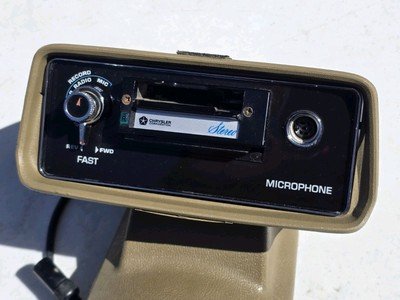
You were not hallucinating. 1971 and 1972 only-1971 through 1974--and if I recall correctly, only on Plymouth Barracuda and Road Runner/Satellite and Dodge Challenger and Coronet/Charger. Nope---just found a reference to them being available on Chrysler New Yorker, so this may have been across all models.

s-l400.jpg

I saw these in cars at the time---but I was under the impression that it played tapes and only recorded through the microphone---but. Look at the knob on the left and the record selector has "RADIO" and "MIC"----so I should have bought a Challenger or a Barracuda (cheaper than a Porsche).


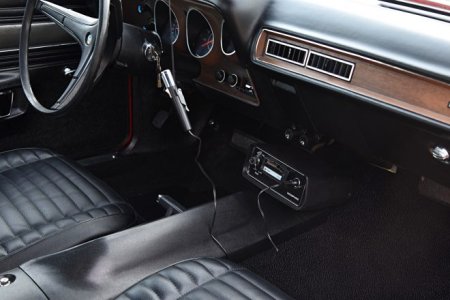
Here's one actually installed in a 1972 Road Runner:

08-1972-plymouth-road-runner-gtx-cassette-recorder-660x440.jpg


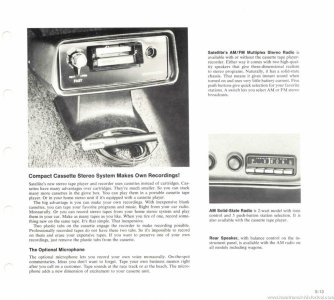
Found a Plymouth Satellite dealer info page on the option---apparently, even if your car had an AM/FM stereo along with the cassette deck, which played back in stereo, if you taped directly from the radio---even an FM stereo station, it was mono. Still---not the worst thing:

71_Satellite_14.jpg


What I can't find is anyone with first-person experience on how well it worked...this was early for car cassette decks and the few friends I had who had them were usually cursing as the tape started pouring out the slot and onto the center console.

Most of the interest in these now is among people restoring Mopars of this era.
 
Last edited:
What I can't find is anyone with first-person experience on how well it worked...this was early for car cassette decks and the few friends I had who had them were usually cursing as the tape started pouring out the slot and onto the center console.

Most of the interest in these now is among people restoring Mopars of this era.

Don't have any first hand experience, but I'll also guess it was more a novelty than anything very useful.
The one and only new car I ever owned was a 1971 Dodge Dart Swinger I bought about a year after I graduated college (fun car...318 with a 4 speed...I think it was a special order that someone backed out on...good performance, and not bad on gas either). The AM-FM radio option was absurdly overpriced, so I just got the AM (besides, it was 1971 and there was very little worth listening to on FM at the time). 5-6 years later I found an AM-FM at a junkyard & replaced it. For about a month. The AM radio was great, good sensitivity and selectivity. The AM-FM one was neither...deaf as a stump on FM, and even the AM section was inferior to the original.
 
---so I should have bought a Challenger or a Barracuda (cheaper than a Porsche).
"Cheaper" in so many ways! (I could not resist the comparison of a Challenger with a Porsche).
 
Since we're talking about uses for cassette tapes, here is one use that was quite technical, was available to only a few members of a minority group (blind), and didn't last very long.

In 1979, TeleSensory Systems, a Mountainview, California-based technology company that manufactured and sold products for the blind and low vision community, came up with the VersaBraille. What the company did was tcreate a product that allowed blind people to use cassette tapes as basically braille notetakers, and I actually got to work with one of the company's products while I was doing a summer 1988 volunteer internship at Channel 10 in Phoenix (I can't remember if it still had the KOOL-TV callsign at the time.)

Anyway, the product looked like a standard cassette player/recorder and you could play standard cassette tapes in it in the standard way. However, it also allowed you to, on higher-quality Type 1 cassette tapes (it didn't work on Type 2 or Type 4 papes) press abutton that transformed the cassette into, essentially, a braille notebook. You could then write notes in braille using a braille keyboard and then compartmentalize those notes into however many different categories you wanted. If you played the portions of the cassette tape with the braille notes on them with a standard recorder, all you heard were a bunch of random beeps.

Here is a website with more information and a picture of the VersaBraille. Enjoy!



An interesting piece on the history of the VersaBraille just showed up in my email box today, including one detail I forgot (you could only use 60-minute cassette tapes) and a couple of others that I knew nothing about at the time (most notably the Touch-Type thing in combination with the BBC).


Enjoy!
 
That's amazing. Did it not catch on because of how expensive it was or what?

That would be correct, and I'll say more about that in a moment. Also, by the time I got to play with the VersaBraille System, TeleSensory Systems had moved on and was using floppy disks and a new device (whose name I forget now) to accomplish the same things and more.

Now back to payments. Since a lot fewer blind and visually impaired people were working in the general economy back then (we didn't know how few until 1996 when the American Printing House for the Blind in Louisville, Kentucky, published a research paper on the subject), you had to be involved in some way with the state's vocational agency or independently wealthy to purchase one of these items. In addition, since the portion of the population that used these machines was very small (.6% using the U.S.' legal definition of blindness which is 20/200 or worse and included a lot of people who could read large print), the number of people under the age of 65 who could actually benefit from using the VersaBraille was even tinier.
 
That would be correct, and I'll say more about that in a moment. Also, by the time I got to play with the VersaBraille System, TeleSensory Systems had moved on and was using floppy disks and a new device (whose name I forget now) to accomplish the same things and more.

Now back to payments. Since a lot fewer blind and visually impaired people were working in the general economy back then (we didn't know how few until 1996 when the American Printing House for the Blind in Louisville, Kentucky, published a research paper on the subject), you had to be involved in some way with the state's vocational agency or independently wealthy to purchase one of these items. In addition, since the portion of the population that used these machines was very small (.6% using the U.S.' legal definition of blindness which is 20/200 or worse and included a lot of people who could read large print), the number of people under the age of 65 who could actually benefit from using the VersaBraille was even tinier.
That's incredible. How much did one of those VersaBraille systems cost?
 
Because there was some discussion of the Internet Archive site on this thread, I think some of you may be interested in the below article which appeared in PC Mag.


While this is not about radio in particular, it is interesting to note that Internet Archive is now considered a federal depository of information.


Back
Top Bottom