• Get involved.
    We want your input!
    Apply for Membership and join the conversations about everything related to broadcasting.

    After we receive your registration, a moderator will review it. After your registration is approved, you will be permitted to post.
    If you use a disposable or false email address, your registration will be rejected.

    After your membership is approved, please take a minute to tell us a little bit about yourself.
    https://www.radiodiscussions.com/forums/introduce-yourself.1088/

    Thanks in advance and have fun!
    RadioDiscussions Administrators

New to FM 103.5 in LA

davideduardo

Moderator/Administrator
Staff member
Here is an ad from Radio-TV Life from 1958. An FM station thought it could be successful with what was obviously an MOR format with personality hosts.

That is two-thirds of a century ago... and FM was about 20 years old and still had not found the Yellow Brick Road.
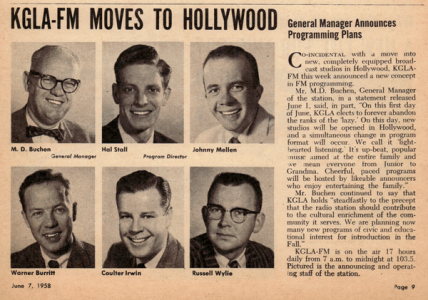
1752978846203.png

They finally "got it" later as KOST.
 
Here's a little more background. Some of it may surprise you.

At the time KGLA went on the air with this format, it was owned by the Echo Park Evangelistic Association, which later (as the International Church of the Foursquare Gospel) owned KFSG-FM/96.3, which they acquired as part of the deal that ended their timeshare with KRKD/1150 (which, after the timeshare ended, became KIIS); KFSG-FM had been KRKD-FM.

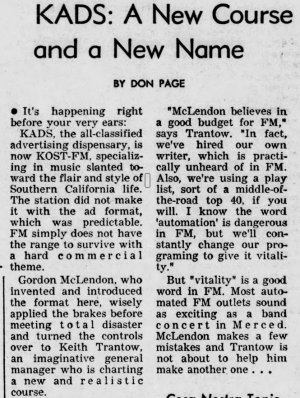
But before that, they sold KGLA in 1959 to Edward Jacobson, who wanted to use it (as well as stations in San Diego, Phoenix and Tucson) for in-store supermarket music. When that failed, Jacobson sold 103.5 to Gordon McLendon, who used it for that disastrous all-classified ads format as KADS (October 1966 to March 1968). When he changed the calls to KOST, he got a waiver from the FCC to have no news requirement.
 
Here's a little more background. Some of it may surprise you.

At the time KGLA went on the air with this format, it was owned by the Echo Park Evangelistic Association, which later (as the International Church of the Foursquare Gospel) owned KFSG-FM/96.3, which they acquired as part of the deal that ended their timeshare with KRKD/1150 (which, after the timeshare ended, became KIIS); KFSG-FM had been KRKD-FM.

But before that, they sold KGLA in 1959 to Edward Jacobson, who wanted to use it (as well as stations in San Diego, Phoenix and Tucson) for in-store supermarket music. When that failed, Jacobson sold 103.5 to Gordon McLendon, who used it for that disastrous all-classified ads format as KADS (October 1966 to March 1968). When he changed the calls to KOST, he got a waiver from the FCC to have no news requirement.
And some complain about just one K-Love religious format on FM in LA!


"Those who don't learn from history are destined to.... be viewing TikTok."
 
Here's a little more background. Some of it may surprise you.

At the time KGLA went on the air with this format, it was owned by the Echo Park Evangelistic Association, which later (as the International Church of the Foursquare Gospel) owned KFSG-FM/96.3, which they acquired as part of the deal that ended their timeshare with KRKD/1150 (which, after the timeshare ended, became KIIS); KFSG-FM had been KRKD-FM.

But before that, they sold KGLA in 1959 to Edward Jacobson, who wanted to use it (as well as stations in San Diego, Phoenix and Tucson) for in-store supermarket music. When that failed, Jacobson sold 103.5 to Gordon McLendon, who used it for that disastrous all-classified ads format as KADS (October 1966 to March 1968). When he changed the calls to KOST, he got a waiver from the FCC to have no news requirement.
Two questions: 1). Did KGLA keep this family friendly format from 1958-65 before it switched to all ads?
2). Why did an FM station go on the air at 7 AM? That sounds awfully late for listeners getting ready for and going to work.
 
Two questions: 1). Did KGLA keep this family friendly format from 1958-65 before it switched to all ads?
2). Why did an FM station go on the air at 7 AM? That sounds awfully late for listeners getting ready for and going to work.

1. As far as I can tell, tracking the station history through Broadcasting, it kept that format at least until the Evangelists sold it to Jacobson, who used the "simplex" method (a process where turning the mike on muted the receivers being used for background music ... approved by the FCC in 1955, then rescinded in 1964) to feed music to supermarkets, so I presume it was all instrumentals until the sale to McLendon.

2. In 1958, FM was far from being a mass medium. Its audience consisted entirely of hi-fi enthusiasts, and the concept of "morning drive" did not exist on that band.
 
1. As far as I can tell, tracking the station history through Broadcasting, it kept that format at least until the Evangelists sold it to Jacobson, who used the "simplex" method (a process where turning the mike on muted the receivers being used for background music ... approved by the FCC in 1955, then rescinded in 1964) to feed music to supermarkets, so I presume it was all instrumentals until the sale to McLendon.

2. In 1958, FM was far from being a mass medium. Its audience consisted entirely of hi-fi enthusiasts, and the concept of "morning drive" did not exist on that band.
You suggest an interesting subject: when were the first FM car radios introduced in the US?

And I think the 7 AM sign-on also illustrated the fact that a "little clock radio with FM" did not exist, I believe. So FM was a "living room" type of thing... if it was anything at all!
 
You suggest an interesting subject: when were the first FM car radios introduced in the US?

In the aftermarket, it was 1952, when Blaupunkt introduced an FM-only car radio. They realized they'd goofed and in 1953, introduced an AM/FM.

The first factory-installed AM/FM radios were in the fall of 1957, in the 1958 Lincolns. An extra-cost option, with a fairly low take rate until the early 60s, by which point, Ford had spread them down into cars like the LTD and Thunderbird---again as extra-cost options.

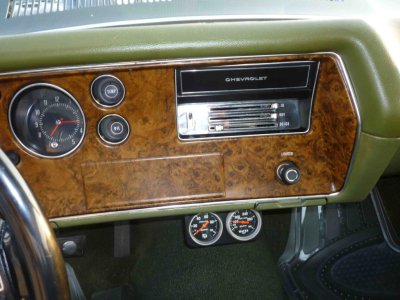
AM radios were extra-cost options on most cars then, as well, apart from upscale vehicles, which put them in not because they wanted to be generous or because there was actual demand, but because they thought their cars' interiors looked downmarket when buyers specified radio delete (pictured, a 1970 Chevrolet Monte Carlo with radio delete and the blank panel covering the space where the radio should go):


117424041_Montewithradiodeleteoption.jpg.4413598ee4da7d2c95a84a3d1cb3dc4b.jpg

So they built the cost of having the radio standard into the price and didn't give buyers the choice.

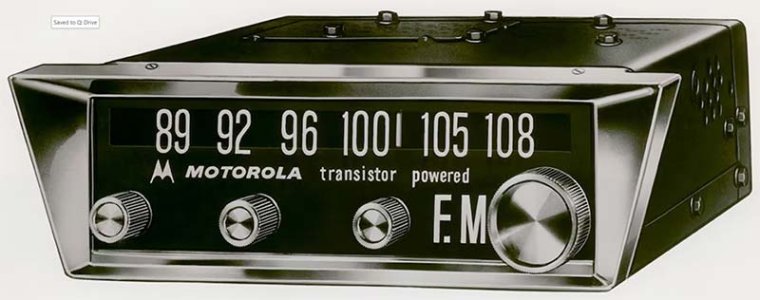
Right around the same time, Motorola started offering an add-on FM tuner. It hung under the dash, the way the later 4-track and 8-track cartridge players would.

NV_0522_Misic_Photo05.jpg
 
In the aftermarket, it was 1952, when Blaupunkt introduced an FM-only car radio. They realized they'd goofed and in 1953, introduced an AM/FM.

The first factory-installed AM/FM radios were in the fall of 1957, in the 1958 Lincolns. An extra-cost option, with a fairly low take rate until the early 60s, by which point, Ford had spread them down into cars like the LTD and Thunderbird.

Right around the same time, Motorola started offering an add-on FM tuner. It hung under the dash, the way the later 4-track and 8-track cartridge players would.

View attachment 9760
Those were still being made in the '70s, and during the mid-'70s CB craze, you could get one that would tune the 27 MHz band, too. I had one!
 
Jacobson sold 103.5 to Gordon McLendon, who used it for that disastrous all-classified ads format as KADS (October 1966 to March 1968). When he changed the calls to KOST, he got a waiver from the FCC to have no news requirement.

Minor correction: Gordon got that waiver when he changed KADS' format to beautiful music in September of 1967. The call letter change came in March of 1968.

That matters because Gordon was able to get the waiver only because he convinced the FCC that his co-owned XETRA-AM (690), which had been all-news since 1961, more than made up for a lack of news on his FM. It's also how he got away with no news when he was in the all-classified ads format.

In March of '68, when he changed the call letters of the FM to KOST, he within days dumped all-news on the AM in the face of KFWB's switch to the format March 11th and the imminent flip of KNX. So the basis for the waiver no longer existed.

The FCC may in fact have acted on that...I do remember as a kid hearing news on KOST, with the soft chime between headlines---something KSLY/KUNA owner Homer Odom (who had been a McLendon sales guy before going off on his own) instituted for newscasts on KUNA.

For anyone who never heard KADS, or wants to hear it again (why?), here it is, courtesy of audio archivist Gordon Skene's great PastDaily website:


Gordon got the date wrong and you'll see the correction in comments from me because....me.
 
Minor correction: Gordon got that waiver when he changed KADS' format to beautiful music in September of 1967. The call letter change came in March of 1968.

I missed the earlier waiver, but he apparently got a separate, second one for KOST:


(bottom right corner)

In March of '68, when he changed the call letters of the FM to KOST, he within days dumped all-news on the AM in the face of KFWB's switch to the format March 11th and the imminent flip of KNX. So the basis for the waiver no longer existed.

The FCC may in fact have acted on that...I do remember as a kid hearing news on KOST, with the soft chime between headlines---something KSLY/KUNA owner Homer Odom (who had been a McLendon sales guy before going off on his own) instituted for newscasts on KUNA.

Just as was the case with the earlier waiver, I didn't find anything when searching.
 
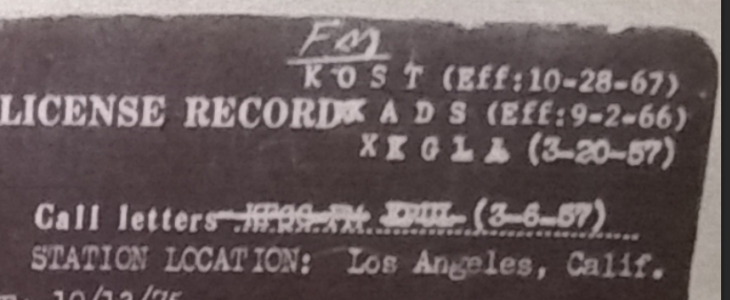
The history card says October '67.
The KOST calls were moved from the FM sister of McLendon's KILT in Houston, which became KZAP for a few months before becoming KILT-FM.
View attachment 9762

I admit that I did not research the actual date of the calls changing from KADS to KOST.

But, if anything, it is evidence that "K-Ads" lasted for an even briefer period than I had presumed.
 
BTW, that history card reveals something I was unaware of ... 103.5 held the KFSG-FM calls for two weeks in 1957 before changing to KGLA. That "lighthearted listening" format may have been a last-minute decision replacing a simulcast of KFSG's hours on 1150.
 
Thanks, Huff! Everything I had seen to that point said the call letter change came in March.
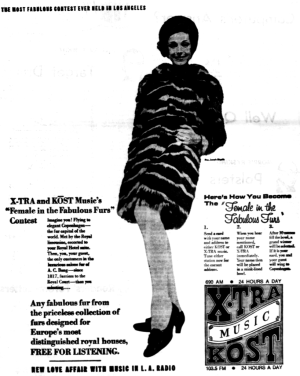
Not surprisingly, KADS never registered in the ratings, but KOST did not show in the Jan/Feb 1968 ratings either, it wasn't until the Apr/May 1968 survey that it first showed up. The earliest promotional ads I found for XTRA/KOST were for a fur coat giveaway from that April... perhaps there was a soft launch, with full launch not coming until the Spring - hence the multiple references to a March change.

Los_Angeles_Herald_Examiner_1968-04-24_15.png
 
Not surprisingly, KADS never registered in the ratings, but KOST did not show in the Jan/Feb 1968 ratings either, it wasn't until the Apr/May 1968 survey that it first showed up. The earliest promotional ads I found for XTRA/KOST were for a fur coat giveaway from that April... perhaps there was a soft launch, with full launch not coming until the Spring - hence the multiple references to a March change.

View attachment 9765

KOST had an uphill climb. KPOL AM/FM was dominant in the beautiful music format in L.A., having chased KGBS out in '66 (they went Country).
 
1. As far as I can tell, tracking the station history through Broadcasting, it kept that format at least until the Evangelists sold it to Jacobson, who used the "simplex" method (a process where turning the mike on muted the receivers being used for background music ... approved by the FCC in 1955, then rescinded in 1964) to feed music to supermarkets, so I presume it was all instrumentals until the sale to McLendon.

2. In 1958, FM was far from being a mass medium. Its audience consisted entirely of hi-fi enthusiasts, and the concept of "morning drive" did not exist on that band.
Thanks for doing the research. I remember first reading Broadcasting in the high school library and being fascinated with the radio and tv business at age 14.
 

It's Summer 1966 - You Live In L.A. - You Bought Your First Car - It Has An FM Radio - You Notice Smog - And Not All The Stations Are Cool.

It's Summer 1966 - You Live In L.A. - You Bought Your First Car - It Has Fm Radio - You Notice Smog - And Not All The Stations Are Cool.
pastdaily.com
pastdaily.com
In the aircheck, caller Dick Burden was cut off with his call about pitching some type of FM broadcasting gear. Burden was an FM engineering pioneer who recently passed away in 2024 at age 92.

Dick Burden obit


Back
Top Bottom