• Get involved.
    We want your input!
    Apply for Membership and join the conversations about everything related to broadcasting.

    After we receive your registration, a moderator will review it. After your registration is approved, you will be permitted to post.
    If you use a disposable or false email address, your registration will be rejected.

    After your membership is approved, please take a minute to tell us a little bit about yourself.
    https://www.radiodiscussions.com/forums/introduce-yourself.1088/

    Thanks in advance and have fun!
    RadioDiscussions Administrators

Nexstar ready to hook up with TEGNA?


Here are more details on the Nexstar's legal issues surrounding the Tegna deal.

Nexstar Media Group finds itself in a self-inflicted financial bind, demanding a staggering $150 million bond from its opponents because it is currently "handheld" with Tegna stations it cannot fully integrate. This legal maneuver, presented to a federal court judge in California, is an attempt to force DirecTV and the attorneys general of eight states to foot the bill for losses Nexstar claims it will suffer while the companies are forced to operate separately. The irony of this $150 million demand lies in the company’s own aggressive timeline; had Nexstar not pushed with such frantic speed to finalize the $6.2 billion tie-up, it might not be facing the massive debt service on $5.1 billion in loans while a temporary restraining order keeps the two entities at arm's length.

The legal battle stems from arguments that the merger is a direct threat to both market competition and the quality of local journalism. Opponents claim that by absorbing Tegna, Nexstar would control 260 stations reaching 80% of U.S. households, granting it unprecedented leverage to hike prices for distributors. DirecTV specifically argued that Nexstar’s increased size would allow it to weaponize "blackouts" during negotiations, eventually passing those higher costs onto consumers. While Nexstar’s representatives countered that they are currently locked into existing contracts, the reality of their "held separate" status means they are paying for a massive acquisition they cannot yet control or streamline.
 

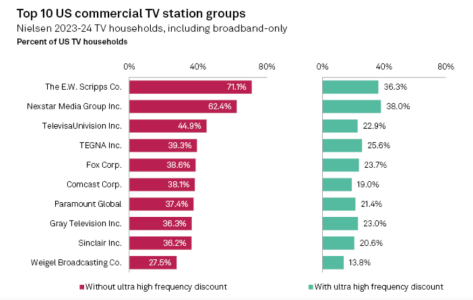
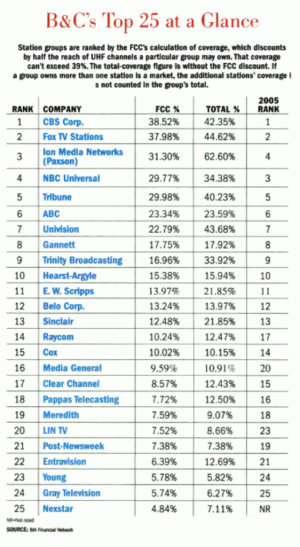
Here is a figure from the past two decades on who the biggest TV stations are. In the 2000's it was CBS and Fox that were the biggest TV station owners. But once we look at how things changed in the past two decades commercial local TV is dominated by Nexstar as a result of them merging with Tegna, Tribune, Lin Media and Media General. Scripps as a result with merging with Ion Networks, Gray as a result of getting Raycom and Meredith, Sinclair is the result of getting a combination of divested stations and merging with Guy Gannett, Fisher Media, Albritton, Bonten Media. In this case we are focusing how Nexstar went from number 25 in the 2005 study to now the top spot of largest TV station owners.

When I see the 2005 list the top 10 had Disney/ABC, CBS, Fox and NBC Universal on that spot. But given the past decade these 4 have been in the process of protecting their apps given where the demos are located with newer TV's and yes a response to go after Netflix has been part of the strategy for some time.
 

Attachments

  • 1730081042184.png
    1730081042184.png
    89.1 KB · Views: 12
  • 1730078313335.png
    1730078313335.png
    415.9 KB · Views: 13
Tonight was the first night on WHO 13 that when they had a national News story it was Newsnation reporting instead of NBC News.
They are really doing anything they can to keep NewsNation afloat. If they have a network affiliation they need to take that networks news feeds. Not in house national news.
 
On the other hand, if Nexstar wants to operate in the state of California, it has to abide by the laws of that state.
Operating by the laws of a state is not germane to this discussion. Of course they would be bound by state employment laws, etc. The FCC, not the state, regulates its broadcast license and, unless the merger is stopped by regulators or the federal courts, the merged entity will be able to operate their stations. Your comment is non sensical as to the State AGs lawsuit. They may get thrown out on appeal for lack of standing.
 
The FCC, not the state, regulates its broadcast license and, unless the merger is stopped by regulators or the federal courts, the merged entity will be able to operate their stations. Your comment is non sensical as to the State AGs lawsuit. They may get thrown out on appeal for lack of standing.

If Nexstar operates TV stations in California, and Californians will be affected by a media monopoly, then they have standing. They are representing the residents of their state.

They’re challenging a waiver, and they’re within their rights to challenge a waiver.
 
Last edited:
Operating by the laws of a state is not germane to this discussion. Of course they would be bound by state employment laws, etc. The FCC, not the state, regulates its broadcast license and, unless the merger is stopped by regulators or the federal courts, the merged entity will be able to operate their stations. Your comment is non sensical as to the State AGs lawsuit. They may get thrown out on appeal for lack of standing.

The suit is not based on broadcast law or regulation. It’s based on issues of economic concentration and market power. Those are well within the ambit of state jurisdiction.

If Nexstar operates TV stations in California, and Californians will be affected by a media monopoly, then they have standing. They are representing the residents of their state.

They’re challenging a waiver, and they’re within their rights to challenge a waiver.

I don’t think they’re challenging the waiver directly, though an implicit challenge is certainly a side effect of the suit.
 
If Nexstar operates TV stations in California, and Californians will be affected by a media monopoly, then they have standing. They are representing the residents of their state.
However do those Attorneys General have any power outside their own state? There are likely many Nexstar and TEGNA stations in red states that don’t have any objection to the overall deal. Nobody is squawking about it here in Texas, for example.

Is there a possibility that a limited merger could be quickly cleared involving markets that are NOT in states challenging the overall deal? Could markets in the challenging states have TEGNA stations remain in a rump company until the court challenges play out?
 
This is expected more than we think given that its all about Nexstar protecting NewsNation and the CW. We first had a preliminary report of Nexstar ordering stations to stop using NBC content during local news but at that point we had no clue if there was going to affiliation flips but here is more.

Nexstar Media Group is orchestrating a massive overhaul of local television by systematically purging content from established national networks like ABC, NBC, and CBS to clear the way for its own NewsNation product. As the nation’s largest owner of local stations, the Irving, Texas-based giant has already begun severing ties with NBC’s news-sharing services, forcing local producers to abandon the deep reporting resources of legacy networks in favor of segments produced within the Nexstar corporate family. CEO Perry Sook has made it clear that this is only the beginning, stating his intention to let agreements with the remaining major broadcast networks expire without renewal. This shift positions NewsNation as the ultimate and exclusive national news partner for all Nexstar stations, effectively replacing the diverse array of third-party wire feeds that local newsrooms have historically relied upon to maintain a broad editorial perspective.

Now another person leaves Nexstar's Seattle affiliate all for the same reasons such as cutting staff due to the Tegna Merger.
 
This is expected more than we think given that its all about Nexstar protecting NewsNation and the CW. We first had a preliminary report of Nexstar ordering stations to stop using NBC content during local news but at that point we had no clue if there was going to affiliation flips but here is more.


Now another person leaves Nexstar's Seattle affiliate all for the same reasons such as cutting staff due to the Tegna Merger.
Isn’t this a breach of affiliation contract.
 
However do those Attorneys General have any power outside their own state?

My view is they don't. However, there are other lawsuits that don't have those limitations.

Is there a possibility that a limited merger could be quickly cleared involving markets that are NOT in states challenging the overall deal?

At some point, they might merge all the national and state lawsuits into one.
 
The suit is not based on broadcast law or regulation. It’s based on issues of economic concentration and market power. Those are well within the ambit of state jurisdiction.
The lawsuit, as filed by Attorney General Rob Bonta (D-CA), didn't mention any California laws that might be being violated.

Instead, the suit relies on the Clayton Antitrust Act, passed by Congress and signed by Woodrow Wilson in 1914. That Act is totally reliant on market domination, and is typically enforced by the US Department of Justice and Federal Trade Commission. The FTC can't currently enforce anything, as the Senate has not yet confirmed the President's nominee(s), which might come into play in this lawsuit.

Here's the original complaint from the California AG if you wish to confirm its reliance on the Clayton Act. The important summary is on page 29, under heading "XI: Violations Alleged"

 
This is expected more than we think given that its all about Nexstar protecting NewsNation and the CW. We first had a preliminary report of Nexstar ordering stations to stop using NBC content during local news but at that point we had no clue if there was going to affiliation flips but here is more.


Now another person leaves Nexstar's Seattle affiliate all for the same reasons such as cutting staff due to the Tegna Merger.
WHO 13 in Des Moines has started doing it as well since Sunday (Yesterday) for Newsnation reporting instead of NBC News.
 
The lawsuit, as filed by Attorney General Rob Bonta (D-CA), didn't mention any California laws that might be being violated.

Instead, the suit relies on the Clayton Antitrust Act, passed by Congress and signed by Woodrow Wilson in 1914.

Thank you. There are state anti-trust laws, too…I know of one situation where a station cluster was rearranged because of just such laws (not in California). But the larger point remains, that the basis of the lawsuit isn’t in communications law. You’ve also nicely invalidated the claim that this wasn’t a federal matter.
 
You’ve also nicely invalidated the claim that this wasn’t a federal matter.
Right. That it is a federal matter seems to be Nexstar's main defense at the moment.

The Clayton Act says "any person, firm, corporation or association shall be entitled to sue for injunctive relief." The State of California does not fit into any of those categories, nor do any of the other states joining the suit, therefore Nexstar argues the suit should be dismissed for lack of standing.
 
If Nexstar operates TV stations in California, and Californians will be affected by a media monopoly, then they have standing. They are representing the residents of their state.
Clearly you are unfamiliar with, or chose to ignore the Supremacy Clause as well as the fact that broadcast television is regulated by the federal government.


Back
Top Bottom