
• Get involved.
    We want your input!
    Apply for Membership and join the conversations about everything related to broadcasting.

    After we receive your registration, a moderator will review it. After your registration is approved, you will be permitted to post.
    If you use a disposable or false email address, your registration will be rejected.

    After your membership is approved, please take a minute to tell us a little bit about yourself.
    https://www.radiodiscussions.com/forums/introduce-yourself.1088/

    Thanks in advance and have fun!
    RadioDiscussions Administrators

NPR without federal funding

Status
Not open for further replies.
Recent squawking on social media, including a post by the new head of DOGE seems to point to a possible end to federal funding of NPR, and a big surprise about all the hosts that make around a half million a year in salary.
1. What percent of NPR is federally funded?
2. What effect would and end to federal funds create?
 
1. What percent of NPR is federally funded?
2. What effect would and end to federal funds create?
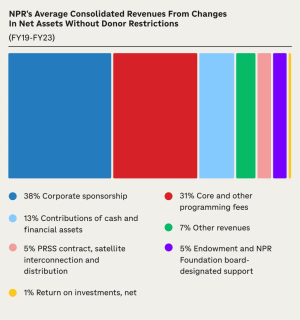
It's a complicated question. First of all, they can't "defund NPR." There is no line in the federal budget for NPR. They would have to defund all of public broadcasting, and maybe even more than that. But here is a graph of NPR's revenues:

1738134607882.png


NPR is run by its member stations. They pay dues and program fees to carry its programming. NPR gets some federal grant money from various agencies, and some funding for the NPR interconnection system from CPB. The main thing CPB does is fund local NPR & PBS stations. Many of them are owned by the states. The states are not of the same mind as the current administration. The states, even the very red ones, are in the service business, and their radio stations are seen as part of that service. So while the government is trying to defund public broadcasting, what they're really doing is cutting federal funding to the states. That puts all of the financial burden for running those radio & TV stations on state governments. That's what the end of federal funding would mean. That's not good, because they will be forced to raise property and other state taxes to continue to provide those services to the public.

But what's going on in government now is far bigger than defunding NPR. The current administration wants to defund the entire government. That's why they offered a buyout for all federal employees. They want to shut the whole thing down. They want anarchy. They call it destroying the administrative state. That's not good for this country. That's what you get when you get government run like a business. It ends up being like iHeart and Cumulus. We all know what that's like.
 
It's a complicated question. First of all, they can't "defund NPR." There is no line in the federal budget for NPR. They would have to defund all of public broadcasting, and maybe even more than that. But here is a graph of NPR's revenues:

View attachment 8482


But what's going on in government now is far bigger than defunding NPR. The current administration wants to defund the entire government. That's why they offered a buyout for all federal employees. They want to shut the whole thing down. They want anarchy. They call it destroying the administrative state. That's not good for this country. That's what you get when you get government run like a business. It ends up being like iHeart and Cumulus. We all know what that's like.
God bless them. The bloated mess of a government far over reaches what it was intended to do. That's how the tampons got in the men's room. Let's cut it to the bone and do what must be done. We need the military, roads, some basic supervision, like for the purpose of this board, the FCC. Someone has to supervise licensing and making sure we don't have pirate radio stations, a million translators reproducing failing AM stations to the detriment of adjacent licensed FM stations. Oh wait, we have all that including the pirates, so the current bloated organization isn't doing a great job (like the post office). Let's tear it down the redo it. To continue the same thing and expect different results is insanity. If we stop throwing money at everything, and get back to common sense, well, perhaps....
 
If we stop throwing money at everything, and get back to common sense, well, perhaps....

We throw money at things people want. People want what they want, and they want it for free. They want education. They want roads. They want airplanes that don't crash. They want information. That's part of what government does. Government is in the public service business. That's where we get that line about "public interest, convenience, and necessity." People don't know what's being done until it's gone. They don't know what goes into keeping planes from crashing into each other. We've had a very stable and efficient government for a long time. It's been so stable that people don't even know what it does, or what it would be like if it was gone. But with the current administration, we're about to find out what it's like to be in a country with no government. Let's tear it all down? You might call that common sense. I call it crazy.
 
We throw money at things people want. People want what they want, and they want it for free. They want education. They want roads. They want airplanes that don't crash. They want information. That's part of what government does. Government is in the public service business. That's where we get that line about "public interest, convenience, and necessity." People don't know what's being done until it's gone. They don't know what goes into keeping planes from crashing into each other. We've had a very stable and efficient government for a long time. It's been so stable that people don't even know what it does, or what it would be like if it was gone. But with the current administration, we're about to find out what it's like to be in a country with no government. Let's tear it all down? You might call that common sense. I call it crazy.
How many trillions of debt are we in? It all crashes sooner or later. That is a mathematical fact. It won't be tomorrow. I might not be in our lifetime, but it WILL happen unless things change and cuts are made. I say cut pubic broadcasting for a start. Either you are correct and a zillion people love it and will support it with their own money or allow changes to allow advertising to be sold, or it isn't as necessary in everyone's life as you think and it will go away and like the AM station down the street, will be unnoticed. This government has done very little right and is a bloated mess. I'm glad to see changes being made and a bit of common sense. And now I don't love Trump and his pompous ass attitude, but I didn't like whomever was running the show while and old man with dementia was pretending to be doing it. Now I must leave to go shake hands with the ghost at the edge of the stage. He wants to introduce me to dead people and to tell me about efficiency. This should be interesting.
 
I say cut pubic broadcasting for a start. Either you are correct and a zillion people love it and will support it with their own money or allow changes to allow advertising to be sold, or it isn't as necessary in everyone's life as you think and it will go away

You haven't read anything I've written. The feds don't fund NPR. Local stations do. The feds are going to cut aid to local stations. The local stations are owned by states. The states are stuck holding the bag. They still have to staff and program the stations without federal aid. All the congress is doing is hurting their own home states. The states will have to raise taxes to stay afloat. The FCC controls whether or not these stations can sell advertising. Not local states. The FCC has to make that change. If they do, it will further dilute the advertising pool and take money away from commercial stations, furthering their decline. But sure, let's blow everything up in order to save money. Just like iHeart has done to local radio.
 
You haven't read anything I've written. The feds don't fund NPR. Local stations do. The feds are going to cut aid to local stations. The local stations are owned by states. The states are stuck holding the bag. They still have to staff and program the stations without federal aid. All the congress is doing is hurting their own home states. The states will have to raise taxes to stay afloat. The FCC controls whether or not these stations can sell advertising. Not local states. The FCC has to make that change. If they do, it will further dilute the advertising pool and take money away from commercial stations, furthering their decline. But sure, let's blow everything up in order to save money. Just like iHeart has done to local radio.
On the other hand, if the public stations competed for advertising dollars, stations would have to do better to be profitable. If they are not, they will fail and there will be one less competitor. The remaining audience will enhance the marketability of the remaining stations. Much like the four gas stations on the corner. When one goes out, the others can make some money and even offer free coffee with a full up
 
On the other hand, if the public stations competed for advertising dollars, stations would have to do better to be profitable.

That's why the NAB for many years has been against allowing public stations to sell advertising. Big radio companies don't like to compete for advertising. That's why they keep selling station to EMF and other religious broadcasters who take the stations non-commercial. That means less competition for ad dollars. So if somehow the FCC allows non-coms to sell commercials (which is very unlikely), all that will do is accelerate the death of existing music radio stations. Why? Because public radio stations deliver a quality product, while iHeart and Cumulus are cutting on staff. So sure, go ahead. Take money from one group and give it to another. When you blow everything up, you get collateral damage. That's what's about to happen.
 
Public broadcasting has the programming it has precisely due to its non-profit and non-commercial nature. If public radio becomes commercial, it would focus less on "niche" programming (such as classical, jazz, indie music, spoken word) and more on more profitable "mass appeal" programming
 
Public broadcasting has the programming it has precisely due to its non-profit and non-commercial nature. If public radio becomes commercial, it would focus less on "niche" programming (such as classical, jazz, indie music, spoken word) and more on more profitable "mass appeal" programming
If it is excellent niche programming, it will attract its own audience, either over the air or elsewhere. There is no need to support it with any government funding. If it needs funding other than contributors voluntarily give, it might not be as popular as you wish. If we were really the richest of the rich and had money falling off of our money trees, it would not bother me. We're broke and in dept and the only way to fix it is to cut spending.
 
1. NPR and PBS are not federally funded like the VOA is.
2. Corporation for Public Broadcasting does fund the local affiliates of NPR and PBS.
3. Local PBS and NPR affiliates are owned by Private educational foundations, State Colleges and Universities and in some cases municipal entities. Even if CPB were to go away wouldn't the major PBS and NPR affiliates in large Radio and TV Markets that will survive but the smaller the Radio and TV markets would either go away or merge with larger entities.
 
Last edited:
If it is excellent niche programming, it will attract its own audience, either over the air or elsewhere. There is no need to support it with any government funding.

The federal funding isn't for the programming. It's for infrastructure. You should do some research on how this system works before you blow the whole thing up.

We're broke and in dept and the only way to fix it is to cut spending.

We're not broke. We are the richest and best country in the world.
 
The federal funding isn't for the programming. It's for infrastructure. You should do some research on how this system works before you blow the whole thing up.


We're not broke. We are the richest and best country in the world.
Will that quality programming not support new tubes for the transmitters?
Not broke? What is that I heard about the national debt? Must be those damned republicans making up stuff again. But is sure seems like if we're paying trillions in just interest, there may be a problem. Let me flip on the news on PBS to double check.
 
Not broke? What is that I heard about the national debt? Must be those damned republicans making up stuff again.

The debt was fine before 2016. Then they cut taxes for the rich and big corporations. That added trillions of debt. They want to do it again.

Hey look, if they cut taxes for the rich, that'll be great for me. I'll be able to buy another house. But everybody else gets screwed.
 
Not broke? What is that I heard about the national debt?

A little over 30 years ago I was listening to this talk show on AM radio, and they were promoting this book. It sounded pretty ominous, so I checked it out. It laid out in great detail how the $4 trillion dollars of debt that had been racked up over the past decade (though they blamed it all on the Clinton administration) was simply unsustainable and if nothing was done, the United States would collapse entirely, and it was coming very, very soon.

The title of the book was "Bankruptcy 1995." I can't recall if it pegged the vast outlay (#sarcasm) for NPR as the lynch pin in the teetering economy, but surely as the sun will rise - the book insisted - the country was on track to go utterly bankrupt by the middle of the decade. It said everything you've been saying about the "unsustainable" national debt, and more.

The predicted disaster never happened, and for me personally, 1995 was one of the best years of my early radio career.
 
We now live in a world where our government is run by celebrities and TV stars, not public servants. In the old days, people went to congress for one reason: To bring home the bacon. That's what they ran on. They said: "We're going to bring home federal money to build roads, bridges, hospitals, airports, and schools." That's how all those things got built. Now the TV stars who run our government don't care about roads or schools. They care about transgender kids and radical left ideology. Nobody cares about bringing home federal money anymore. Who hurts from that? Not the celebrities who run government. Their health care is paid for. They have no worries at all. But we have to wonder who will build the roads and schools when the federal funds go away. Public broadcasting is a small part of that, because its funding is part of the education budget. The celebrities in government may not know that. But public broadcasting is funded along with your state colleges and universities. In the old days, politicians used to care about education. Now it's part of the culture war. Take a look around at this country as it is now. If these celebrities get their way, a lot of what you see today will go away.
 
Status
Not open for further replies.


Back
Top Bottom