
Below is a table showing received field intensity vs. distance from the transmit antenna, for the configuration defined there.
The transmitter and antenna system described in this graphic are about the best-performing that could be used, while still complying with FCC §15.219.
Most operators won't know the true value of Earth conductivity at/near their transmit site. They also won't know how much field intensity is needed to overcome the r-f noise and interference present at receive sites, or the sensitivity of the receive equipment needed for useful reception of an interference-free signal.
But the table might still be useful if one considers that a received, interference-free field intensity of about 100 µV/m might typically be needed for acceptable(?) performance of a good AM receive system, and about 25 µV/m for an excellent one.
However local r-f noise and nighttime interference from licensed AM broadcast stations on/near the Part 15 AM carrier frequency can (considerably) reduce their useful coverage areas from the ranges shown in the table.
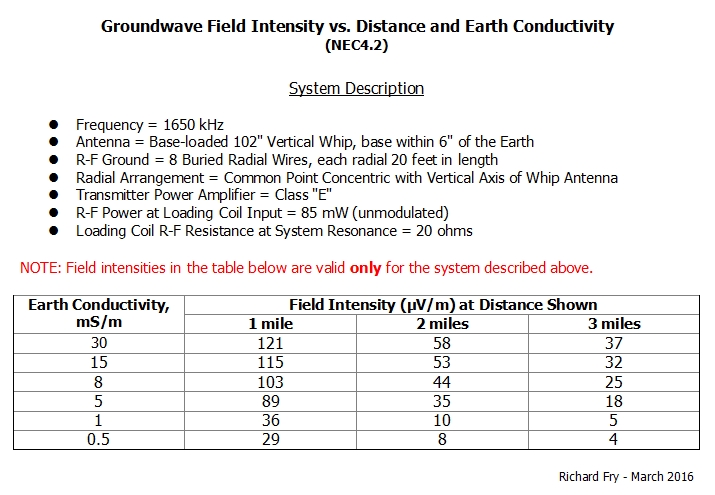
The transmitter and antenna system described in this graphic are about the best-performing that could be used, while still complying with FCC §15.219.
Most operators won't know the true value of Earth conductivity at/near their transmit site. They also won't know how much field intensity is needed to overcome the r-f noise and interference present at receive sites, or the sensitivity of the receive equipment needed for useful reception of an interference-free signal.
But the table might still be useful if one considers that a received, interference-free field intensity of about 100 µV/m might typically be needed for acceptable(?) performance of a good AM receive system, and about 25 µV/m for an excellent one.
However local r-f noise and nighttime interference from licensed AM broadcast stations on/near the Part 15 AM carrier frequency can (considerably) reduce their useful coverage areas from the ranges shown in the table.