• Get involved.
    We want your input!
    Apply for Membership and join the conversations about everything related to broadcasting.

    After we receive your registration, a moderator will review it. After your registration is approved, you will be permitted to post.
    If you use a disposable or false email address, your registration will be rejected.

    After your membership is approved, please take a minute to tell us a little bit about yourself.
    https://www.radiodiscussions.com/forums/introduce-yourself.1088/

    Thanks in advance and have fun!
    RadioDiscussions Administrators

Pirate on 107.5 in the East Valley?


Circling back to @LamptimerFan's original question, then ...

Shouldn't we be hearing a TOH legal ID of "KVCP-HD4 Phoenix"? (Not KCVP, as typo'd above ...)

the family radio website infact lists KVCP ...... now wether its runnign a legal id or not...... alotta people get it wrong or dont do it. .and if FR isnt doing it, whatever they use for the ID'er crapped the bed and no ones noticed.
 
Translators only have to ID three times a day (yes, a weird FCC rule). So no, they don't have to say anything about the primary feed station.
Here are the official FCC rules:
Identification of translator and booster stations. Translator stations must be identified by the licensee by the following means:

  • ... by arranging with the primary station whose signal is being rebroadcast to identify the translator by call sign and location. The identification must occur 3 times daily: once between 7 AM and 9 AM, once between 12:55 PM and 1:05 PM, and once between 4 PM and 6 PM. Stations that do not begin operating before 9 AM must provide the identification at the beginning of the broadcast day. The licensee of the translator station must arrange for the primary station to keep in the primary FM station's file (and to make available to FCC personnel), the call sign and location of the translator station. This record must include the name, address, and telephone number of the translator licensee or his service representative to be contacted in the case of a malfunction of the translator. See 47 CFR Section 74.1283(c)(1).
  • ... by transmitting the call sign in Morse Code at least once hour. See 47 CFR Section 74.1283(c)(2) for additional requirements for transmission of the call sign in this manner.

 
OK, I can now confirm that it is in fact K298CK, comparing 107.5 with 88.3-HD4. I'm not all that surprised that I can pick it up here, at 1500 ft ASL and a good shot to the west. But I was shocked that I heard it in Gilbert. 250 watts on Shaw Butte I wouldn't think would get out that far, especially where it's entirely possible to hear KHYT.
 
Translators only have to ID three times a day (yes, a weird FCC rule). So no, they don't have to say anything about the primary feed station.
Here are the official FCC rules:
Identification of translator and booster stations. Translator stations must be identified by the licensee by the following means:

  • ... by arranging with the primary station whose signal is being rebroadcast to identify the translator by call sign and location. The identification must occur 3 times daily: once between 7 AM and 9 AM, once between 12:55 PM and 1:05 PM, and once between 4 PM and 6 PM. Stations that do not begin operating before 9 AM must provide the identification at the beginning of the broadcast day. The licensee of the translator station must arrange for the primary station to keep in the primary FM station's file (and to make available to FCC personnel), the call sign and location of the translator station. This record must include the name, address, and telephone number of the translator licensee or his service representative to be contacted in the case of a malfunction of the translator. See 47 CFR Section 74.1283(c)(1).
  • ... by transmitting the call sign in Morse Code at least once hour. See 47 CFR Section 74.1283(c)(2) for additional requirements for transmission of the call sign in this manner.

You left out the third option:
Transmission of the call sign can be accomplished by Frequency Shifting Key; the carrier shift shall not be less than 5 kHz nor greater than 25 kHz.

FSK is actually how the majority of translators comply, because it is not audible to listeners.
 
Last edited:
You left out the third option:
Transmission of the call sign can be accomplished by Frequency Shifting Key; the carrier shift shall not be less than 5 kHz nor greater than 25 kHz.

FSK is actually how the majority of translators comply, because it is not audible to listeners.

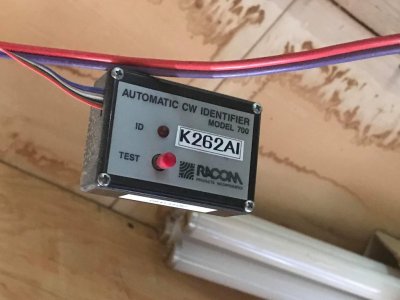
Most modern transmitters these days have the FSK option built in, but if you're dealing with a bit of an older crown transmitter on a translator you oversaw then you have one of these things attached


67445798_10216703106107502_4695604293502238720_n (2).jpg
 
Most modern transmitters these days have the FSK option built in, but if you're dealing with a bit of an older crown transmitter on a translator you oversaw then you have one of these things attached


View attachment 11025

Most Crown translators manufactured later than 2000 have as an option a circuit board which does the same thing. I know because I researched it for KRKE and then we decided just tossing in the translator ID as a two-second TOH voicer wasn't objectionable enough to bother buying and installing that board.

But, if what some people in the industry predict happens eventually, §73.1201 will go away, and likely take §74.1283 along with it.


Back
Top Bottom