I will never forget in one of the early episodes or the pilot, they forgot to put a needle in the truntable arm.WKRP in Cincinnati would like a word...

-
Get involved.
We want your input!
Apply for Membership and join the conversations about everything related to broadcasting.
After we receive your registration, a moderator will review it. After your registration is approved, you will be permitted to post.
If you use a disposable or false email address, your registration will be rejected.
After your membership is approved, please take a minute to tell us a little bit about yourself.
https://www.radiodiscussions.com/forums/introduce-yourself.1088/
Thanks in advance and have fun!
RadioDiscussions Administrators
You are using an out of date browser. It may not display this or other websites correctly.
You should upgrade or use an alternative browser.
You should upgrade or use an alternative browser.
Poorly done "fictional" radio stations
- Thread starter Yabadabado1
- Start date

How relevant is this! Here's a list of the 17 best movies about radio.

 www.rogerebert.com
The 17 Best Movies About Radio, Ranked
Films that celebrate the analog in an age of digital disconnection.
www.rogerebert.com
It's not for everyone (as many Terry Gilliam movies can be), but it is really quite good. One of Robin Willams' many "oh, he's actually a good serious actor" films. In addition to the radio angle (Bridges' character faking a radio contest with his voice and a cassette deck) it's a look into homelessness, mental illness, and PTSD. But it has a happy ending...Another one I tried to watch but just couldn't get into it.

The simplest answer is that probably no one on the set designing crew had ever been to a radio station.
I mean, if this is the clip we're talking about...
There's not that much wrong, other than there's no need for three consoles in one studio. Legit equipment (boards, carts and cart decks, turntables, mike, headphones).
Steve firing the carts for Robin isn't that far off what a jock/engineer setup was like...
...but if you put Steve in his own booth on the other side of the glass, you've complicated camera shots and limited interactions.
Of course, not all radio stations separated jock and engineer that way. WABC in the 60s had them in the same room, on opposite sides of a table:
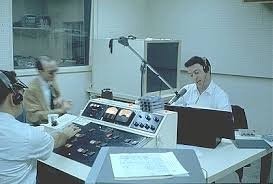
If Steve's firing the carts, why not have him play the records, too? Because then Robin's just talking.
The priority was on telling a story, not teaching the kids what radio was really like 40 years ago.
For the most realistic, it's hard to top American Graffiti (1973)...
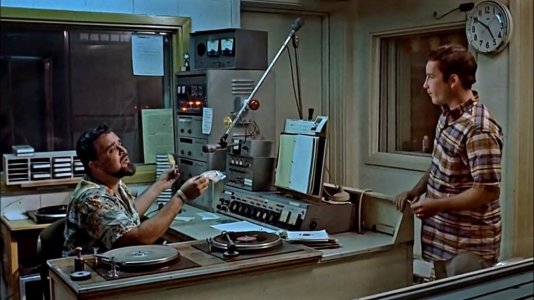
...or Play Misty For Me (1971)...
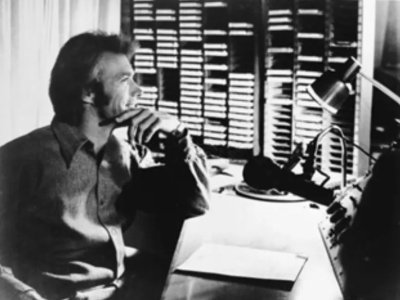
...because both were shot in actual radio studios (KRE, Berkeley and KRML, Carmel, respectively) during those stations' off-air hours.
And I see Frasier has already been mentioned---a set, but closely modeled on KABC, Los Angeles.
Last edited:
As for the "kids running the radio station", Hawkins, Indiana is supposed to be a small town, 10,000-20,000 people.
There were a lot of times when I, between the ages of 15 and 17, was the only person in the building at KIBS in Bishop (population 3,500).
The oldest jock on the staff of KSLY in San Luis Obispo (population 30,000) when I was there, was 24. I had just turned 18 when they gave me morning drive.
And at KUKI in Ukiah (population 10,000), I was the morning man at 19. The Chief Engineer was 19. And our production director had just turned 18 and was finishing his final semester of high school.
There were a lot of times when I, between the ages of 15 and 17, was the only person in the building at KIBS in Bishop (population 3,500).
The oldest jock on the staff of KSLY in San Luis Obispo (population 30,000) when I was there, was 24. I had just turned 18 when they gave me morning drive.
And at KUKI in Ukiah (population 10,000), I was the morning man at 19. The Chief Engineer was 19. And our production director had just turned 18 and was finishing his final semester of high school.
Not qualified to say right or wrong on the actual radio/station portrayal, but as someone going to school at the Univ of Cincinnati during the show's run, I was impressed at the time how well they "knew" Cincinnati.WKRP in Cincinnati would like a word...
Many of the places/events mentioned were authentic, including sadly the Who concert tragedy. There were lots of subtleties, like characters wearing the same, actual Cincinnati-related apparel we were wearing at the time. There were also a few episodes that showed a current Univ of Cincinnati football (basketball?) schedule tacked to a bulletin board. That's an eye for detail.
Not qualified to say right or wrong on the actual radio/station portrayal, but as someone going to school at the Univ of Cincinnati during the show's run, I was impressed at the time how well they "knew" Cincinnati.
Many of the places/events mentioned were authentic, including sadly the Who concert tragedy. There were lots of subtleties, like characters wearing the same, actual Cincinnati-related apparel we were wearing at the time. There were also a few episodes that showed a current Univ of Cincinnati football (basketball?) schedule tacked to a bulletin board. That's an eye for detail.
They got a lot right. Steve Marshall (writer, editor and consultant) came from KNX-FM in Los Angeles. Howard Hessemann had been a jock.
That said, there is ZERO point in making a TV show with a realistic portrayal of a radio studio. The studio speakers mute when you open the microphone. Nobody wants to see someone cue a record more than once.
You make the studio set that serves the story and the camera angles, period.
Seen bits and pieces of that movie. One of these days, I'll have to watch the whole thing. But I do know that former reporter for WJW TV, Dave Buckel, had a part in the movie as a newsman.
Wasn't Dave Buckel an actual newscaster on WHK radio around the the time that Telling Lies was set? He didn't get into TV news until later.
I thought it was obvious they do that to prevent it from being confused with a real radio station, just like using 555- phone numbers.On that note, what really bugs me is when they use an incorrect frequency allocation for the fake station. Like FM 108.0, or the AM 510 I saw once.
On "NewsRadio", the fictional WNYX was on 585 kHz AM.
So, I got a little curious---turns out the Duffer Bros didn't just replicate the exterior of WPTF.
@fybush hisownself has been inside and profiled it in 2016:
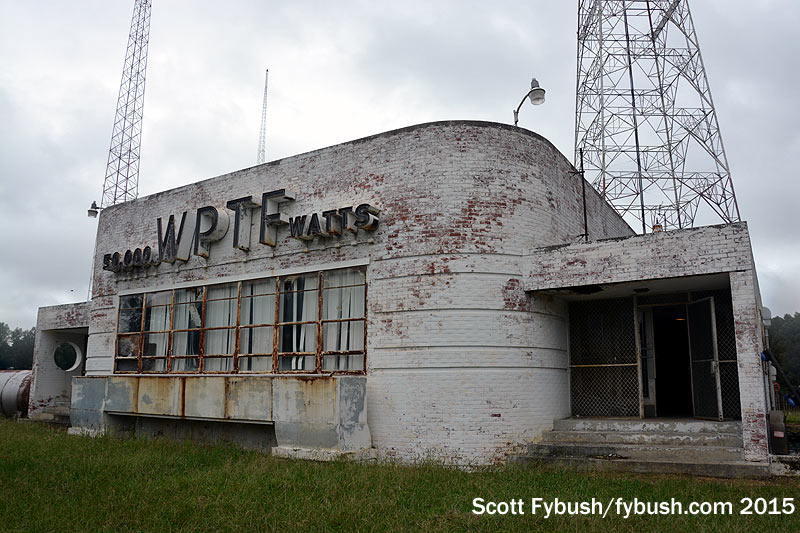
Looks to me like they nailed the booth and the transmitter (now the backup, but in the 80s, the main).
RadioWorld has been in more recently:

 www.radioworld.com
Again, my only quibble is three consoles (small, medium and large) and nobody using any of them...but so what?
@fybush hisownself has been inside and profiled it in 2016:
Site of the Week 3/4/16: Raleigh, NC
Text and photos by SCOTT FYBUSH It's amazing how time flies when you're having fun out on the road photographing
www.fybush.com
Looks to me like they nailed the booth and the transmitter (now the backup, but in the 80s, the main).
RadioWorld has been in more recently:
WPTF's Transmitter Site Is Host to a Radio Time Capsule - Radio World
If there's one thing our readers love, it's radio history — especially if that history is combined with a healthy dose of nostalgic tech.
www.radioworld.com
Again, my only quibble is three consoles (small, medium and large) and nobody using any of them...but so what?
I thought it was obvious they do that to prevent it from being confused with a real radio station, just like using 555- phone numbers.
On "NewsRadio", the fictional WNYX was on 585 kHz AM.
Yeah...especially in big markets with a ton of receivable signals, it's easier just to fictionalize a signal. TV shows do it all the time. Before NBC started using its shows to promote its own newscasts (E.R. and West Wing) by using affiliate logos for scenes involving TV stations, L.A. Law would have scenes where the TV vans or mic flags were wearing a fictional set of call letters and channels 3, 6 or 12 (none of which are L.A.).
2 more classic movies that used real TV stations are "White Christmas ", when Bing Crosby goes to New York to plug their Vermont salute to Dean Jagger the cameras have WNBT displayed, the call sign for channel 4 in 1952, and "Oceans 11", filmed in Las Vegas in 1959 where we see a reporter and TV crew from KLAS, owned at the time by Howard Hughes.
"Oceans 11", filmed in Las Vegas in 1959 where we see a reporter and TV crew from KLAS, owned at the time by Howard Hughes.
Small correction: Howard bought KLAS in September, 1967 when he was unhappy with the late movies they were running (he'd been living at the Desert Inn since 1966).
For its first 14 years, and at the time of the "Ocean's 11" filming (January and February 1960), KLAS was owned by the Las Vegas Sun newspaper.
There's a few sites that have stuff about WPTF:So, I got a little curious---turns out the Duffer Bros didn't just replicate the exterior of WPTF.
@fybush hisownself has been inside and profiled it in 2016:
Site of the Week 3/4/16: Raleigh, NC
Text and photos by SCOTT FYBUSH It's amazing how time flies when you're having fun out on the road photographingwww.fybush.com
Looks to me like they nailed the booth and the transmitter (now the backup, but in the 80s, the main).
RadioWorld has been in more recently:
WPTF's Transmitter Site Is Host to a Radio Time Capsule - Radio World
If there's one thing our readers love, it's radio history — especially if that history is combined with a healthy dose of nostalgic tech.
Again, my only quibble is three consoles (small, medium and large) and nobody using any of them...but so what?
Stranger Things: Peak inside real-life inspiration for WSQK Radio
Watching 'Stranger Things' is like being stuck in a violent video game. I don't see the appeal of this show beyond teens, or early 20's, and fans of video games or Dungeons and Dragons. The 80's factor wasn't enough to keep me interested.
I did like seeing the old refurbished Continental transmitter with the glowing tubes. 😊
I did like seeing the old refurbished Continental transmitter with the glowing tubes. 😊
Watching 'Stranger Things' is like being stuck in a violent video game. I don't see the appeal of this show beyond teens, or early 20's, and fans of video games or Dungeons and Dragons. The 80's factor wasn't enough to keep me interested.
We watched the first three seasons, but the beginning of the fourth felt like way too much, so my wife and I bailed out there.
I did like seeing the old refurbished Continental transmitter with the glowing tubes. 😊
Yeah, me too.
Did anyone else catch the "50,000 WATTS' signage in front of the WSQK building. I thought this was an AM until I saw 94.5 FM on the side of the van.
At least they used a REAL frequency!
At least they used a REAL frequency!
Did anyone else catch the "50,000 WATTS' signage in front of the WSQK building. I thought this was an AM until I saw 94.5 FM on the side of the van.
At least they used a REAL frequency!
Not many FMs talk about their effective radiated power.
(I have no idea why, but you have to click "Watch on YouTube" to hear it)
Last edited:

I was not aware of this movie. Around 1962 I was good friends with the overnight jock at WHK. We chatted on the phone often, and I visited the Euclid Avenue location once I could drive.Another good movie radio set is in "Telling Lies in America" with Kevin Bacon and written by Joe Eszterhaus about a teen growing up in Cleveland circa 1960 who is befriended by a WHK DJ. The producers built an excellent set modeled after the WHK 5000 Euclid Avenue studios of that era with many WHK vintage pieces loaned by collectors, the radio museum and the historical society. Although the plot does not center around radio as such, it is a good effort.
I note that it is available on Amazon Prime, so I will view it soon.

My god that was a dreadful show.Good Morning World says, "Hold My Beer".