
-
Get involved.
We want your input!
Apply for Membership and join the conversations about everything related to broadcasting.
After we receive your registration, a moderator will review it. After your registration is approved, you will be permitted to post.
If you use a disposable or false email address, your registration will be rejected.
After your membership is approved, please take a minute to tell us a little bit about yourself.
https://www.radiodiscussions.com/forums/introduce-yourself.1088/
Thanks in advance and have fun!
RadioDiscussions Administrators
You are using an out of date browser. It may not display this or other websites correctly.
You should upgrade or use an alternative browser.
You should upgrade or use an alternative browser.
PPM vs. Diary Markets?
- Thread starter tall_guy1
- Start date


K.M. Richards
Program Director, The Eighties Channel™
Simply put, market size by population. The top 50 markets are PPM, everything else is diary.
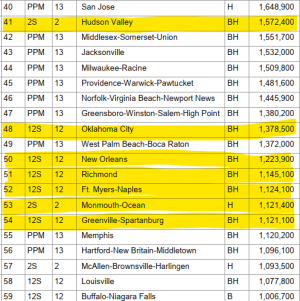
In recent years, population shifts have moved some of the markets along the dividing line back and forth but Nielsen has stuck with the original choice of markets for those (likely due to the cost of trying to change a PPM market back to diaries and vice versa). Hence -- for example -- Memphis, market #55, still being a PPM market because it was in the top 50 when the list was made, and Hudson Valley (#41) still being a diary market.
There is one exception to this rule that I believe was the case from the beginning, and that is Puerto Rico always having been a diary market.
In recent years, population shifts have moved some of the markets along the dividing line back and forth but Nielsen has stuck with the original choice of markets for those (likely due to the cost of trying to change a PPM market back to diaries and vice versa). Hence -- for example -- Memphis, market #55, still being a PPM market because it was in the top 50 when the list was made, and Hudson Valley (#41) still being a diary market.
There is one exception to this rule that I believe was the case from the beginning, and that is Puerto Rico always having been a diary market.

There were a couple of skipped markets where they did not want the much higher cost, but I do not remember well; they were at the bottom of the top 50. And New Orleans, after the hurricane became smaller and ceased to be a PPM market.Simply put, market size by population. The top 50 markets are PPM, everything else is diary.
In recent years, population shifts have moved some of the markets along the dividing line back and forth but Nielsen has stuck with the original choice of markets for those (likely due to the cost of trying to change a PPM market back to diaries and vice versa). Hence -- for example -- Memphis, market #55, still being a PPM market because it was in the top 50 when the list was made, and Hudson Valley (#41) still being a diary market.
There is one exception to this rule that I believe was the case from the beginning, and that is Puerto Rico always having been a diary market.
There really are not 50 truly separate PPM markets, either. Ones like Long Island and San Jose are really break-outs of the larger market under which roof they are covered.
Beyond the Top 50 markets, there is just not enough agency business to warrant buying a more expensive ratings service.
There were a couple of skipped markets where they did not want the much higher cost, but I do not remember well; they were at the bottom of the top 50. And New Orleans, after the hurricane became smaller and ceased to be a PPM market.
There really are not 50 truly separate PPM markets, either. Ones like Long Island and San Jose are really break-outs of the larger market under which roof they are covered.
Beyond the Top 50 markets, there is just not enough agency business to warrant buying a more expensive ratings service.
While I agree with you about San Jose and Riverside (I've been to both markets many times), I'm wondering if the eastern end of Long Island (say Southampton) can receive New York City's most powerful AM signals (WFAN, WABC) during daylight hours like Riverside can for some of the Los Angeles AM and FM outlets and San Jose can for some of the San Francisco AM and FM outlets.
Probably not. I'm not posh enough to be visiting the Hamptons, but I assume that's the reason why WABC bought WLIR 107.1 in Hampton Bays.While I agree with you about San Jose and Riverside (I've been to both markets many times), I'm wondering if the eastern end of Long Island (say Southampton) can receive New York City's most powerful AM signals (WFAN, WABC) during daylight hours

There are 48 PPM markets (though 3 are subsets of larger markets: San Jose is within San Francisco and Middlesex and Nassau-Suffolk [Long Island] are within New York City.) Every four weeks, PPM data is released for 12 markets per day over 4 days. Excluding Puerto Rico, these were the 48 largest markets when the PPM markets were set in 2007. One market, Hudson Valley, is now in the top 50 by virtue of being combined from two previous smaller markets, while population shifts mean there are six other markets that are now larger than the smallest PPM markets of Memphis and Hartford.
Riverside / San Bernardino is a totally separate market and not part of the LA MSA, which is Los Angeles and Orange counties only.While I agree with you about San Jose and Riverside (I've been to both markets many times), I'm wondering if the eastern end of Long Island (say Southampton) can receive New York City's most powerful AM signals (WFAN, WABC) during daylight hours like Riverside can for some of the Los Angeles AM and FM outlets and San Jose can for some of the San Francisco AM and FM outlets.
When Arbitron configured the metro survey areas, they tried to make all of them based on full counties. There are only a couple of past or present examples of split counties, such as Worcester in MA and Fairfield, CT. So all of the counties of Nassau and Suffolk on Long Island are part of the NYC MSA.