If they're going through the effort to put together the programs, they should at least fix what they've got. As for the lack of commercial style slick production, some of that may be lack of engineering budget, but some of it may also be communist philosophy. North Korea's programming isn't all that slick. Well produced, in its own way, but it isn't slick like CNR-1. VOA, or the BBC.The SW broadcasts, esp. english are largely unlistenable, therefore a waste.. if they cant afford to fix it in the last 2 decades, they need to shut it off.
The AM signals are slightly better.. but you always know its cuba vs something in the US... audio is kinda muddy slightly fuzzy, not as crisp or clear

-
Get involved.
We want your input!
Apply for Membership and join the conversations about everything related to broadcasting.
After we receive your registration, a moderator will review it. After your registration is approved, you will be permitted to post.
If you use a disposable or false email address, your registration will be rejected.
After your membership is approved, please take a minute to tell us a little bit about yourself.
https://www.radiodiscussions.com/forums/introduce-yourself.1088/
Thanks in advance and have fun!
RadioDiscussions Administrators
You are using an out of date browser. It may not display this or other websites correctly.
You should upgrade or use an alternative browser.
You should upgrade or use an alternative browser.
Problems In Havana Tonight!
- Thread starter SomeRadioGuy
- Start date
In the 70s, RHC followed the pattern of Radio Moscow and most Communist broadcasters, a man and woman reading a script and alternating paragraphs.If they're going through the effort to put together the programs, they should at least fix what they've got. As for the lack of commercial style slick production, some of that may be lack of engineering budget, but some of it may also be communist philosophy. North Korea's programming isn't all that slick. Well produced, in its own way, but it isn't slick like CNR-1. VOA, or the BBC.
RHC "relayed" The Voice of Vietnam by RHC staffers reading a script that was telexed (for lack of better word) from North Korea.

That was pretty much the format for the "Spoken Newspaper" (Diario Hablado) done by at least several stations in every larger Latin American city "back in the day". It was popular due to widespread illiteracy and the cost of buying a newspaper.In the 70s, RHC followed the pattern of Radio Moscow and most Communist broadcasters, a man and woman reading a script and alternating paragraphs.
When I got to Quito in '64, we had three or four stations doing that, either two men or a man and a woman.
This wasn't just a "commie" thing. Even the morning, midday and afternoon hour or more of news on WQBA and WFAB in Miami in the 60's was done that way. Often the announcers sat across from each other at what appeared to be two facing lecterns so that they could give visual cues easily.
In 1963 when I visited a couple of hundred stations in Central America, Venezuela and Colombia, I saw dozens of such setups at the larger "news voice" stations. One, the 10 kw Radio Sonora on 1390 in Guatemala City, had its building painted in big letters saying "Diario Hablado Radio Reporter" as 'Radio Reporter' was the name of the news program.
Here is the studio:
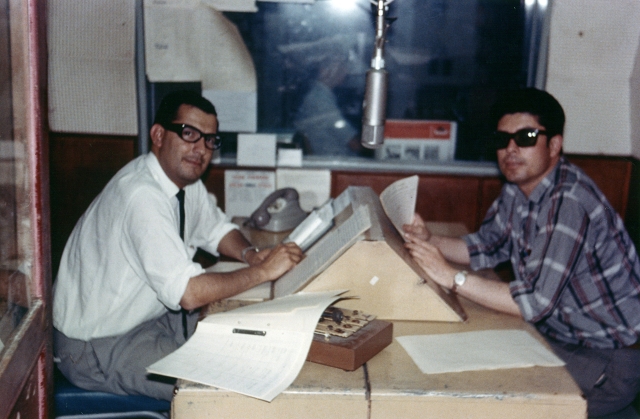
Note that under the big pieces of paper is a chime box, used for separation of news segments and the station identifications
And here is the building:
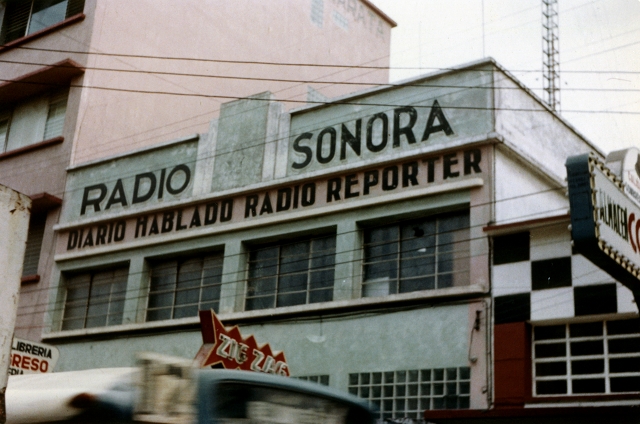
Some of us are old enough to remember "The Aliance for Progress" that went back at least 'til the Turman administration. I think the Roosevelt administration had the "Good Neighbor" policy. Both of these programs provided money for construction of schools, roads, bridges, etc. Don't seem to recall much of a border crisis at that time. I guess it was becasue we were supporting the economy of Latin America and the folks didn't have as much need to come to the U.S. It also allowed us to pick whatever right wing thug we wanted for president of the various countries so long as he was violently anti-comunist.
Can someone explain to me the purpose of the damned clock that used to tick behind the newscasts? I'm thinking Radio Relo in Cuba but believe it was common in many countries.
Can someone explain to me the purpose of the damned clock that used to tick behind the newscasts? I'm thinking Radio Relo in Cuba but believe it was common in many countries.
Some variation of this seems to still happen now, and is not uncommon in the US (when there's two anchors speaking on KCBS 740, for example, they will often alternate, where they take a turns reading out a paragraph or so. I've also noticed this technique on cable news shows (from CNN and the like) that feature two anchors).In the 70s, RHC followed the pattern of Radio Moscow and most Communist broadcasters, a man and woman reading a script and alternating paragraphs.
c
The Voice Of Vietnam also had recordings of captured American airmen reading their 'confessions' and saying that they were being treated well. So recordings obviously were posted from Hanoi to Havana as well.In the 70s, RHC followed the pattern of Radio Moscow and most Communist broadcasters, a man and woman reading a script and alternating paragraphs.
RHC "relayed" The Voice of Vietnam by RHC staffers reading a script that was telexed (for lack of better word) from North Korea.
The word is reloj, not relo. It's Spanish for "clock" and the j is silent. This should explain the ticking, right?Some of us are old enough to remember "The Aliance for Progress" that went back at least 'til the Turman administration. I think the Roosevelt administration had the "Good Neighbor" policy. Both of these programs provided money for construction of schools, roads, bridges, etc. Don't seem to recall much of a border crisis at that time. I guess it was becasue we were supporting the economy of Latin America and the folks didn't have as much need to come to the U.S. It also allowed us to pick whatever right wing thug we wanted for president of the various countries so long as he was violently anti-comunist.
Can someone explain to me the purpose of the damned clock that used to tick behind the newscasts? I'm thinking Radio Relo in Cuba but believe it was common in many countries.
Sorry, my Spanish is not nearly as good as it should be.The word is reloj, not relo. It's Spanish for "clock" and the j is silent. This should explain the ticking, right?
"Radio Reloj" means "Radio Clock" so the ticking goes with the name. Part of the reasoning was that, until cheap digital watches became available, most people in Latin America could not afford watches and so the station was their watch.Can someone explain to me the purpose of the damned clock that used to tick behind the newscasts? I'm thinking Radio Relo in Cuba but believe it was common in many countries.
David would provide a better answer, but I believe that people didn't have watches. The ticking came (and still does) with time checks at the top of each minute. (which I now see he just did)Some of us are old enough to remember "The Aliance for Progress" that went back at least 'til the Turman administration. I think the Roosevelt administration had the "Good Neighbor" policy. Both of these programs provided money for construction of schools, roads, bridges, etc. Don't seem to recall much of a border crisis at that time. I guess it was becasue we were supporting the economy of Latin America and the folks didn't have as much need to come to the U.S. It also allowed us to pick whatever right wing thug we wanted for president of the various countries so long as he was violently anti-comunist.
Can someone explain to me the purpose of the damned clock that used to tick behind the newscasts? I'm thinking Radio Reloj in Cuba but believe it was common in many countries.
- Status
- This thread has been closed due to inactivity. You can create a new thread to discuss this topic.