
Yup, same guy. The same one who also used to anchor at WCBS (NYC) before that. (So he only had one letter to relearn.)@Steve Scott probably isn't that Steve Scott, because it's probably one of the most common names on earth, but at the very least, it's an interesting coincidence.

-
Get involved.
We want your input!
Apply for Membership and join the conversations about everything related to broadcasting.
After we receive your registration, a moderator will review it. After your registration is approved, you will be permitted to post.
If you use a disposable or false email address, your registration will be rejected.
After your membership is approved, please take a minute to tell us a little bit about yourself.
https://www.radiodiscussions.com/forums/introduce-yourself.1088/
Thanks in advance and have fun!
RadioDiscussions Administrators
You are using an out of date browser. It may not display this or other websites correctly.
You should upgrade or use an alternative browser.
You should upgrade or use an alternative browser.
Radio by the Bay
- Thread starter Bay Radiohead
- Start date
Really!Yup, same guy. The same one who also used to anchor at WCBS (NYC) before that. (So he only had one letter to relearn.)
Then I must give this compliment (it's not often I get this opportunity!): as a regular KCBS listener, I find that Steve Scott's voice is exceptionally clear and easy to listen to, with excellent intonation and pronunciation.
c
Absolutely agree. But that's how most of the (now former) WCBS people used to sound on air, as well as most of the (now deceased or retired) former KCBS anchors too. It's an authoritative style of speaking, but unfortunately it can sound dated to younger listeners.Really!
Then I must give this compliment (it's not often I get this opportunity!): as a regular KCBS listener, I find that Steve Scott's voice is exceptionally clear and easy to listen to, with excellent intonation and pronunciation.
c
I am absolutely not accusing Mr. Scott of this, but ... for a sample of what I'm trying to describe, find any example of a radio or TV announcer or newscaster from the '30s, '40s or '50s. What becomes apparent almost immediately is how stilted they sound compared to the present day sound we're used to hearing. Today's practitioners are more relaxed, less "starched", like they're talking with you instead of at you. You hear the difference instantly. And it seems so do the Millennials and Gen Z's when they hear the "news anchor" sound many of us grew up with. So in the chase for younger demos, stations like KCBS have run away from that sound, especially outside of drive time. (IMHO, of course.)
Yes, I totally agree. The old newsreel announcers sound very stilted. That seemed to fade away rather quickly, though, as by the latter half of the 50s and into the 60s, we have greats such as Walter Cronkite, whose delivery I find to be authoritative, but more relaxed and not so stilted.
A sound similar to Cronkite's seems to have prevailed in most national news programs, I'd say, until quite recently. Maybe ten or so years ago it started giving way to the more laid back, conversational sound we have now. At least in SF.
For something like a DJ at a music station, I don't particularly care (however, it would sound very odd and amusing having a stilted-sounding news person DJ a modern CHR!), but for news, It does come across better when the anchorperson has good diction and strong, authoritative delivery.
I do agree, though, that taken too far (or taken back to the way it was before the 60s), it could be rather off putting to a younger audience who is sensitive to that sort of thing.
To bring it back to Mr. Scott, I would say that he strikes a good balance. He has a good, strong tone, but he's able to modulate it such that he is also more relaxed and conversational.
c
A sound similar to Cronkite's seems to have prevailed in most national news programs, I'd say, until quite recently. Maybe ten or so years ago it started giving way to the more laid back, conversational sound we have now. At least in SF.
For something like a DJ at a music station, I don't particularly care (however, it would sound very odd and amusing having a stilted-sounding news person DJ a modern CHR!), but for news, It does come across better when the anchorperson has good diction and strong, authoritative delivery.
I do agree, though, that taken too far (or taken back to the way it was before the 60s), it could be rather off putting to a younger audience who is sensitive to that sort of thing.
To bring it back to Mr. Scott, I would say that he strikes a good balance. He has a good, strong tone, but he's able to modulate it such that he is also more relaxed and conversational.
c

Yes, it’s me - Steve Scott from KCBS. Thank you to those who offered kind words. Much appreciated.

Yes, it’s me - Steve Scott from KCBS. Thank you to those who offered kind words. Much appreciated.
Steve, seeing your avatar, I realize I passed by you in the crowd a couple of times without recognizing you. Next time, I'll be sure to stop, introduced myself and get acquainted.
Absolutely agree. But that's how most of the (now former) WCBS people used to sound on air, as well as most of the (now deceased or retired) former KCBS anchors too. It's an authoritative style of speaking, but unfortunately it can sound dated to younger listeners.
I am absolutely not accusing Mr. Scott of this, but ... for a sample of what I'm trying to describe, find any example of a radio or TV announcer or newscaster from the '30s, '40s or '50s. What becomes apparent almost immediately is how stilted they sound compared to the present day sound we're used to hearing. Today's practitioners are more relaxed, less "starched", like they're talking with you instead of at you. You hear the difference instantly. And it seems so do the Millennials and Gen Z's when they hear the "news anchor" sound many of us grew up with. So in the chase for younger demos, stations like KCBS have run away from that sound, especially outside of drive time. (IMHO, of course.)
Hi Weiserguy. Thank you for your nice comments.
I think anyone who’s been on the air goes through periods where they’re too in love with their own voice. I’ve certainly been guilty of that. I was raised in an era of radio when big voices ruled. Thankfully, the medium has evolved away from that.
Even after 45 years on the job, it’s still a work in progress for me to find the right mix of “sounding like I know what I’m talking about” and “not sounding like a bellowing blowhard.”
Steve
Yes, I totally agree. The old newsreel announcers sound very stilted. That seemed to fade away rather quickly, though, as by the latter half of the 50s and into the 60s, we have greats such as Walter Cronkite, whose delivery I find to be authoritative, but more relaxed and not so stilted.
A sound similar to Cronkite's seems to have prevailed in most national news programs, I'd say, until quite recently. Maybe ten or so years ago it started giving way to the more laid back, conversational sound we have now. At least in SF.
For something like a DJ at a music station, I don't particularly care (however, it would sound very odd and amusing having a stilted-sounding news person DJ a modern CHR!), but for news, It does come across better when the anchorperson has good diction and strong, authoritative delivery.
I do agree, though, that taken too far (or taken back to the way it was before the 60s), it could be rather off putting to a younger audience who is sensitive to that sort of thing.
To bring it back to Mr. Scott, I would say that he strikes a good balance. He has a good, strong tone, but he's able to modulate it such that he is also more relaxed and conversational.
c
Hi cc -
I absolutely agree about styles changing. I was News Director and Morning Anchor at WLS in Chicago in the 1990s and 2000s. As a student of station history, I would listen to archival audio of great WLS news broadcasters from the 1930s and ‘40s like Julian Bentley and Herb Morrison. Why couldn’t I sound like them? Or great WLS newscasters of a later era, like Lyle Dean and Jeff Hendrix. Why couldn’t I sound like them?
It took me a while to understand that styles change, and the only person I needed to sound like…was Steve. I was a better broadcaster when I got that through my head.
I appreciate your kind words and keen observations.
Steve Scott
Hi Michael. I remember seeing you! I think you were inside the KFRC Sturgeon, and I didn’t want to interrupt. I do hope we get to say hello sometime.Steve, seeing your avatar, I realize I passed by you in the crowd a couple of times without recognizing you. Next time, I'll be sure to stop, introduced myself and get acquainted.
Steve
Hi Michael. I remember seeing you! I think you were inside the KFRC Sturgeon, and I didn’t want to interrupt. I do hope we get to say hello sometime.
Steve
I was and I wish you had. I'm a CHRS member, so I'm sure we'll get the opportunity.
@michael hagerty I just noticed you updated your avatar to the photo of you in the Sturgeon.
It looks like you were having lots of fun!
I will continue to enjoy listening to you on KCBS!
By the way, what happened to Pat Thurston? I haven't heard her lately, so I assume she is no longer working there. Hopefully she moved on to some kind of talk. I first heard her several years ago on KGO 810 (during the period after "All News some of the time" and before "let's dump everything and do sports betting!")
She was one of the few bright spots of that otherwise dismal period.
c
It looks like you were having lots of fun!
And I likewise appreciate your thoughtful reply!Hi cc -
I absolutely agree about styles changing. I was News Director and Morning Anchor at WLS in Chicago in the 1990s and 2000s. As a student of station history, I would listen to archival audio of great WLS news broadcasters from the 1930s and ‘40s like Julian Bentley and Herb Morrison. Why couldn’t I sound like them? Or great WLS newscasters of a later era, like Lyle Dean and Jeff Hendrix. Why couldn’t I sound like them?
It took me a while to understand that styles change, and the only person I needed to sound like…was Steve. I was a better broadcaster when I got that through my head.
I appreciate your kind words and keen observations.
Steve Scott
I will continue to enjoy listening to you on KCBS!
By the way, what happened to Pat Thurston? I haven't heard her lately, so I assume she is no longer working there. Hopefully she moved on to some kind of talk. I first heard her several years ago on KGO 810 (during the period after "All News some of the time" and before "let's dump everything and do sports betting!")
She was one of the few bright spots of that otherwise dismal period.
I bought a pair of MDR 7506s back in 2015 for my recording classes, and they're excellent. I use them all the time (the original pads lasted quite a few years, but the replacements (I can only afford the cheap ones) only seem to last a year or two.Although I will say I'd gladly pay 20 bucks more for a pair of Sony MDR 7506s (my cans of choice for 25 years now).
I now have a reason to visit Alameda next time I'm down in the East Bay!And even if you can't time it for Radio Day by the Bay, the museum itself is open Wednesdays and Saturdays 10:00 a.m.-3:00 p.m.
I like that approach too. I enjoy taking my time, maybe chatting with someone about a particular display, or just quietly absorbing it all.Personally, I'm looking forward to going back and taking the usual leisurely approach I use in a museum. It was crowded yesterday, and I felt the need to move more quickly so other people could see things.
It looks like I might have a reason to visit Modesto at some point, too (why Modesto, of all places??)If only they had room to put the KFRC mobile studio on permanent display (I understand that is likely to happen in Modesto at their American Graffiti Museum.)
c
@michael hagerty I just noticed you updated your avatar to the photo of you in the Sturgeon.
It looks like you were having lots of fun!
I was. It's a great machine. There's also more than a little awe. Some of the best talent I ever heard stood at that board. To be there myself---that was something.
It looks like I might have a reason to visit Modesto at some point, too (why Modesto, of all places??)
I'm going to assume that you haven't seen the movie American Graffiti. After all, it's 52 years old and you're not:
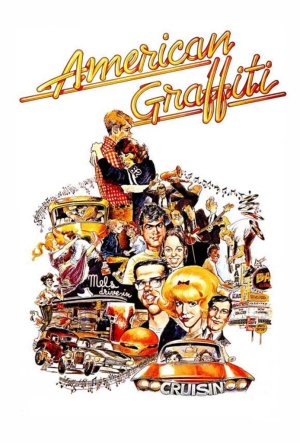
This was George Lucas' (who went on to create the Star Wars and Indiana Jones franchises) second movie ever and his first hit. And radio plays a big part in it. It's essentially one night in 1962, from just before sundown to just after sunup, the night before kids who'd graduated high school earlier that summer were supposed to go off to college.
They're cruising the downtown streets, listening to the radio. On that radio---Wolfman Jack (That was artistic license. Wolf was working in Shreveport, Louisiana at that time, and was a year away from really figuring out that character).
One of the characters (played by Richard Dreyfuss) sees a beautiful girl in a white '57 T-Bird at a stoplight. She mouths "I love you" before driving off. He can't find her, so he goes to the outskirts of town, to a local radio station, to see if Wolfman will deliver a message on-air to her.
The movie was based on Lucas' experiences as a teenager in Modesto. And it was huge---the third highest-grossing movie of 1973, behind The Exorcist and The Sting. So there's a whole "American Graffiti" culture in the town and there's been an annual event with a festival and street show in early June every year for 30-plus years.
Because of the timing, Chris Sharp (owner of the Sturgeon) has helped extend the early June timeline with "610 Day" on June 10th for the past several years.
In its Top 40 era, KFRC's signal came into Modesto loud and clear 24-7---as loud on the dial as local stations. People there grew up listening to KFRC just as much as they did to their local Top 40 station, KFIV.
For the past several years, the Sturgeon has been stored in an RV storage facility and only brought out for events a few times a year. A place in the Modesto Graffiti USA Museum would serve as storage but allow it to be seen by the public instead of hidden out of sight.
Vision And Timeline – Graffiti USA Museum
 www.graffitiusamuseum.com
Last edited:
I can imagine!I was. It's a great machine. There's also more than a little awe. Some of the best talent I ever heard stood at that board. To be there myself---that was something.
I really must see it sometime. I'll bet it would be quite an experience!
You assume correctly, and I am definitely less than 52 years old (I was born at the tail end of the 80s, so I missed out on a lot of this stuff).I'm going to assume that you haven't seen the movie American Graffiti. After all, it's 52 years old and you're not:
This was George Lucas' (who went on to create the Star Wars and Indiana Jones franchises) second movie ever and his first hit.
Ahhhhh, that makes perfect sense, then!
I, of course, have heard of American Graffiti, and I have grown up listening to and enjoying much of the music that was featured therein, but as I alluded to above, I have yet to actually see it, nuch to the astonishment of you and everyone else, I'm sure

Fun fact: For several years back in the late 90s, George Lucas' Skywalker Ranch was our neighbor. I was too young to fully appreciate the fact (unfortunately, I was around 8 or so when we moved there, so I didn't really appreciate the significance of it until much later; obviously, I never got into Star Wars, or else I'm sure I would've been fascinated no end).
I think I knew that he had directed American Graffiti, and that it was based on his teenage years, but I think I missed the fact that it was based in Modesto, and that he also grew up there.It was based on Lucas' experiences as a teenager in Modesto.
c
I was News Director and Morning Anchor at WLS in Chicago in the 1990s and 2000s. As a student of station history, I would listen to archival audio of great WLS news broadcasters from the 1930s and ‘40s like Julian Bentley and Herb Morrison. Why couldn’t I sound like them? Or great WLS newscasters of a later era, like Lyle Dean and Jeff Hendrix. Why couldn’t I sound like them?
It took me a while to understand that styles change, and the only person I needed to sound like…was Steve. I was a better broadcaster when I got that through my head.
I think we all went through that evolution, Steve. In Southern California, we had J. Paul Huddleston and Marv Howard at KHJ. Very much the old-school big voice guys.
Lyle Dean was next-level voice of God (I have to remember to ask Charlie Van Dyke if he felt inadequate around Lyle---he'll love that).
But---before I heard KHJ, I heard my parents' station, KMPC. And even back in the 60s and 70s, their news guys always had a more natural, conversational approach.
KMPC News Bob Steinbrinck 19731120.mp3
 drive.google.com
KMPC News Mike Botula 19770321.mp3
drive.google.com
Their influence was hugely helpful to me, because I made the jump from disc jockey to newsguy at the same radio station (KOLO in Reno) and didn't feel like I had to change my style drastically.

Growing up, I could hear Lyle on WLS, at least in the winter when some of the Chicago drive-time newscasts hitched a ride on the skywave. Decades later, after I moved to Chicago, I was tuning one day between my usual AM choices of WMAQ and WBBM when the radio landed briefly on WGN and I heard a familiar voice...Lyle Dean. He sounded a little more relaxed than he did at WLS, but not much. I think that really was a case of Lyle sounding like Lyle.Lyle Dean was next-level voice of God (I have to remember to ask Charlie Van Dyke if he felt inadequate around Lyle---he'll love that).
The other thing is that he must have been in his 20s...early 30s at most...when he was at WLS. To my teenage ears, he sounded much older. Edit: From some later Chicago newspaper articles, I figured out that he started at WLS in 1968 at the age of 29.
The last mention of Lyle Dean that I see in the Chicago papers was an appearance on WGN for the station's 100th anniversary in 2022.
And he has a website: Lyle Dean Broadcast Services - Housesmarts Radio Minutes, To Your Health Radio Minutes, Marketing Plans
Last edited:
I can imagine!
I really must see it sometime. I'll bet it would be quite an experience!
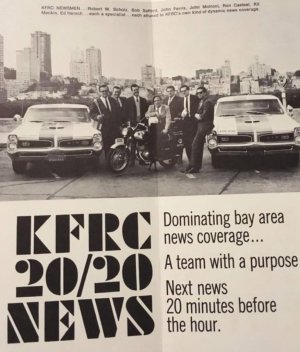
Apparently KFRC has always had its stuff together when it came to vehicles. 1967 GTOs for news cars?

K.M. Richards
Program Director, The Eighties Channel™
And a motorcycle!Apparently KFRC has always had its stuff together when it came to vehicles. 1967 GTOs for news cars?
For lanesplitting?And a motorcycle!
Maybe. Back in '67, though, the traffic on the city streets could be pretty tough. Delivery trucks would double-park in front of stores and on those narrow streets, going around in a car could be tricky. I can see where the bike would be an advantage.For lanesplitting?
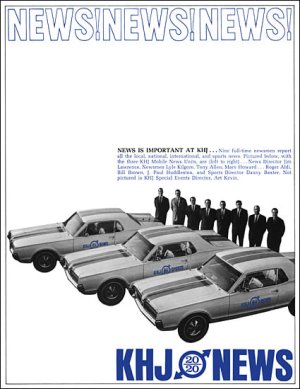
Also, it wasn't just KFRC. Sister station KHJ went with three Mercury Cougar news cars the same year:

I was. It's a great machine. There's also more than a little awe. Some of the best talent I ever heard stood at that board. To be there myself---that was something.
I'm going to assume that you haven't seen the movie American Graffiti. After all, it's 52 years old and you're not:
View attachment 9803
This was George Lucas' (who went on to create the Star Wars and Indiana Jones franchises) second movie ever and his first hit. And radio plays a big part in it. It's essentially one night in 1962, from just before sundown to just after sunup, the night before kids who'd graduated high school earlier that summer were supposed to go off to college.
They're cruising the downtown streets, listening to the radio. On that radio---Wolfman Jack (That was artistic license. Wolf was working in Shreveport, Louisiana at that time, and was a year away from really figuring out that character).
To bring this part of the discussion full circle – or full semi-circle – and because, like Sammy, I gotta be me, I have to mention the Wolfman Jack connection to Bay Area radio history.
The former home of the California Historical Radio Society and its
The Wolfman Jack scene in American Graffiti was filmed in the KRE studio on August 3, 1972. Many years later, the KRE building fell into miserable disrepair but was rescued by CHRS, whose amazing team of engineers, tinkerers and radioholics lovingly refurbished the old dump, which included restoring the old studio to a near mirror-image of how it looked in American Graffiti – a task made somewhat easier because of the large number of still publicity shots taken during that day's filming.
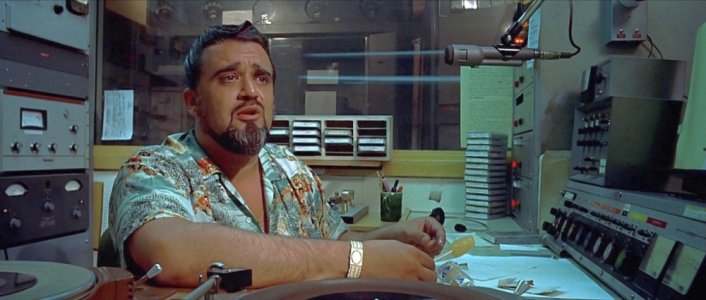
I was lucky enough to have the opportunity to interview numerous local radio stars in the Wolfman Jack Memorial Studio at KRE over the years. I'm not sure what the joint looks like these days, as CHRS and BARHOF were booted out by the new owners of KVTO (successor to KRE), Pham Radio Communication, a few years ago. (Both KVTO and KEAR, the ghost of KFRC, continue to transmit from the adjoining transmitter shack on that site.)
Anyway, here's my story (with lots of pictures and some audio) about Wolfman's day at KRE in Berkeley back in August 1972:

KRE Radio, Wolfman Jack and American Graffiti | Bay Area Radio Museum
Wolfman Jack American Graffiti KRE Radio, Berkeley 1972 Wolfman Jack howls in a publicity photo for
 bayarearadio.org