
That's a nice report from the front, Mark. I have to carve out time to cross the San Tomato Bridge and experience it for myself. Maybe drag my wife with me, but her tolerance for radio history and geekdom is way lower than mine. But I have to question something you wrote: what does "eisenhowered" mean. I've never heard the term. The only thing that comes to mind is painting anything with 100 coats of government white. Can you expand?Speaking of which, the restoration of the building is beautiful. The exterior had been eisenhowered for decades; the museum stripped all that away and its appearance is now very close to what it was originally.

-
Get involved.
We want your input!
Apply for Membership and join the conversations about everything related to broadcasting.
After we receive your registration, a moderator will review it. After your registration is approved, you will be permitted to post.
If you use a disposable or false email address, your registration will be rejected.
After your membership is approved, please take a minute to tell us a little bit about yourself.
https://www.radiodiscussions.com/forums/introduce-yourself.1088/
Thanks in advance and have fun!
RadioDiscussions Administrators
You are using an out of date browser. It may not display this or other websites correctly.
You should upgrade or use an alternative browser.
You should upgrade or use an alternative browser.
Radio by the Bay
- Thread starter Bay Radiohead
- Start date
I met him too! And I agree with you; he's very friendly and enthusiastic, and was (in my case) very pleased that I'm interested in radio.I think the closest we came to meeting a radio celebrity was when Sam Van Zandt came over at one point and introduced himself. I have to admit that I didn't know who he was (much of his later career was in San Jose)...but he was friendly and enthusiastic, as was just about everyone else at the museum.
I'm hoping to get there on a Wednesday to see him again (he's only there Wednesdays, I believe). Eventually, if I can find the time, I'll see about joining up and volunteering there, too.
c

I can expand, but not too much.That's a nice report from the front, Mark. I have to carve out time to cross the San Tomato Bridge and experience it for myself. Maybe drag my wife with me, but her tolerance for radio history and geekdom is way lower than mine. But I have to question something you wrote: what does "eisenhowered" mean. I've never heard the term. The only thing that comes to mind is painting anything with 100 coats of government white. Can you expand?
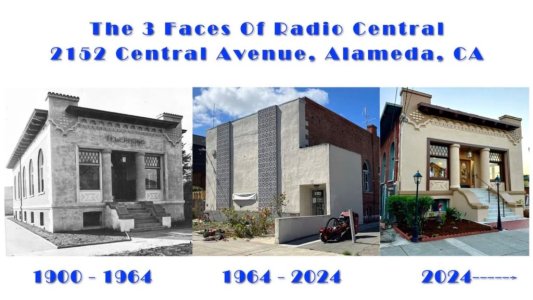
It's San Francisco slang for an old building, usually a house, whose architectural features have been covered up, often rather crudely, by something more appropriate to the 1950s or 1960s.
Armistead Maupin used the term in one of his "Tales of the City" books. In this case, it was Significant Others. You don't need to know the context for the quote, and you probably don't want to know it. So I'll just provide the quote:
The geography is a little muddled there; you'd have to cross a couple of short blocks to the east to get to Noe but, yes, once there, you'd be climbing quite a hill.He strode briskly at first, then began to run up Castro as the band blared for with "If My Friends Could See Me Now". At Nineteenth {yes, Maupin spelled it out}, he cut across Noe and completed his ascent to Joe's apartment. The house, as he'd remembered, was a potentially handsome Victorian that had been hideously eisenhowered with green asbestos shingles.
Probably no one south of South City has encountered the term and I rarely heard it in the East Bay. It seems very specific to San Francisco.

While it was "Eisenhowered" ( I think you have to have been in the City, not just the Bay Area, and be a certain age for that reference), the covering of that beautiful building with that ugly facade actually happened during the Johnson administration (1964).
Last edited:
That's quite impressive!
What amazes me most is that when they changed it in 1964, it appears that virtually the entire original facade was intact underneath, and literally all they did was box it in. Either that, or it was a masterful restoration job, because the way it looks now is virtually identical to how it looked pre-'64 aside from the lack of "telephone" across the top, and the more modern-looking front door (and, probably, the paint job, though it's hard to tell the color(s), if any, it was painted in the B&W photo).
c
What amazes me most is that when they changed it in 1964, it appears that virtually the entire original facade was intact underneath, and literally all they did was box it in. Either that, or it was a masterful restoration job, because the way it looks now is virtually identical to how it looked pre-'64 aside from the lack of "telephone" across the top, and the more modern-looking front door (and, probably, the paint job, though it's hard to tell the color(s), if any, it was painted in the B&W photo).
c

So it got Johnsoned!While it was "Eisenhowered" ( I think you have to have been in the City, not just the Bay Area, and be a certain age for that reference), the covering of that beautiful building with that ugly facade actually happened during the Johnson administration (1964).
View attachment 10868
At least it wasn't Rockefellered.While it was "Eisenhowered" ( I think you have to have been in the City, not just the Bay Area, and be a certain age for that reference), the covering of that beautiful building with that ugly facade actually happened during the Johnson administration (1964).
More to the point: looking back through the newspapers.com archive, the first reference I found to the term was in 1957, by a syndicated columnist named Holmes Alexander. He used the term to refer to conservative Republican senators who had changed their votes and public stances to line up with President Eisenhower's more moderate politics.
The term pops up again in wire-service dispatches around December 11, 1961, this time referring to John F. Kennedy. President Kennedy's more liberal supporters were becoming disillusioned with some of JFK's more moderate stances. They accused him of having "out-Eisenhowered Eisenhower".
It wasn't until the 1970s when the term had a more cultural flavor. Still, it wasn't common. In 1979, a Dayton (Ohio) Daily News editorial referred to the 1950s in this manner: "Americans as a whole are spending less of their income on food now than they did in 1960, when everyone was complacent and Eisenhowered back." Didn't realize it could be a phrasal verb.
A couple of examples, on consecutive days even, came in January 1980, in a Houston Chronicle review of a biopic of Jack Kerouac, Heart Beat, starring Nick Nolte. The Chronicle's critic, Jeff Millar, didn't think much of the film. A January 17 preview of the film pretty much sums up the use of the word "Eisenhowered":
The film recalls the lifestyle of the "beat generation" which lived beneath the bland Eisenhowered America of the 1950s ....
The next day: the movie review:
But what you'll take out of the film is the latent image of Nolte as this walking hyperbole, full of Lee Marvin hipster mannerisms and fully self-aware. He smiles at himself as much as at the squares of the Eisenhowered early '50s with whom he finds himself sharing a planet.
The only reference to "eisenhowered" that I found that relates specifically to San Francisco real estate was in the San Francisco Examiner in 1986, when it was serializing the Armistead Maupin stories that later went into Significant Others, part of the Tales of the City series. That may seem a thin thread to hang on to, but Maupin is a quintessential San Francisco author even if he doesn't live there any more, and I have to believe he was reflecting what he heard and saw going on around him in the city at the time he was writing his books.
While never a formally defined word, it seemed there was enough understanding of the concept: a bland exterior hiding something more interesting going on inside. Then, for whatever reason, San Franciscans adapted the concept to refer specifically to real-estate.
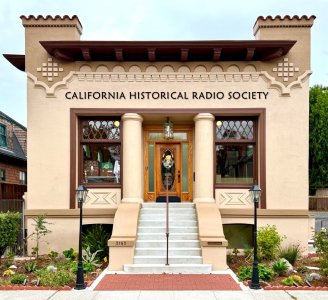
One of the folks at the museum told me that they were looking into doing something with the blank space where "Telephone" was. One possibility was putting the museum's (or society's) name there; another was to put "Telephone" back up there.What amazes me most is that when they changed it in 1964, it appears that virtually the entire original facade was intact underneath, and literally all they did was box it in. Either that, or it was a masterful restoration job, because the way it looks now is virtually identical to how it looked pre-'64 aside from the lack of "telephone" across the top, and the more modern-looking front door (and, probably, the paint job, though it's hard to tell the color(s), if any, it was painted in the B&W photo).
One of the folks at the museum told me that they were looking into doing something with the blank space where "Telephone" was. One possibility was putting the museum's (or society's) name there; another was to put "Telephone" back up there.
I didn't realize that hadn't been done yet. The monthly newsletter uses this image:
One of the folks at the museum told me that they were looking into doing something with the blank space where "Telephone" was. One possibility was putting the museum's (or society's) name there; another was to put "Telephone" back up there.
I didn't realize that hadn't been done yet. The monthly newsletter uses this image:
View attachment 10870
That's quite impressive!
What amazes me most is that when they changed it in 1964, it appears that virtually the entire original facade was intact underneath, and literally all they did was box it in. Either that, or it was a masterful restoration job, because the way it looks now is virtually identical to how it looked pre-'64 aside from the lack of "telephone" across the top, and the more modern-looking front door (and, probably, the paint job, though it's hard to tell the color(s), if any, it was painted in the B&W photo).
c
It was as much a re-creation as a restoration---the website has the story:
Museum Updates - California Historical Radio Society
Over the past year, the California Historical Radio Society (CHRS) has made significant updates to its Radio Central museum in Alameda, California.
 californiahistoricalradio.com
And here's a Google Street View from last year that shows the work in progress: