After hurricane Milton knocked WYKS 105.3 out of the air, I was able to pick up WOMX 105.1 out of Orlando about 110 mile out. When WSKY 97.3 switched off HD for a few days, WPCV 97.5 came in no problem at all about 125 mile from where I live. Both cases happened during board daylight I'm pretty sure it wasn't DX or anything. I did lose some high end and it sounded a bit dull, but they were listenable. I think what limits how far a station can be heard really boils down to adjacent and/or co channel interference. Without adjacent / co channel or translator interfering, FM just goes on and on until another station on the same frequency takes over.

-
Get involved.
We want your input!
Apply for Membership and join the conversations about everything related to broadcasting.
After we receive your registration, a moderator will review it. After your registration is approved, you will be permitted to post.
If you use a disposable or false email address, your registration will be rejected.
After your membership is approved, please take a minute to tell us a little bit about yourself.
https://www.radiodiscussions.com/forums/introduce-yourself.1088/
Thanks in advance and have fun!
RadioDiscussions Administrators
You are using an out of date browser. It may not display this or other websites correctly.
You should upgrade or use an alternative browser.
You should upgrade or use an alternative browser.
Range of your local signals
- Thread starter charlestondxman
- Start date

WPCV 97.5 came in no problem at all about 125 mile from where I live.
Without adjacent / co channel or translator interfering, FM just goes on and on until another station on the same frequency takes over.
I think the 97.5 in South Central Florida is one of the best signals in the state, and their blowtorch Signal easily reaches out into both Florida Coasts from their central location...
I agree with that assessment, I remember I just think the other Orlando stations are a bit farther north and east than necessary, serving the Daytona area as an Orlando station, or Vice Versa. ...WPCV has a great signal, but they could have been even stronger, they are only 1000 feet. Many Orlando FMs are 100kw at 1600 feet. Including the previously mentioned WOMX.
94.5 & 101.9 & 107.7 near Deltona (Orlando NE) For Example, can reach up to Jacksonville, but doesnt make much to the west beyond Lakeland, I guess to Protect the designated Tampa signals.
I think some of the greatest signals in FL are both the 100.7 and 101.5 in Both Tampa and Jax. For example, I've heard 101.5 WSOL reach down to St Augustine and Heard up I-95 into Savannah and like 30 miles into SC.

Getting back to line of site from my earlier post, my 90 watts at 60 feet makes it 15 miles in one direction to the edge of another small community to our west because of line of sight.
Theres a translator about 1/2 mile away, K232DZ 94.3 fed over satellite by KIAM Nenana, AK 250 miles away. Its 250 watts at about 20 feet. It doesnt have nearly the range 90 watts at 60 feet does. It's immediately surrounded by trees
Theres a translator about 1/2 mile away, K232DZ 94.3 fed over satellite by KIAM Nenana, AK 250 miles away. Its 250 watts at about 20 feet. It doesnt have nearly the range 90 watts at 60 feet does. It's immediately surrounded by trees
Getting back to line of site from my earlier post, my 90 watts at 60 feet makes it 15 miles in one direction to the edge of another small community to our west because of line of sight.
Theres a translator about 1/2 mile away, K232DZ 94.3 fed over satellite by KIAM Nenana, AK 250 miles away. Its 250 watts at about 20 feet. It doesnt have nearly the range 90 watts at 60 feet does. It's immediately surrounded by trees
Why such little power? Unless its enough to cover the small town and that all that's necessary. Surely with a mostly empty dial in a rural area they could allow more wattage to cover at least like 20 miles with just a minimal power increase. Maybe 1000 watts at 100 feet but, less than that seems barely enough to go anywhere.
Rural Alaska has the KBRW station up in Barrow. I think its just under 1000 watts but enough to reach the entire town and up to Point Barrow at the top of the North Slope, and their programming streams online. Similar situation in Nome 📻 With Station KNOM.
'Why such little power? Unless its enough to cover the small town and that all that's necessary. Surely with a mostly empty dial in a rural area they could allow more wattage to cover at least like 20 miles with just a minimal power increase. Maybe 1000 watts at 100 feet but, less than that seems barely enough to go anywhere.
Rural Alaska has the KBRW station up in Barrow. I think its just under 1000 watts but enough to reach the entire town and up to Point Barrow at the top of the North Slope, and their programming streams online. Similar situation in Nome 📻 With Station KNOM.
1000 Watts at 100 feet wouldnt gain us a city grade to any other community and wed cover no more population and have a higher electric bill.
90 watts at 60 feet cover everything we need.
we have a station running 90 watts from the roof of a building in another community, relaying KSKO full time (KMGS) and its like 30 feet up. like KSKO, it covers all hat matters. we have another station, KSKP which we own that relays KSKO thats 90 watts at -448 feet from the roof of a one story school and it more than covers all that counts.
KBRW with 10,000 watts covers a couple hundred miles.
Why else do we not upgrade KSKO? A little known law exempts us from maintaining a public file and if we upgrade the license, we'll be forced to maintain a public file
I remember many years ago (~pre 2010? if my memory serves me right ) I used to be able to pick up WMGF 107.7, WOCL 105.9, WJHM 101.9, WDBO 96.5, WOMX and RUMBA 100.3 near Tampa International Airport. Now it's almost impossible thanks to all the LPFMs and translators.I agree with that assessment, I remember I just think the other Orlando stations are a bit farther north and east than necessary, serving the Daytona area as an Orlando station, or Vice Versa. ...
94.5 & 101.9 & 107.7 near Deltona (Orlando NE) For Example, can reach up to Jacksonville, but doesnt make much to the west beyond Lakeland, I guess to Protect the designated Tampa signals.
I think some of the greatest signals in FL are both the 100.7 and 101.5 in Both Tampa and Jax. For example, I've heard 101.5 WSOL reach down to St Augustine and Heard up I-95 into Savannah and like 30 miles into SC.
Likewise, WFLZ 93.3 WWRM 94.9, mix 100.7 and HOT 101.5 used to be able to make it all the way to the I-4 & I-95 junction near daytona, of course now this is no more.
Definitely. I remember back in the day listening to a program EVER Friday night on WMTX 100.7 out of Tampa in downtown Orlando. No fading at all, even under an overpass with the Orlando skyline between my car and Tampa. With all the translators, most of the Tampa full-power stations are getting hammered by Sea World. Don't remember about the others, but WTBV 101.5 used to make it to Cocoa Beach. It may still do that as whatever translator or LP is on that frequency in Orlando, would have faded long before that.I remember many years ago (~pre 2010? if my memory serves me right ) I used to be able to pick up WMGF 107.7, WOCL 105.9, WJHM 101.9, WDBO 96.5, WOMX and RUMBA 100.3 near Tampa International Airport. Now it's almost impossible thanks to all the LPFMs and translators.
Likewise, WFLZ 93.3 WWRM 94.9, mix 100.7 and HOT 101.5 used to be able to make it all the way to the I-4 & I-95 junction near daytona, of course now this is no more.
Heading the other way, WMGF 107.7 is now gone by Lakeland.
I agree with that assessment, I remember I just think the other Orlando stations are a bit farther north and east than necessary, serving the Daytona area as an Orlando station, or Vice Versa. ...
Daytona Beach is sort of in the radio Orlando market. The ever-popular WCFB 94.5 city-of-license is Daytona Beach.
Daytona is definitely in the TV market. WESH 2 (NBC) is a Daytona Beach station.

Daytona Beach, Melbourne and Orlando are three separate radio markets, all located within the Orlando TV market (bounded by reddish lines)Daytona Beach is sort of in the radio Orlando market.
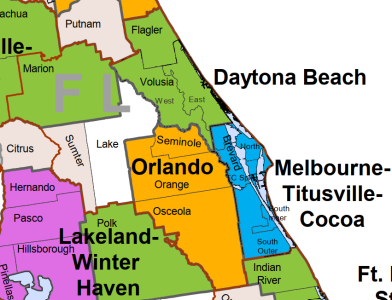
Is Lakeland-Winter Haven in the Tampa radio market?Daytona Beach, Melbourne and Orlando are three separate radio markets, all located within the Orlando TV market (bounded by reddish lines)
View attachment 9578
Lakeland was its own radio market within the Tampa TV market. Nielsen cancelled radio surveys for Lakeland earlier this year.Is Lakeland-Winter Haven in the Tampa radio market?
In Waukesha County in the very late 1970s, there were radio-geek tolerable slightly scratchy signals from WJFM (now WBCT) across the lake from Michigan and WeFM (now WUSN) from Chicago.These are also some of the most reliable Michigan signals here on the other side of the lake. Actually, THE most reliable Michigan FM here is WBLV 90.3. Big signal, helped by the no competition on the frequency.
Most of the Chicago full-market stations used to be decent all the way to the Milwaukee County line, until their frequencies started being used for Milwaukee translators and/or HD hash. Most are not comfortably listenable in Kenosha anymore.
Most Milwaukee FMs are dead before Waukegan, again largely from HD sidebands. Most Milwaukee stations are on adjacent frequencies to Chicago's.
There were others from both markets, but these 2 were the most consistent then. The Chicago and Michigan stations that were/are first-adjacent to Milwaukee signals were a lot harder to listen to.
From the north, WAPL Appleton was decent, as was WIXX Green Bay. WZEE Madison had a pretty good signal, but WLVE (now WOLX) was the strongest Madison signal then. This of course was before 80-90 dropins, translators, LPFM, and HD, so the dial must sound different there now.
KNOM, KOTZ with 10kw non direction from 300-350 miles away are easily audible here at night. KICY not quite as much because theyre directional at night.
They go directional 11pm to 4am year round with a 3 tower directional headed west into russia with russian programming, otherwise are non directional. Theyre a 50kw clear non directional days and nights and the 3 tower directional is listed in the fcc database as critical hours even though thats not what it is (critical hours is sunrise to 2 hours after and 2 hours before sunset to sunet) KICY is due protection and the special operating parameters needed to be noted.
Btw, for you nerds, KICY pays pays about 50c a kwh for power. KSKO pays 75c kwh
They go directional 11pm to 4am year round with a 3 tower directional headed west into russia with russian programming, otherwise are non directional. Theyre a 50kw clear non directional days and nights and the 3 tower directional is listed in the fcc database as critical hours even though thats not what it is (critical hours is sunrise to 2 hours after and 2 hours before sunset to sunet) KICY is due protection and the special operating parameters needed to be noted.
Btw, for you nerds, KICY pays pays about 50c a kwh for power. KSKO pays 75c kwh
Early 2000s you could hear a lot of different markets before the band got so crowded with translators and HD here in Charleston. I remember Charlotte was pretty common on 103.7, 105.7, even 104.7. 101.9 came in more often. WWDM on 101.3 from Sumter was pretty much a entire state of SC station.
Charleston FMs are basically an average of 50-60 miles around the metro, with the stronger ones (92.5, 101.7, 96.9, 95.1) going much further than that.
96.9 has nothing in the 150 miles around it which makes it the best signal in town. It tripped up the HD in Georgetown when the other locals did not and is audible pretty much anywhere on the SC coast. The only things to stop it through most of SC is a gospel station in the Augusta area and the Charlotte country signal.
96.9 is steady 90 miles from the transmitter usually. The weaker stations like 100.5 WALC (His Radio) and the local translators (250 watts) usually come in about 20-25 miles out, while 100.5 is usually about 30 miles.
KNOM, KOTZ with 10kw non direction from 300-350 miles away are easily audible here at night. KICY not quite as much because theyre directional at night.
Btw, for you nerds, KICY pays pays about 50c a kwh for power. KSKO pays 75c kwh
Does KNOM & KBRW fully simulcast their programming on their FM station? On my earlier post I was referring to their FM signal. I use TuneIn for Streaming.
The FM signal in their respective cities (96.1 KNOM-FM / 1000w) + (91.9 KBRW-FM / 890w) should easily reach about 20 miles as a Class A Station with their setup. Seems that Negative HAAT would be like a bad deal as far as broadcasting DX, maybe not as much in their (targeted) broadcast area.
Btw 50c per kWh is expensive. At least 2x more what most of the US pays ⚡ That adds up for 24/7 of broadcasting. Neither of their AMs are the max 50kW. But I wonder how far they reach DX.
Last edited:
knom is easily heard here at nightDoes KNOM & KBRW fully simulcast their programming on their FM station? On my earlier post I was referring to their FM station Broadcast. I tune in for Streaming. But I bet their FM signal in their respective cities (KNOM-FM & KBRW-FM) easily reach about 20 miles as a Class A Station with just under 1000w.
Btw 50c per kWh is expensive. At least 2x more what most of the US pays ⚡ That adds up for 24/7 of broadcasting. Neither of their AMs are the max 50kW. But I wonder how far they reach DX.
i doubt kbrw fm or knom fm get 20 miles.. they dont need to. look at a map.
they dont seperate programming
KICY-FM and AM dio
About that in the South when you have much further in between stations and 100KW signals that are off of 1000+’ towers. When you get above central VA and you get into class B territory where the stations can only be 50kw you cut that to 60-70 miles.
The cutoff is thru the middle of Hampton Roads and 106.9 WAFX can run 100KW while most of the other stations there are limited to 50. And that signal blasts into Petersburg and even Richmond.
Most of the Baltimore stations struggle to hit city-grade in all of the DC metro which is only 35-40 miles out from city to city. Several more of the DC stations hit Baltimore and get ratings in the Baltimore book.
The cutoff is thru the middle of Hampton Roads and 106.9 WAFX can run 100KW while most of the other stations there are limited to 50. And that signal blasts into Petersburg and even Richmond.
Most of the Baltimore stations struggle to hit city-grade in all of the DC metro which is only 35-40 miles out from city to city. Several more of the DC stations hit Baltimore and get ratings in the Baltimore book.
About that in the South when you have much further in between stations and 100KW signals that are off of 1000+’ towers. When you get above central VA and you get into class B territory where the stations can only be 50kw you cut that to 60-70 miles.
The cutoff is thru the middle of Hampton Roads and 106.9 WAFX can run 100KW while most of the other stations there are limited to 50. And that signal blasts into Petersburg and even Richmond.
A few months ago, I heard WNOB 93.7 from the VA Beach area, all the way from/up/along I-85 from South Hill to Petersburg, mostly static free almost the entire way...and still audible even into and beyond Richmond. Must've Been an Overnight Tropo DX opportunity, but wow what a Pretty impressive signal (Class C1) that's also just a few hundred feet from the Class I/II zone.