
Now, who can argue with that?

-
Get involved.
We want your input!
Apply for Membership and join the conversations about everything related to broadcasting.
After we receive your registration, a moderator will review it. After your registration is approved, you will be permitted to post.
If you use a disposable or false email address, your registration will be rejected.
After your membership is approved, please take a minute to tell us a little bit about yourself.
https://www.radiodiscussions.com/forums/introduce-yourself.1088/
Thanks in advance and have fun!
RadioDiscussions Administrators
You are using an out of date browser. It may not display this or other websites correctly.
You should upgrade or use an alternative browser.
You should upgrade or use an alternative browser.
Record Ratings (7.4 6+) for KRTH
- Thread starter michael hagerty
- Start date
You summed up my own personal feelings pretty well here. I was born in 1995. I listen to different genres of music, but when it comes to the radio, classic hits is all I listen to. While I technically grew up with music made from the 1960’s through the 1990’s, the 1980’s is the decade of music that resonates with me the most. So the #1 preset in my car is always the local classic hits radio station.I'm going to ask you to remember a lot of similar discussions we've had here, Patrick. I know you can connect those with what I am going to say.
It is a fact, proven by the ratings in many markets, that 80's-based Classic Hits draws a significant number of listeners younger than what is expected of the format. My own "liner reader" Gene Knight experienced it first hand at his last on-air gig at KXSN (Sunny 98.1) in San Diego; he noticed that contest winners sounded considerably younger than the Boomers that were "supposed to be" the core demographic. So he started asking them why they listened, and the answers were all along the same line of thinking:
"The 80's is when all the good music came out."
Without going into detail again, you will remember the discussions about how CHR started to fragment into sub-formats by genre ... mainstream, rock, rhythmic, etc. That has given every Classic Hits PD a colossal headache in terms of which genre of 90's music can be integrated into the mix without turning listeners away every other song. (Remember, Classic Hits is defined as a mass appeal "consensus hits" format.)
A listener whose CHR choice of stations played "Vogue" is, most likely, going to be turned off by "Policy of Truth", "Smells Like Teen Spirit" or "Gangsta's Paradise" ... and vice versa. But the 80's was the last decade where all the genres co-existed.
So those of us whose CHR listening pretty much came to an end with that fragmentation find the mix on KRTH unpalatable.
I have my favorite stations across different markets. At the same time, I’ve heard other classic hits stations that don’t resonate that well with me. As I’ve mentioned in my other thread, 95.7 in Seattle, 103.7 in San Francisco, and 106.7 in Portland are probably at the top of my list since they have a solid variety and strong focus on the 80’s.
I can see why someone might find KRTH a bit jarring if they are hearing some of the 90’s tracks that they sprinkle in. The tracks you mentioned wouldn’t rank very high in my personal list of favorites, but they don’t turn me off completely. I can hear them, and understand how they fit the market. I wouldn’t choose to listen to Gangsters Paradise on my own, but I have no problem with it. When the tracks start to skew too modern, I start to lose interest.
So in short (TLDR): I probably wouldn’t go out of my way to stream KRTH or listen all of the time. But when I’m in Los Angeles and driving around? It’s definitely what I would (and do) listen to.
Just looked at the music logs, having not listened in a while and is it just me, or are Jack and KRTH looking uncomfortably close these days?
Just looked at the music logs, having not listened in a while and is it just me, or are Jack and KRTH looking uncomfortably close these days?
4:00 pm hour today:
KRTH: Bananarama-Cruel Summer/JACK: Fleetwood Mac-Dreams
KRTH: Elton John-Bennie and the Jets/JACK: Spin Doctors-Two Princes
KRTH: Billy Idol-Rebel Yell/JACK: Dramarama-Anything, Anything
KRTH: Phil Collins-In The Air Tonight/JACK: Nena-99 Luftballons
KRTH: Goo Goo Dolls-Iris/JACK: Killers-When You Were Young
KRTH: Soft Cell-Tainted Love/Where Did Our Love Go/JACK: Alanis Morisette-You Oughta Know
KRTH: Spandau Ballet-True/JACK: Beastie Boys-Fight For Your Right (To Party)
KRTH: Fleetwood Mac-Go Your Own Way/JACK:No Doubt-Underneath It All
KRTH: Human League-Don't You Want Me/JACK:Cheap Trick-I Want You To Want Me
KRTH: Pat Benatar-Love Is A Battlefield/JACK: Eurythmics-Sweet Dreams
Eh...JACK still strikes me as more KROQ and KRTH more KIIS. And if one's where the audience goes when there's a commercial break on the other or just a desire for something a little different, that's probably smart programming on Audacy's part.

K.M. Richards
Program Director, The Eighties Channel™
Since Mike posted that list, I thought it might be of interest for me to note songs that I'm playing on KRKE.
Red are powers, green are secondaries, blue are the New Wave accent and Flashback Weekend library.
What I found interesting in doing that was that both stations seem to diverge from the 80's at about the same point in the hour.
Red are powers, green are secondaries, blue are the New Wave accent and Flashback Weekend library.
4:00 pm hour today:
KRTH: Bananarama-Cruel Summer/JACK: Fleetwood Mac-Dreams
KRTH: Elton John-Bennie and the Jets/JACK: Spin Doctors-Two Princes
KRTH: Billy Idol-Rebel Yell/JACK: Dramarama-Anything, Anything
KRTH: Phil Collins-In The Air Tonight/JACK: Nena-99 Luftballons
KRTH: Goo Goo Dolls-Iris/JACK: Killers-When You Were Young
KRTH: Soft Cell-Tainted Love/Where Did Our Love Go/JACK: Alanis Morisette-You Oughta Know
KRTH: Spandau Ballet-True/JACK: Beastie Boys-Fight For Your Right (To Party)
KRTH: Fleetwood Mac-Go Your Own Way/JACK:No Doubt-Underneath It All
KRTH: Human League-Don't You Want Me/JACK:Cheap Trick-I Want You To Want Me
KRTH: Pat Benatar-Love Is A Battlefield/JACK: Eurythmics-Sweet Dreams
What I found interesting in doing that was that both stations seem to diverge from the 80's at about the same point in the hour.

I have a question about how it's determined when a song is dropped out of power rotation down to secondary. Is there music research done, looking up Mediabase airplays, or does that list even change?Since Mike posted that list, I thought it might be of interest for me to note songs that I'm playing on KRKE.
Red are powers, green are secondaries, blue are the New Wave accent and Flashback Weekend library.
What I found interesting in doing that was that both stations seem to diverge from the 80's at about the same point in the hour.
.JACK still strikes me as more KROQ and KRTH more KIIS. And if one's where the audience goes when there's a commercial break on the other or just a desire for something a little different, that's probably smart programming on Audacy's part.
Keep in mind that KRTH and KCBS are overseen by the same person. So any overlap is planned.
As far as the high ratings for KRTH. Of course there are exceptions, but music FM's that program Classic Hits and Classic Rock are doing very well across the country, many posting record high ratings. It's where the radio audience gravitates toward these days.
K.M. Richards
Program Director, The Eighties Channel™
I have a question about how it's determined when a song is dropped out of power rotation down to secondary. Is there music research done, looking up Mediabase airplays, or does that list even change?
If you're asking me, Kat, I can tell you how I determine it.
I weight the spin counts so that the stations in the biggest markets count more than the ones in the medium markets, which is more than the smaller markets. Generally, I make the decision for the Power rotation using mostly "tier one" station spin counts, and I have a threshold below which a song moves to Secondary. And I allow for several weeks of "wobble" before deciding to move a song. I also look in the opposite direction to see if Secondary titles are starting to get "hot" again.
On average, only about ten songs out of an average of 125 will move back and forth over three or four weeks.
So it does change a bit, but there are songs whose spin count has been in the stratosphere practically forever and they never move out of Power rotation.
Music research (testing) is only done in the largest markets, generally only by the major group station owners, and usually no more often than twice a year. That's why I can dependably rely on those biggest market stations to be a reliable indicator of mass appeal consensus favorites.
Other programmers will use Mediabase in different ways, or by monitoring different stations and markets; for example, some PDs will check the individual stations' airplay monitors and find the ones that align with their own stations' sound, then only use those stations. I do that to some degree myself; my portfolio of monitored Classic Hits stations are ones that have a strong focus on 80's music (the logic of which should be obvious to everyone here).
Of course, this is how it applies to gold-based formats. Current-based ones will do testing more often (but if they play any gold, they'll probably also test those annually) and they're much more likely to seek out stations that are similar as to whatever "flavor" of CHR they are doing.
That’s basically how I treat Jack. It’s basically just a backup (with a music selection that is decent but not really what I’m looking for).4:00 pm hour today:
KRTH: Bananarama-Cruel Summer/JACK: Fleetwood Mac-Dreams
KRTH: Elton John-Bennie and the Jets/JACK: Spin Doctors-Two Princes
KRTH: Billy Idol-Rebel Yell/JACK: Dramarama-Anything, Anything
KRTH: Phil Collins-In The Air Tonight/JACK: Nena-99 Luftballons
KRTH: Goo Goo Dolls-Iris/JACK: Killers-When You Were Young
KRTH: Soft Cell-Tainted Love/Where Did Our Love Go/JACK: Alanis Morisette-You Oughta Know
KRTH: Spandau Ballet-True/JACK: Beastie Boys-Fight For Your Right (To Party)
KRTH: Fleetwood Mac-Go Your Own Way/JACK:No Doubt-Underneath It All
KRTH: Human League-Don't You Want Me/JACK:Cheap Trick-I Want You To Want Me
KRTH: Pat Benatar-Love Is A Battlefield/JACK: Eurythmics-Sweet Dreams
Eh...JACK still strikes me as more KROQ and KRTH more KIIS. And if one's where the audience goes when there's a commercial break on the other or just a desire for something a little different, that's probably smart programming on Audacy's part.
Credit when credit is due, I do think Jack in LA sounds pretty good as a whole. There are other Jack FM’s that skew quite a bit more modern that put me off.
I'm going to ask you to remember a lot of similar discussions we've had here, Patrick. I know you can connect those with what I am going to say.
It is a fact, proven by the ratings in many markets, that 80's-based Classic Hits draws a significant number of listeners younger than what is expected of the format. My own "liner reader" Gene Knight experienced it first hand at his last on-air gig at KXSN (Sunny 98.1) in San Diego; he noticed that contest winners sounded considerably younger than the Boomers that were "supposed to be" the core demographic. So he started asking them why they listened, and the answers were all along the same line of thinking:
"The 80's is when all the good music came out."
Without going into detail again, you will remember the discussions about how CHR started to fragment into sub-formats by genre ... mainstream, rock, rhythmic, etc. That has given every Classic Hits PD a colossal headache in terms of which genre of 90's music can be integrated into the mix without turning listeners away every other song. (Remember, Classic Hits is defined as a mass appeal "consensus hits" format.)
A listener whose CHR choice of stations played "Vogue" is, most likely, going to be turned off by "Policy of Truth", "Smells Like Teen Spirit" or "Gangsta's Paradise" ... and vice versa. But the 80's was the last decade where all the genres co-existed.
So those of us whose CHR listening pretty much came to an end with that fragmentation find the mix on KRTH unpalatable.
One other thing to keep in mind (though most won't want to admit it). The 1980s was the last decade in which the majority of songs that reached the top of the Billboard hot 100 were by white artists working either as solo acts or in groups. During the 1990s, particularly after the institution of SoundScan in December of 1991, the majority of artists reaching the top of the Billboard hot 100 had dark skins.
I know that shouldn't matter but it does to a whole lot of people. My guess, from what I'm hearing, is that program directors of classic hits stations, when they look for what to play from the 1990s, will use other charts instead of Billboard to pick the songs they will test and play.
Last edited:
Unless they want to reach listeners who went the Rhythmic CHR route in the '90s when the great CHR schism developed. While the music may have had its strongest appeal to blacks and Latinos living in urban areas, its reach broadened with each passing year as grunge and emo -- the dominant rock styles heading into the new millennium -- drove suburban white CHR listeners to more rhythmic genres, be it the beat-driven danceability of rhythmic pop and r&b or the pounding, throbbing immediacy of hip-hop. In 2025, those listeners aren't going to want their classic hits stations to reflect the music they had rejected on rock-leaning CHR stations in the '90s.One other thing to keep in mind (though most won't want to admit it). The 1980s was the last decade in which the majority of songs that reached the top of the Billboard hot 100 were by white artists working either as solo acts or in groups. During the 1990s, particularly after the institution of SoundScan in December of 1991, the majority of artists reaching the top of the Billboard hot 100 had dark skins.
I know that shouldn't matter but it does to a whole lot of people. My guess, from what I'm hearing, is that program directors of classic hits stations, when they look for what to play from the 1990s, will use other charts instead of Billboard to pick the songs they will test and play.
(duplicate)
One other thing to keep in mind (though most won't want to admit it). The 1980s was the last decade in which the majority of songs that reached the top of the Billboard hot 100 were by white artists working either as solo acts or in groups. During the 1990s, particularly after the institution of SoundScan in December of 1991, the majority of artists reaching the top of the Billboard hot 100 had dark skins.
I know that shouldn't matter but it does to a whole lot of people. My guess, from what I'm hearing, is that program directors of classic hits stations, when they look for what to play from the 1990s, will use other charts instead of Billboard to pick the songs they will test and play.
BUT...that "racial schism" is from the point of view (largely) of whites who were approaching the end of the demo for CHR anyway.
A lot of calendar pages have been ripped (now there's an outdated reference) since then.
Context time again:
Today's 50 year old: Born 1975, entered high school 1989, graduated high school 1993, graduated college 1997.
That's the upper end of what KRTH is aiming for. And Snoop's "Gin and Juice" is still in their musical vocabulary.
There may have been some people of that era who listened to lily-white "mainstream" CHRs, but they're really unlikely to be living in L.A. today.
Also---some of us, pushing 70 now----were really happy when CHR stopped being so damn white, because the Top 40 we grew up with wasn't:
(tympani roll; Bill Drake voiceover: "55 Years Ago Today")
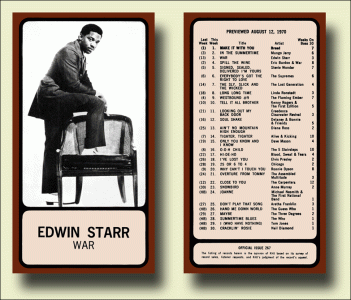
Eleven of the songs on that Boss 30 are from Black artists (I'm counting "Spill the Wine" because, as we'd learn as the 70s went on, that was a War record that Eric Burdon did a rap/narration/whatever that was...over).
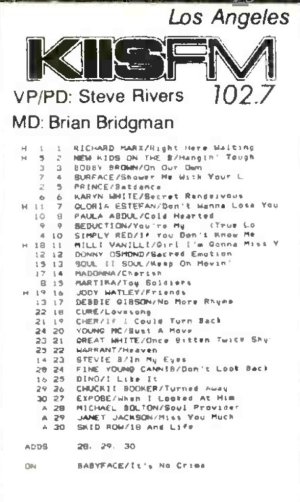
And while we're doing the playlist thing, here's KIIS this week in 1989 (just as today's 50 year old was getting ready for his/her/their freshman year in high school:
And from this week in 1993, a couple months after graduating high school:
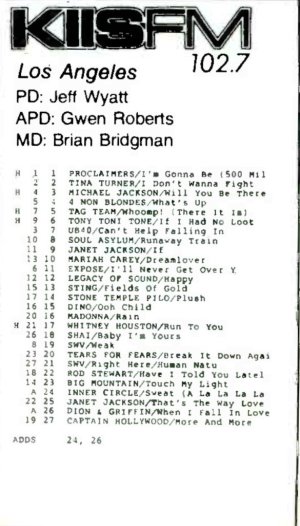
Ted, let me know if your software can't read the text within the images. I'll be happy to break it out. Short version, even the oldest person KRTH is aiming for came up at a time when CHR had stopped being segregated, at least in L.A., and, from experience, I can say that even in 2% Black Phoenix, where you and I both lived in those years, the playlists at KZZP, Y95 and the pre-hip-hop Power 92 weren't a lot different.
And from this week in 1993, a couple months after graduating high school:
Ted, let me know if your software can't read the text within the images. I'll be happy to break it out. Short version, even the oldest person KRTH is aiming for came up at a time when CHR had stopped being segregated, at least in L.A., and, from experience, I can say that even in 2% Black Phoenix, where you and I both lived in those years, the playlists at KZZP, Y95 and the pre-hip-hop Power 92 weren't a lot different.
And while we're doing the playlist thing, here's KIIS this week in 1989 (just as today's 50 year old was getting ready for his/her/their freshman year in high school:
View attachment 9992
And from this week in 1993, a couple months after graduating high school:
View attachment 9993
Ted, let me know if your software can't read the text within the images. I'll be happy to break it out. Short version, even the oldest person KRTH is aiming for came up at a time when CHR had stopped being segregated, at least in L.A., and, from experience, I can say that even in 2% Black Phoenix, where you and I both lived in those years, the playlists at KZZP, Y95 and the pre-hip-hop Power 92 weren't a lot different.
While I can't read the images, I'm guessing you're taking them from the ARSA survey site which I read regularly. And, if you look at the surveys from that site for 1993, you will see that KIIS was adding some of the more popular hiphop tracks to its playlist. That's true!
But if you look at the surveys for KDWB-FM in Minneapolis, MN, for the same timeperiod (and I have), you quickly find out that that CHR was not adding Dr. Dre or Tag Team or Snoop Dogg or Warren G to its playlists. While the station did play some R&B during this period, it very much shied away from rap.
And that brings me to Phoenix. By the time 1993 rolled around, KZZP had become KVRY which would either qualify as a hot or modern AC format. KYOT-FM was still doing top-40, that's true, but it wasn't playing the rap songs KIIS-FM was--its playlist (though not available currently on the ARSA surveys) aligned much more with what KDWB-FM was playing. That leaves KKFR which, in 1993, was still the only station in the Phoenix market playing R&B and hiphop. It would take a brief break from that in 1994 after KYOT went (mostly) oldies but returned to the format in 1995.
My point is, of course, that quite a few stations in the U.S. followed the lead of KDWB-FM back in 1993 and didn't play most of the popular hiphop tracks that were out there. Many of the songs' lyrics were considered too controversial to play by the musical directors of the time.
And this showed on the countdown shows that the stations were airing on weekends. While Billboard adopted SoundScan in December of 1991 to create its top 100, Shadoe Stevens and the crew with "American Top 40," opted to go with the magazine's radio airplay charts instead of the combined sales/airplay charts they had been using previously.
Over at Record World, the magazine whose charts were used for Casey Kasem's and Rick Dees' countdown shows at the time, the emphasis also remained on radio airplay. In fact, in March of 1994 (going by memory here), one week had "Born on a Roll," by Masta Ace debuting at #40 and "Regulate," by Warren G and Nate Dogg debuting at #39; the next week, both songs were not listed. And while "Regulate," eventually peaked at #3 on Billboard, its peak position on the Record World chart used by Rick Dees and Casey Kasem was #38 and it only stayed on that chart for four weeks.
What I'm ultimately saying (and I am willing to bet this was true) is that a whole lot of CHR radio stations in the 1990s *did* not follow KIIS' lead in playing the most popular rap recordings. So the fact that some of these records are showing up now on KRTH in Los Angeles and that KRTH is now the #1 station in the Los Angeles area is not going to automatically mean that putting those same records into rotation on classic hits stations focused on the 1990s in other parts of the country are going to also make those stations ratings leaders in either the short or long terms in their markets.
K.M. Richards
Program Director, The Eighties Channel™
One other thing to keep in mind (though most won't want to admit it). The 1980s was the last decade in which the majority of songs that reached the top of the Billboard hot 100 were by white artists working either as solo acts or in groups. During the 1990s, particularly after the institution of SoundScan in December of 1991, the majority of artists reaching the top of the Billboard hot 100 had dark skins.
I know that shouldn't matter but it does to a whole lot of people. My guess, from what I'm hearing, is that program directors of classic hits stations, when they look for what to play from the 1990s, will use other charts instead of Billboard to pick the songs they will test and play.
If a Classic Hits PD is smart and knows how to use research, they will follow the "prime directive" of the format, which is to play whatever songs are the consensus favorites in their target demo, regardless of artist ethnicity.
Songs that were popular as currents are not necessarily the biggest hits as gold. What you suggest is a little dangerous because of that, although those stations doing their own audience response research should seek out a variety of genres and ethnicities when choosing songs to test for possible addition to their libraries.
Remember, a CH station that plays too many marginal records risks alienating the audience, who want to hear their favorites, regardless of the factors you are concerned with.
Good point here regarding the hits. I listen to AT40 from the 80’s every weekend. Many of the tracks that end up in the top 10 are not songs you hear very often on the radio today. There was one a few weeks ago that made it to the top that was part of a movie soundtrack. But it’s certainly not a song that would land well today.If a Classic Hits PD is smart and knows how to use research, they will follow the "prime directive" of the format, which is to play whatever songs are the consensus favorites in their target demo, regardless of artist ethnicity.
Songs that were popular as currents are not necessarily the biggest hits as gold. What you suggest is a little dangerous because of that, although those stations doing their own audience response research should seek out a variety of genres and ethnicities when choosing songs to test for possible addition to their libraries.
Remember, a CH station that plays too many marginal records risks alienating the audience, who want to hear their favorites, regardless of the factors you are concerned with.
BUT...that "racial schism" is from the point of view (largely) of whites who were approaching the end of the demo for CHR anyway.
A lot of calendar pages have been ripped (now there's an outdated reference) since then.
Context time again:
Today's 50 year old: Born 1975, entered high school 1989, graduated high school 1993, graduated college 1997.
That's the upper end of what KRTH is aiming for. And Snoop's "Gin and Juice" is still in their musical vocabulary.
There may have been some people of that era who listened to lily-white "mainstream" CHRs, but they're really unlikely to be living in L.A. today.
Also---some of us, pushing 70 now----were really happy when CHR stopped being so damn white, because the Top 40 we grew up with wasn't:
(tympani roll; Bill Drake voiceover: "55 Years Ago Today")
View attachment 9991
Eleven of the songs on that Boss 30 are from Black artists (I'm counting "Spill the Wine" because, as we'd learn as the 70s went on, that was a War record that Eric Burdon did a rap/narration/whatever that was...over).
Growing up in Tennessee, black crossovers were always big on top 40. Even at the height of the disco backlash in the early 1980s, I remember hearing You Dropped A Bomb On Me and Super Freak on top 40. WTIX in New Orleans would sometimes be 50% R&B.
The opposite was a station like WLS in Chicago which often played only one or two black crossovers. Even some big crossover Motown hits charted very low on WLS, if at all. The exception being when John Rook was PD in the late 1960s and early 1970s.
I've read before that Los Angeles was the best city for black music on top 40 outside the Southern markets and KHJ playlists always reflected this.
I've read before that Los Angeles was the best city for black music on top 40 outside the Southern markets and KHJ playlists always reflected this.
After looking at the ARSA surveys for WKNR in Detroit, I would have to believe that it was ahead of KHJ in that department. Also, not all stations in the South played lots of R&B. If you look at the surveys for WLOF in Orlando at the ARSA site, that station was playing very little R&B, especially during the 1960s. And the same can be said for both WFUN and WQAM in Miami, prior to 1967.